
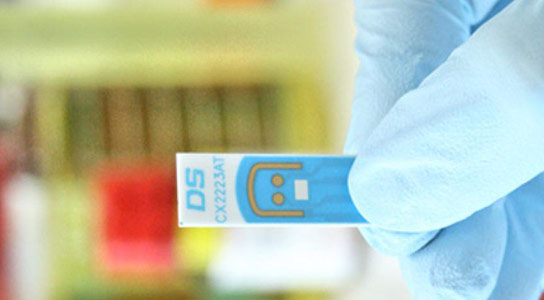
Researchers at the University of Leeds have developed a biosensor that can detect very small quantities of amyloid-beta clusters, which could open the door to future blood tests for Alzheimer’s disease.
Scientists at the University of Leeds have developed a new technology that could form the basis of a simple blood test for Alzheimer’s disease.
The new biosensor measures harmful clusters of the protein amyloid-beta, an early indicator of Alzheimer’s disease. The study is published in the Biosensors and Bioelectronics journal.
Alzheimer’s disease is the most common form of dementia, with more than 37 million sufferers worldwide, but currently cannot be conclusively diagnosed until after death.
Dr Jo Rushworth, who led the study by a team in the University of Leeds’ Faculty of Biological Sciences, said: “At present, if you go to a doctor, they will do a memory test and they may say you have dementia. They may also say that Alzheimer’s is the probable cause, but the only way to definitely find out whether someone had the disease is to examine the brain after death.”
Dr Rushworth added: “Because we are relying on symptoms, drugs are given to the patient late. What we need is a reliable early test so we can intervene when it is actually going to be of some use. If we were able to diagnose Alzheimer’s disease earlier, the symptoms could be better managed and future treatments could be given at a time when they would have the most effect.”
The team at the University of Leeds devised a biosensor that can detect very small quantities of amyloid-beta clusters, an early indicator of Alzheimer’s disease. The biosensor, which is contained on a small gold chip, generates an electrical signal in the presence of amyloid clusters, the strength of which indicates the number of clusters in the sample.
Previous research had shown that the level of amyloid clusters in a patient’s bloodstream correlates with the level of amyloid clusters in the brain, which is linked to Alzheimer’s disease onset and severity.
Dr Rushworth said: “Amyloid-beta is a bit like chewing gum; it is very sticky and clumps together in balls. In Alzheimer’s disease, you get lots of big sticky balls of amyloid-beta, made up of many individual amyloids, which latch onto brain neurons. This key event triggers disruption of neuronal communication and leads to the eventual death of the neurons.
She added: “Until now, it has been very difficult to pick out these amyloid clusters from the individual amyloid proteins which are present in healthy people. Our biosensor test uses a new molecular recognition tool that works like a lock that only fits one key; it picks out the ball-shaped amyloid clusters without detecting the individual amyloids.”
The team at Leeds tested their biosensor on amyloid clusters generated by cells grown in a test tube. The biosensor was able to pick out amyloid clusters similar to those found in human Alzheimer’s disease patients.
“We are still at the laboratory stage but, eventually, if we are able to develop this technology, we would be looking to have a mobile phone-sized device where you could do a finger-prick blood test and get an immediate readout telling the doctor the level of these markers in your system.”
Biosensors, such as the finger-prick blood sugar monitor used by diabetics, have the advantage of being rapid, easy to handle and can be used in a doctor’s surgery or by a patient at home.
As well as speeding up diagnosis, an Alzheimer’s biosensor would also allow doctors to distinguish Alzheimer’s from other types of dementia and avoid prescribing drugs that are not relevant to a patient’s condition.
Dr Simon Ridley, Head of Research at the charity Alzheimer’s Research UK who provided research funding, said: “A blood test to help diagnose Alzheimer’s could be extremely beneficial for patients, but this new technology is still at an early stage of development and further research will be needed to determine its potential for use in the clinic.”
Dr Ridley added: “Diagnosing diseases like Alzheimer’s is a challenge and a biosensor for markers of the disease could be a helpful addition to the current methods used. The search for diagnostic markers of Alzheimer’s is developing at a rapid pace and investment in research is crucial if we are to explore the true potential of this kind of technology for helping people with dementia.”
Reference: “A label-free electrical impedimetric biosensor for the specific detection of Alzheimer’s amyloid-beta oligomers” by Jo V. Rushworth, Asif Ahmed, Heledd H. Griffiths, Niall M. Pollock, Nigel M. Hooper and Paul A. Millner, 23 December 2013, Biosensors and Bioelectronics.
DOI: 10.1016/j.bios.2013.12.036
Never miss a breakthrough: Join the SciTechDaily newsletter.
Follow us on Google and Google News.
2 Comments
By deciding on Alzheimerism earlier, supportive drugs can be started earlier. More research should be done in finding to stop Beta-Ameloid plaques to form on the Brain gradually which naturally intervene to disrupt the ‘tangles’ or the brain channels of food that eventually lead to shrinkage of Brain Mass and stopping the neurotransmitters to propagate. Here a natural protein plays a villain in elderly people, because of failure of ‘chaperones’ to modulate the protein. Thank You.
Keep in mind that the disease (Dementia, Alzheimer’s disease, etc.) is the culprit to blame for undesirable behaviors, NOT THE PERSON. It will help you provide the compassionate care vital to those suffering from Dementia or Alzheimer’s disease. Validate your loved one’s very real emotions before redirecting behaviors and avoid responding to nonsensical requests with a resounding “no” can help moderate catastrophic reactions and maintain the elderly patient’s sense of dignity.