
Close Menu
    Facebook X (Twitter) Instagram
    SciTechDaily
    • Biology
    • Chemistry
    • Earth
    • Health
    • Physics
    • Science
    • Space
    • Technology
    Facebook X (Twitter) Pinterest YouTube RSS
    SciTechDaily
    Home»Chemistry»New Catalyst Breakthrough Slashes Platinum Use in Green Hydrogen Tech
    Chemistry

    New Catalyst Breakthrough Slashes Platinum Use in Green Hydrogen Tech

    By Dalian Institute of Chemical Physics, Chinese Academy SciencesJuly 23, 2025No Comments3 Mins Read
    Facebook Twitter Pinterest Telegram LinkedIn WhatsApp Email Reddit
    Share
    Facebook Twitter LinkedIn Pinterest Telegram Email Reddit
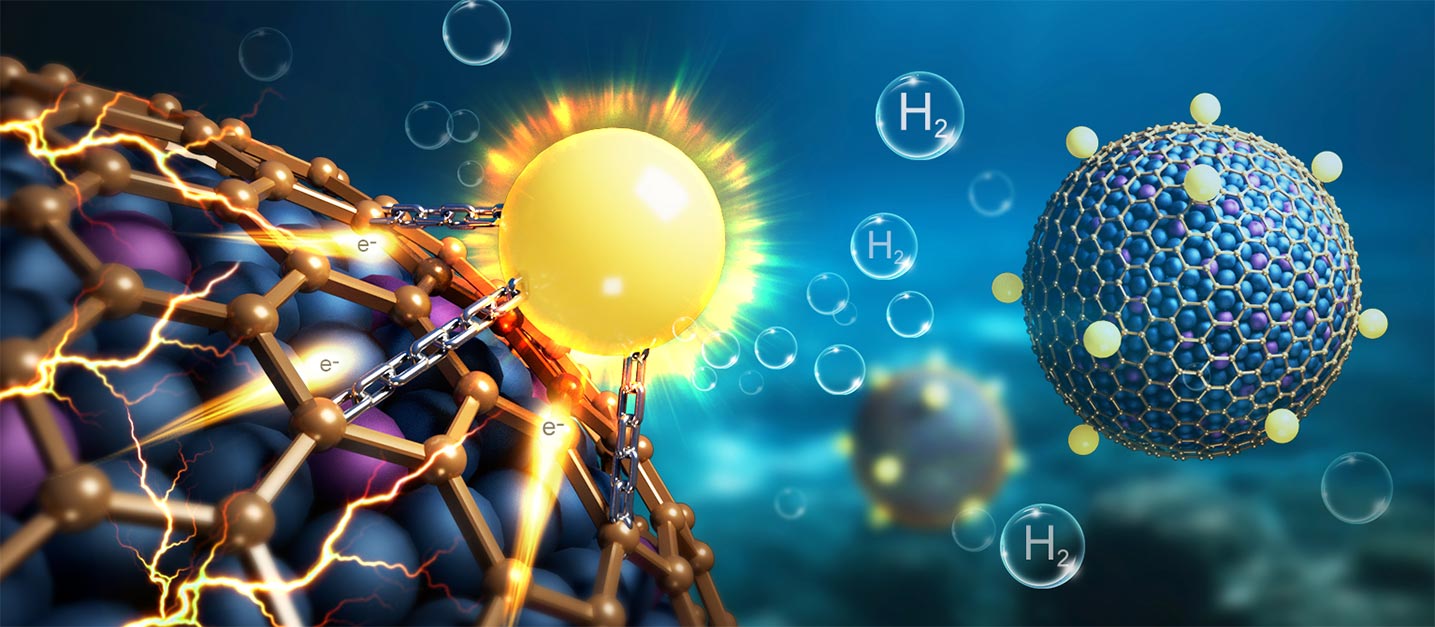
    Enriched Asymmetric π Electrons in Chainmail Catalyst Boost Acidic Hydrogen Evolution
    Enriched asymmetric π electrons in chainmail catalyst boost acidic hydrogen evolution. Credit: DICP

    Researchers engineered a graphene-encased catalyst with ultra-low platinum use that delivers high-efficiency, industrial-scale hydrogen production.

    Proton exchange membrane (PEM) water electrolysis plays a key role in the production of green hydrogen on a large scale. One of the most commonly used materials in this process is Platinum on Carbon (Pt/C), which serves as an advanced cathode catalyst. Its popularity comes from its ability to effectively bind hydrogen and its strong resistance to acidic environments. However, using high amounts of platinum makes this approach expensive and limits its broader adoption.

    In research published in Joule, a team led by Prof. Dehui Deng and Prof. Liang Yu from the Dalian Institute of Chemical Physics (DICP) at the Chinese Academy of Sciences (CAS) worked with Prof. Junling Lu from the University of Science and Technology of China (also part of CAS) and Prof. Hongmei Yu from DICP. Together, they developed a new catalyst that is both highly efficient and stable for use in acidic hydrogen production.

    Their innovation centers around a unique “chainmail” catalyst made from a cobalt-nickel (CoNi) nano-alloy that is enclosed within a single layer of graphene. The team found that electrons transferred from the CoNi alloy into the surrounding carbon layer. This process, combined with a 3d-2p electronic interaction, caused the surface of the graphene to accumulate an uneven distribution of π electronic states, which played a critical role in enhancing catalytic behavior.

    Synergistic Confinement and Platinum Stability

    After depositing Pt single atoms using atomic layer deposition, these enriched asymmetric π electrons exhibited a unique confinement effect on the Pt atoms.

    This confinement operated through two synergistic mechanisms. Electron transfer from CoNi to Pt via the graphene layer resulted in an electron-rich Pt site, optimizing hydrogen adsorption energy and promoting hydrogen desorption, thereby improving catalytic activity. Besides, strong interactions between the asymmetric π electrons and the Pt 5d orbital enhanced the structural stability of Pt sites, boosting the durability of the catalyst.

    The researchers assembled a PEM water electrolyzer using this catalyst, which achieved an ultra-high current density of 4.0 A cm−2 at 2.02 V and maintained excellent durability over 1,000 hours at 2 A cm−2, using only 1.2 μgPt cm−2 Pt loading. They also assembled a 2.85 kW PEM water electrolyzer using this catalyst, which operated stably for over 300 hours at an industrial current density of 1.5 A cm−2, highlighting its outstanding industrial application potential.

    “This work provides a new idea for developing high-performance, long-life, and low-cost catalysts for hydrogen production via acid water electrolysis,” said Prof. Deng.

    Reference: “Enriched asymmetric π electrons confining single-site Pt for acidic hydrogen evolution” by Mingxia Xu, Yiran Kang, Leilei Wang, Yunlong Zhang, Guang Jiang, Yafeng Cai, Yunchuan Tu, Qiao Zhao, Jun Chi, Wei Song, Hongmei Yu, Jingting Hu, Wei Liu, Rui Huang, Liang Yu, Junling Lu, Xinhe Bao and Dehui Deng, 28 May 2025, Joule.
    DOI: 10.1016/j.joule.2025.101968

    Never miss a breakthrough: Join the SciTechDaily newsletter.
    Follow us on Google and Google News.

    Catalysts Chinese Academy of Sciences Green Energy Materials Science
    Share. Facebook Twitter Pinterest LinkedIn Email Reddit

    Related Articles

    Scientists Discover Hidden Pathway Inside Catalysts That Defies Decades of Assumptions

    The New King of Propylene? Cobalt Catalyst Outperforms Precious Metals

    Eco-Friendly Breakthrough: Single Atom Catalyst Transforms CO2 Into Ethanol

    Catalytic Hydrogenation of CO2 to Methanol: Low Temperature and High Efficiency

    Catalyst Zeolite Nanopores Discovery May Lead to New Materials for Clean Energy and Carbon Capture

    Chemists Create Flexible Polymer Gels From Caffeine

    New Catalyst Promotes Carbon Dioxide Conversion into Fuels

    UJI Patents New Graphene-Based Catalysts

    Scientists Examine Platinum-Based Catalyst Design

    Leave A Reply Cancel Reply

    • Facebook
    • Twitter
    • Pinterest
    • YouTube

    Don't Miss a Discovery

    Subscribe for the Latest in Science & Tech!

    Trending News

    Monster Storms on Jupiter Unleash Lightning Beyond Anything on Earth

    Scientists Create “Liquid Gears” That Spin Without Touching

    The Simple Habit That Could Help Prevent Cancer

    Millions Take These IBS Drugs, But a New Study Finds Serious Risks

    Scientists Unlock Hidden Secrets of 2,300-Year-Old Mummies Using Cutting-Edge CT Scanner

    Bread Might Be Making You Gain Weight Even Without Eating More Calories

    Scientists Discover Massive Magma Reservoir Beneath Tuscany

    Europe’s Most Active Volcano Just Got Stranger – Here’s Why Scientists Are Rethinking It

    Follow SciTechDaily
    • Facebook
    • Twitter
    • YouTube
    • Pinterest
    • Newsletter
    • RSS
    SciTech News
    • Biology News
    • Chemistry News
    • Earth News
    • Health News
    • Physics News
    • Science News
    • Space News
    • Technology News
    Recent Posts
    • Scientists Were Wrong About This Strange “Rule-Breaking” Particle
    • Webb Space Telescope Uncovers Unexpected Ice Clouds on a Jupiter-Like World
    • 289-Million-Year-Old Reptile Mummy Reveals Origin of Human Breathing System
    • New Brain Discovery Challenges Long-Held Theory of Teenage Brain Development
    • Sharks Are Overheating as Warming Oceans Push Them to the Edge
    Copyright © 1998 - 2026 SciTechDaily. All Rights Reserved.
    • Science News
    • About
    • Contact
    • Editorial Board
    • Privacy Policy
    • Terms of Use

    Type above and press Enter to search. Press Esc to cancel.