
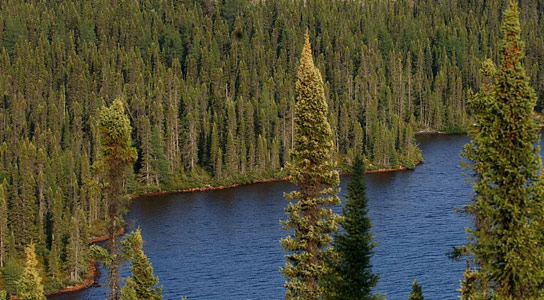
New climate change research from the Berkeley Lab suggests that boreal forests will likely shift north and will relinquish more trapped carbon than most current climate models predict.
It’s difficult to imagine how a degree or two of warming will affect a location. Will it rain less? What will happen to the area’s vegetation?
New Berkeley Lab research offers a way to envision a warmer future. It maps how Earth’s myriad climates—and the ecosystems that depend on them—will move from one area to another as global temperatures rise.
The approach foresees big changes for one of the planet’s great carbon sponges. Boreal forests will likely shift north at a steady clip this century. Along the way, the vegetation will relinquish more trapped carbon than most current climate models predict.
The research is published online on May 5 in the journal Nature Geoscience.
Boreal ecosystems encircle the planet’s high latitudes, covering swaths of Canada, Europe, and Russia in coniferous trees and wetlands. This vegetation stores vast amounts of carbon, keeping it out of the atmosphere where it can contribute to climate change.
Scientists use incredibly complex computer simulations called Earth system models to predict the interactions between climate change and ecosystems such as boreal forests. These models show that boreal habitat will expand poleward in the coming decades as regions to their north become warmer and wetter. This means that boreal ecosystems are expected to store even more carbon than they do today.
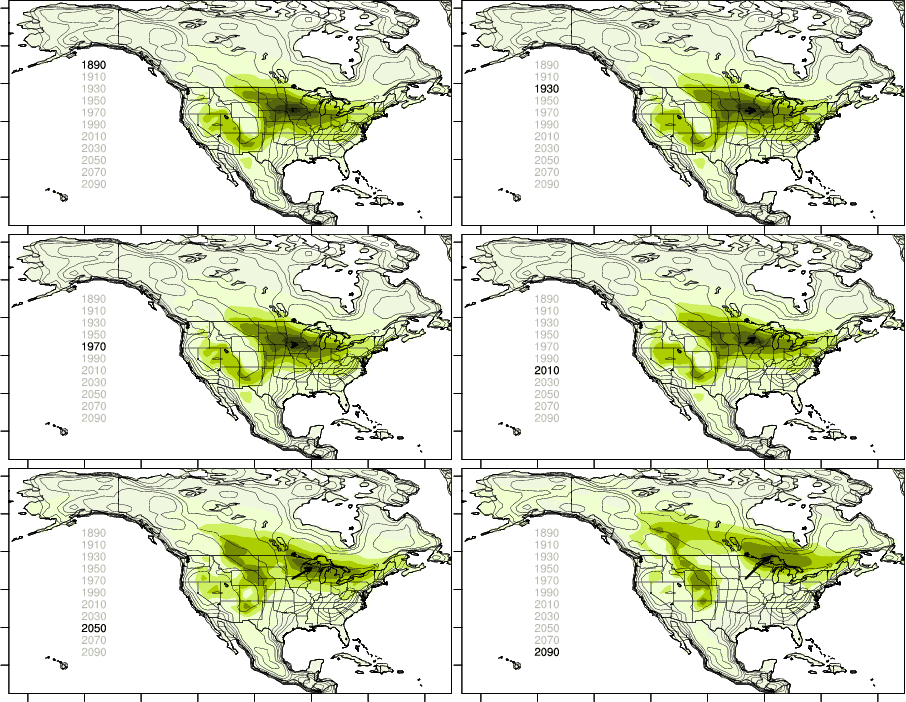
But the Berkeley Lab research tells a different story. The planet’s boreal forests won’t expand poleward. Instead, they’ll shift poleward. The difference lies in the prediction that as boreal ecosystems follow the warming climate northward, their southern boundaries will be overtaken by even warmer and drier climates better suited for grassland.
And that’s a key difference. Grassland stores a lot of carbon in its soil, but it accumulates at a much slower rate than is lost from diminishing forests.
“I found that the boreal ecosystems ringing the globe will be pushed north and replaced in their current location by what’s currently to their south. In some places, that will be forest, but in other places it will be grassland,” says Charles Koven, a scientist in Berkeley Lab’s Earth Sciences Division who conducted the research.
“Most Earth system models don’t predict this, which means they overestimate the amount of carbon that high-latitude vegetation will store in the future,” he adds.
Koven’s results come from a new way of tracking global warming’s impact on Earth’s mosaic of climates. The method is based on the premise that as temperatures rise, a location’s climate will be replaced by a similar but slightly warmer climate from a nearby area. The displaced climate will in turn shift to another nearby location with a slightly cooler climate. It’s as if climate change forces warmer climates to flow toward cooler areas, making everywhere warmer over time.
This approach can help determine where a given climate is going to in the future, and where a given climate will come from.
Koven applied this approach to 21 climate models. He used simulations that depict a middle-of-the-road climate change scenario, meaning the range of warming by the end of this century is 1.0°C (1.8°F) to 2.6°C (4.7°F) above a 1986 to 2005 baseline.
Climate models divide the planet into gridcells that cover tens or hundreds of square kilometers. In each model, Koven identified which gridcells in a warmer climate have a nearby gridcell with a similar climate in terms of average monthly temperature and precipitation. A good match, for example, is a neighboring gridcell that has similar rainfall patterns but is slightly warmer in the summer and winter.
Koven then calculated the speed at which a gridcell’s climate will shift toward its matching gridcell over the next 80 years. He also investigated how this shift will transport the carbon stored in the vegetation that grows in the gridcell’s climate.
In general, he found that climates move toward the poles and up mountain slopes. In parts of South America, warmer climates march westward up the Andes. In the southern latitudes, warmer climates head south.
But the most dramatic changes occur in the higher latitudes. Here, boreal ecosystems will have to race poleward in order to keep up with their climates. They’ll also be encroached by warmer climates from the south. By the end of this century, a forest near Alberta, Canada will have to move 100 miles (62 miles) north in order to maintain its climate. And it will gain a climate that is now located 100 miles to the south.
Forests can’t adapt this quickly, however, meaning that in the short-term they’ll be stressed. And in the long-term they’ll be forced to move north and give up their southern regions to grassland.
Only one of the Earth system models shows this precipitous loss of carbon in southern boreal forests. Koven says that’s because most models don’t account for random events such as fire, drought, and insects that kill already-stressed trees. His “climate analog” approach does account for these events because they’re implicit in the spatial distribution of ecosystems.
In addition, Earth system models predict carbon loss by placing vegetation at a given point, and then changing various climate properties above it.
“But this approach misses the fact that the whole forest might shift to a different place,” says Koven.
Reference: “Boreal carbon loss due to poleward shift in low-carbon ecosystems” by Charles D. Koven, 5 May 2013, Nature Geoscience.
DOI: 10.1038/ngeo1801
This research was supported by the U.S. Department of Energy’s Office of Science.
Never miss a breakthrough: Join the SciTechDaily newsletter.
Follow us on Google and Google News.
2 Comments
In other words, they have no idea what will happen.
I think this year, 2013, the world will recognize the evidence of the albedo effect that will give the world pause – they won’t do anything about it – but we will pause. The release of trapped carbon is going to open a lot of eyes…
It will be the speed of the release that will give pause.