

The future of desalination: Using a Teflon-like membrane to purify water
Water scarcity is a growing problem around the globe. In Africa alone, it is estimated that about 230 million people will face water shortages by 2025, with up to 460 million living in water-stressed regions.
Water covers 70% of Earth, so it is easy to assume that it will always be abundant. However freshwater is very scarce. One technology designed to help produce more freshwater is desalination plants. Water desalination is the process of removing salt from seawater to produce fresh water that can be processed further and safely used. A desalination plant converts about half of the water it receives into drinkable water.
Although seawater desalination is a well-established way of producing drinking water, it comes with a high energy cost. Researchers have successfully filtered salt from water for the first time using fluorine-based nanostructures. These fluorous nanochannels are more effective than conventional desalination technologies because they operate quicker, use less pressure, are a more effective filter, and use less energy.
Fluorous Nanochannels: A Breakthrough in Desalination Technology
You’ve probably seen how effortlessly wet ingredients slide across a nonstick Teflon-coated frying pan if you’ve ever used one. Fluorine, a lightweight ingredient that is inherently water-repellent, or hydrophobic, is a crucial component of Teflon. Teflon can also be used to enhance the flow of water by lining pipes with it. Associate Professor Yoshimitsu Itoh of the University of Tokyo’s Department of Chemistry and Biotechnology, as well as his colleagues, were intrigued by this behavior. Thus, they were inspired to investigate how fluorine pipelines or channels may work on a different scale, the nanoscale.
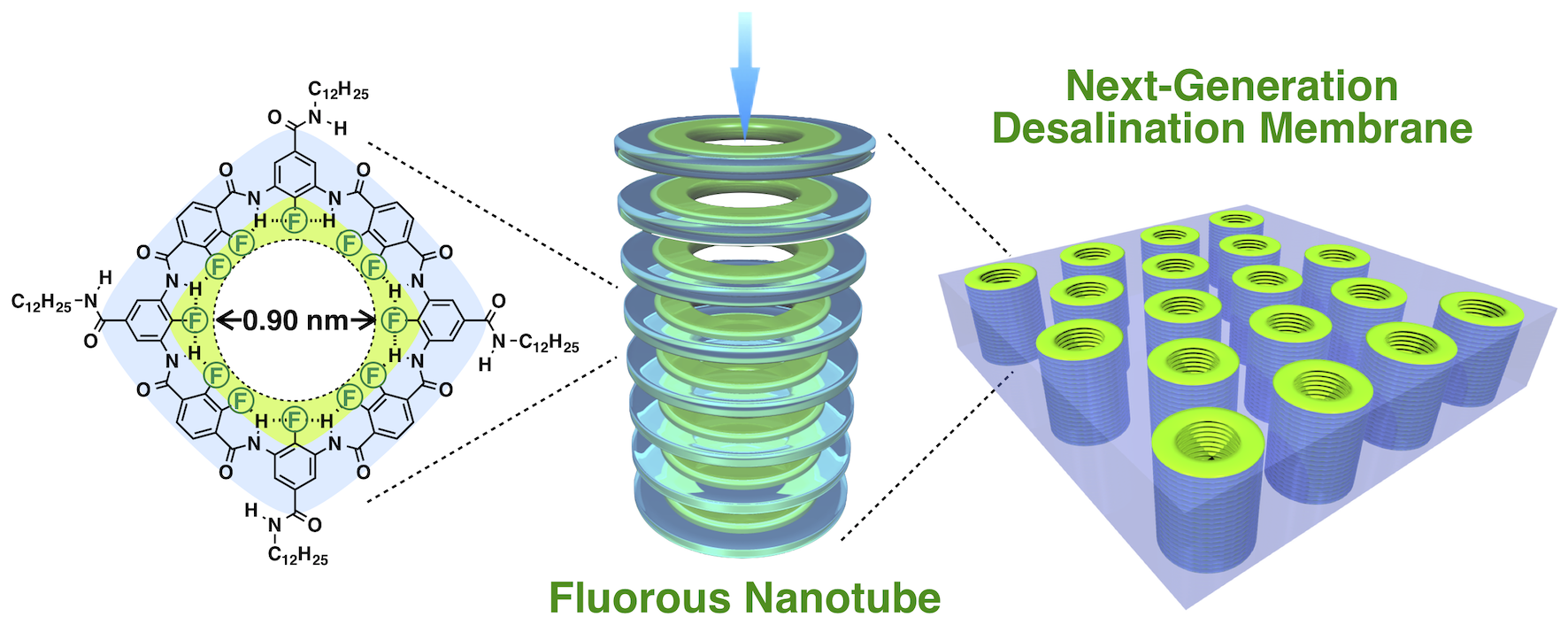
“We were curious to see how effective a fluorous nanochannel might be at selectively filtering different compounds, in particular, water and salt. And, after running some complex computer simulations, we decided it was worth the time and effort to create a working sample,” said Itoh. “There are two main ways to desalinate water currently: thermally, using heat to evaporate seawater so it condenses as pure water, or by reverse osmosis, which uses pressure to force water through a membrane that blocks salt. Both methods require a lot of energy, but our tests suggest fluorous nanochannels require little energy and have other benefits too.”
The researchers developed test filtration membranes by chemically manufacturing nanoscopic fluorine rings that were stacked and implanted in an otherwise impenetrable lipid layer, similar to the organic molecules found in cell walls. They developed multiple test samples with nanorings ranging in size from 1 to 2 nanometers. A human hair is almost 100,000 nanometers wide for comparison. Itoh and his colleagues evaluated the presence of chlorine ions, one of the major components of salt (the other being sodium), on either side of the test membrane to determine the effectiveness of their membranes.
Superior Performance and Surprising Speed
“It was very exciting to see the results firsthand. The smaller of our test channels perfectly rejected incoming salt molecules, and the larger channels too were still an improvement over other desalination techniques and even cutting-edge carbon nanotube filters,” said Itoh. “The real surprise to me was how fast the process occurred. Our sample worked around several thousand times faster than typical industrial devices, and around 2,400 times faster than experimental carbon nanotube-based desalination devices.”
As fluorine is electrically negative, it repels negative ions such as the chlorine found in salt. But an added bonus of this negativity is that it also breaks down what is known as water clusters, essentially loosely bound groups of water molecules, so that they pass through the channels quicker. The team’s fluorine-based water desalination membranes are more effective, faster, require less energy to operate, and are made to be very simple to use as well, so what’s the catch?
“At present, the way we synthesize our materials is relatively energy-intensive itself; however, this is something we hope to improve upon in upcoming research. And, given the longevity of the membranes and their low operational costs, the overall energy costs will be much lower than with current methods,” said Itoh. “Other steps we wish to take are of course scaling this up. Our test samples were single nanochannels, but with the help of other specialists, we hope to create a membrane around 1 meter across in several years. In parallel with these manufacturing concerns, we’re also exploring whether similar membranes could be used to reduce carbon dioxide or other undesirable waste products released by industry.”
Reference: “Ultrafast water permeation through nanochannels with a densely fluorous interior surface” by Yoshimitsu Itoh, Shuo Chen, Ryota Hirahara, Takeshi Konda, Tsubasa Aoki, Takumi Ueda, Ichio Shimada, James J. Cannon, Cheng Shao, Junichiro Shiomi, Kazuhito V. Tabata, Hiroyuki Noji, Kohei Sato and Takuzo Aida, 12 May 2022, Science.
DOI: 10.1126/science.abd0966
Never miss a breakthrough: Join the SciTechDaily newsletter.
Follow us on Google and Google News.
33 Comments
Teflon and fluorine? So, no salt but carcinogens?
Has there been a study to see how much micro elements leach into the “clean” water?
No worries…the entire planet is already contaminated with PFOA, Teflon, other fluorine based toxic chemicals, and more micro and nanoplastic than you can shake and ocean at…maybe someone will find a membrane to filter out all of our previous “revolutionary” ideas from the water.
I cant figure out why they would use this instead of alginate
Just add any water to our patented, state of the fart, radioactive jug, wait 30mins and viola! The water is saferish to drink. The jug is ranked #1 in safest household products by the CIA, EPA and FDA. Jug glows at night and is always warm to the touch, perfect for camping! Dolphin safe and organic certified!
If it is the only water you have to drink it beats dying of dehydration
Id like to see the experiment study if their filter design captures PFAS molecules and microplastics. With the lower pressures, leeching Teflon into the effluent might not be an issue. Curious to see how this plays out. Promising news so far, though.
What @ssholes. Flourine/ide is bad. Teflon is bad. So that makes the maker of these tubes bad too. Evil in fact. Poison. They’ve poisoned the water supply in America. They’re doing it globally under the guise of “research”.
This is not Teflon or PFAS, you troglodyte. This is a theoretical proof of concept using fewer fluorine atoms than are in your teeth prevent decay. This is legitimate, basic science to understand the physics behind water purification and improve the supply of fresh water with minimal energy use. So many commenters here write as if THEY have all the answers and cluelessly bash this research. WRONG. You are not scientists and way out of your lane. You are the evil. Go back to your conspiracy TV and yelling at kids to get off your lawn.
I just find it amazing that Africa has to be linked to anything and everything negative. Like almost everytime. You haters worry about Africa’s problems more than Africans. Everything negative have to be linked to black people like they are the only ones suffering. You act like you don’t have problems of your own. You act like there’s no proverty in your countries. Really? For some reason they cannot resist Africa. They say Africa is bad…but they still take their asses to Africa. Funny! How about you mind your damn business? Leave us alone. Our problem is not your problem. We don’t depend on you to live.
No worries! We won’t see this “States side. That’s crazy talk -Just a few billion in USAID contracts with the [Nestlé] Corporation to help those poor people in war-torn [Insert “third world” country here].
I had a contract to sink eight boreholes and a distribution network using solar power in difficult to reach communities in the Niger Delta. Salinity and iron content are serious issues begging for remediation. What can we do?
Very good article. I’m always amazed at the Japanese genius. Water is so necessary for life. I pray they find the right answers.
SCIENCE is Always, A Stair of Steps/Stairway….Sometimes, A New Path Too (A Great Diversion/Deviation); Millennia-Old Myths Should yield ASAP.
Here are some thoughts to counteract some of the negative assumptions people have in their comments. First, 90% of water is used for agriculture and for landscape. If we only used purified water by this method for that, we would have plenty of drinking water locally. Second, a large percentage of the water that goes into reverse osmosis comes out as hazardous waste that must be hauled away. However, perhaps with a system like this, the wastewater could be reused because it would only be contaminated with fluoride. So perhaps it could be used many times drastically reducing the waste water amount. Third, they actually add fluoride to municipal Water systems now. It is in the water in juice, milk, etc. It is in a high concentration in your toothpaste. You spit it out but you still get some. So it is probably that they might even prefer to have it there, leaving you with the same problem you have now. Fourth, they can remove fluoride with alumina, if I’m saying that correctly. It is one of the methods of removing fluoride in an absorbs it. I’m not big on fluoride either but there could be answers beyond assumptions.
Fascinating, it would be interesting to know if this film would also filter our or otherwise reduce the level of arsenic which is a growing problem in areas that are increasingly drawing from water sources that are not only high in salt, but carry high levels of arsenic.
Interesting article. Once the principle is demonstrated, then we can look into alternate advanced materials that could be more cost effective in mass production. If an advanced porous ceramic can be used instead of teflon, it might be possible to achieve the same effects without invoking the worries of internet trolls. (Also the use of teflon itself, does not automatically mean that the process is hazardous, merely that materials leaching would need to be a concern to be resolved during development.)
Leave it to socalled eco nuts to think teflon will leach into water at cold temperatures. Teflon flakes and does such on hot pans that are being scraped. You guys endorse attacking pure water while the underground water is depleted and causing salt water intrusion. The ocean is huge and its salty.
I think Ken knows what’s up.
So the teflon industry is now promoting junk science on this website. Teflon is a carcinogen that severely stunts humam growth and is responsible for million of people suffering from cancer. In addition to the fact that it causes abnormalities and physical disabliites in babies and foetuses. Better boil salt water and use condensation to separate it from salt
Researchers have successfully filtered using fluorine- (a lightweight ingredient) based nanostructures. These fluorous nanochannels are more effective than conventional desalination technologies because they operate quicker, use less pressure, are a more effective filter, and use less energy. Filtration membranes were developed by chemically manufacturing nanoscopic fluorine rings that were stacked and implanted in an otherwise impenetrable lipid layer, similar to the organic molecules found in cell walls.
Fluorine is the most reactive chemical element and highly toxic.
Day after Day, Unimaginable SciTech Achievements are being publshed in a row this fortnight; ~20 being Completely Cured of Cancer followed by another study about a Molecule Ready to Wipe out almost all Cancers.
Key Part to Focus on: “Fluorine Rings Stacked & Implanted in Impenetrable LIPID Layer”
Peace corps cribs videps hows lost of the third world don’t even have plumbing. Please clean people’s mosquito infested diseased water, I would love to work there manufacturing this. Dysentery
Assumptions & judgment of each other is not useful in overcoming wordly challenges. Just because we had a out of control President that pigeon holed & named called others, we do not have to follow this poorest example. Seems to me this research is timely, suggest we hold criticism and give them support. How can we help, what can we do to serve each other vs making the other wrong suggestions help and go a lot further in communication.
Being open to possibility should become our new way of life. Support each other, we are all in this world together.
I just find it amazing that Africa has to be linked to anything and everything negative. Like almost everytime. You haters worry about Africa’s problems more than Africans. Everything negative have to be linked to black people like they are the only ones suffering. You act like you don’t have problems of your own. You act like there’s no proverty in your countries. Really? For some reason they cannot resist Africa. They say Africa is bad…but they still take their asses to Africa. Funny! How about you mind your damn business? Leave us alone. Our problem is not your problem. We don’t depend on you to live.
… and there is just way to many deserts in the world, … drop desserts,…
California should use this and stop draining the Colorado River
Dr. Thunderfoot, you have a call on the white courtesy phone.
Is the stuff that is removed simply put back in the ocean ? A small scale operation would have no impact but large scale operations would require further research I think The answer lies in reducing the population In a generation or 2 this could reduce consumption Just because we might be able to carry 10+ billion doesn’t mean we should 1 billion would be much better
The hidden side to this breakthrough is ‘one persons waste is anothers high grade ore’.
By this I mean an effective way to get freshwater is also an effective way to get sea minerals cheaply.
Some of the useful minerals in sea water are Lithium and Magnesium.
What is to be done with the salt which is removed by this clean water process? Is it going to be put back into the Ocean? What is going to happen when Ocean areas become more highly salted? How will this effect the life that has adjusted itself to ordinary saline fluctuations? Just sain’…just “thinking.”