
Close Menu
    Facebook X (Twitter) Instagram
    SciTechDaily
    • Biology
    • Chemistry
    • Earth
    • Health
    • Physics
    • Science
    • Space
    • Technology
    Facebook X (Twitter) Pinterest YouTube RSS
    SciTechDaily
    Home»Space»New ESA Image of the Milky Way and of Its Neighboring Magellanic Clouds
    Space

    New ESA Image of the Milky Way and of Its Neighboring Magellanic Clouds

    By European Space AgencyJuly 3, 2015No Comments3 Mins Read
    Facebook Twitter Pinterest Telegram LinkedIn WhatsApp Email Reddit
    Share
    Facebook Twitter LinkedIn Pinterest Telegram Email Reddit
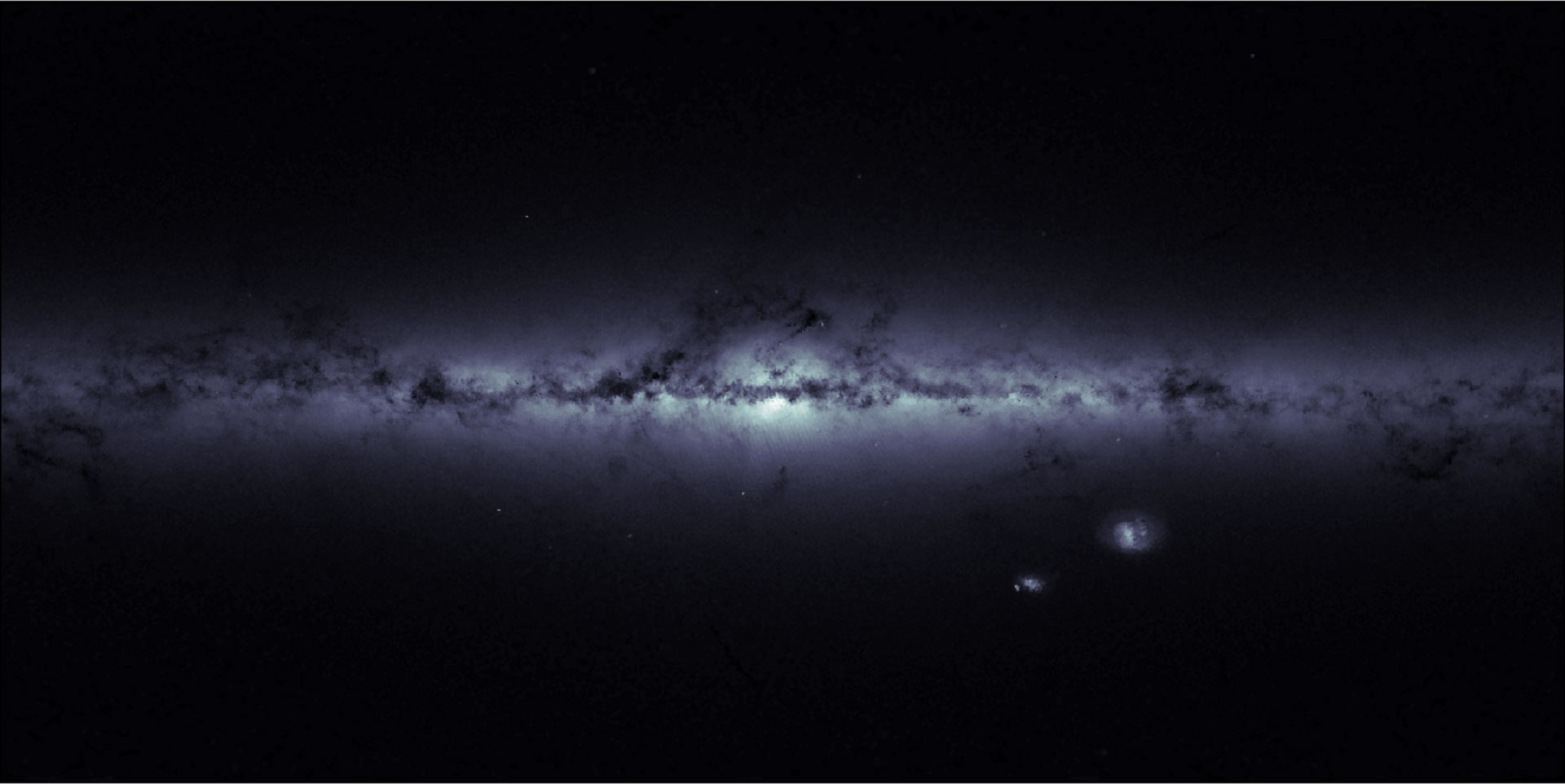
    Gaia Satellite Image of the Milky Way and Magellanic Clouds
    Gaia satellite image of the Milky Way and Magellanic Clouds. Credit: Gaia Annotated Stellar Density Map

    This newly released image from the European Space Agency shows the outline of our Galaxy and of its neighboring Magellanic Clouds.

    This image, based on housekeeping data from ESA’s Gaia satellite, is no ordinary depiction of the heavens. While the image portrays the outline of our Galaxy, the Milky Way, and of its neighboring Magellanic Clouds, it was obtained in a rather unusual way.

    As Gaia scans the sky to measure positions and velocities of a billion stars with unprecedented accuracy, for some stars it also determines their speed across the camera’s sensor. This information is used in real time by the attitude and orbit control system to ensure the satellite’s orientation is maintained with the desired precision.

    These speed statistics are routinely sent to Earth, along with the science data, in the form of housekeeping data. They include the total number of stars, used in the attitude-control loop, that is detected every second in each of Gaia’s fields of view.

    It is the latter – which is basically an indication of the density of stars across the sky – that was used to produce this uncommon visualization of the celestial sphere. Brighter regions indicate higher concentrations of stars, while darker regions correspond to patches of the sky where fewer stars are observed.

    The plane of the Milky Way, where most of the Galaxy’s stars reside, is evidently the brightest portion of this image, running horizontally and especially bright at the center. Darker regions across this broad strip of stars, known as the Galactic Plane, correspond to dense, interstellar clouds of gas and dust that absorb starlight along the line of sight.

    The Galactic Plane is the projection on the sky of the Galactic disc, a flattened structure with a diameter of about 100,000 light-years and a vertical height of only 1000 light-years.

    Beyond the plane, only a few objects are visible, most notably the Large and Small Magellanic Clouds, two dwarf galaxies orbiting the Milky Way, which stand out in the lower right part of the image.
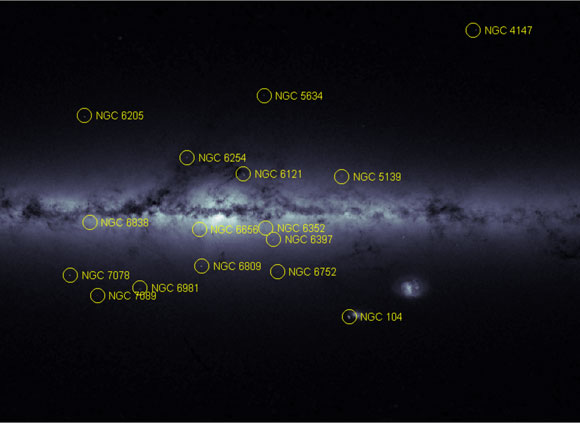
    Gaia Annotated Stellar Density Map
    Credit: Gaia Annotated Stellar Density Map

    A few globular clusters – large assemblies up to millions of stars held together by their mutual gravity – are also sprinkled around the Galactic Plane. Globular clusters, the oldest population of stars in the Galaxy, sit mainly in a spherical halo extending up to 100 000 light-years from the center of the Milky Way.

    The globular cluster NGC 104 is easily visible in the image, to the immediate left of the Small Magellanic Cloud. Other globular clusters are highlighted in an annotated version of this image.

    Interestingly, the majority of bright stars that are visible to the naked eye and that form the familiar constellations of the sky are not accounted for in this image because they are too bright to be used by Gaia’s control system. Similarly, the Andromeda galaxy – the largest galactic neighbor of the Milky Way – also does not stand out here.

    Counterintuitively, while Gaia carries a billion-pixel camera, it is not a mission aimed at imaging the sky: it is making the largest, most precise 3D map of our Galaxy, providing a crucial tool for studying the formation and evolution of the Milky Way.


    Never miss a breakthrough: Join the SciTechDaily newsletter.
    Follow us on Google and Google News.

    Astronomy European Space Agency Magellanic Cloud Milky Way
    Share. Facebook Twitter Pinterest LinkedIn Email Reddit

    Related Articles

    Scientists Discover a Giant, Unexplained Wave Rippling Through the Milky Way

    Gaia Completes Its Stellar Odyssey, Leaving a Cosmic Legacy

    Scientists Surprised by Sleeping Giant – Most Massive Stellar Black Hole in Our Galaxy Found Lurking Nearby

    Starquakes! Gaia Spacecraft Sees Strange Stars in Most Detailed Milky Way Survey to Date

    Gaia Spacecraft Reveals a New Member of the Milky Way Family

    Gaia Spacecraft Discovers Parts of the Milky Way Are Much Older Than Thought

    Planck Space Telescope Reveals the Magnetic Field Lines of the Milky Way

    ESA’s Gaia Spacecraft Ready to Create a 3D Map of the Milky Way Galaxy

    Astronomers Find Bizarre Alignment of Planetary Nebulae in the Milky Way

    Leave A Reply Cancel Reply

    • Facebook
    • Twitter
    • Pinterest
    • YouTube

    Don't Miss a Discovery

    Subscribe for the Latest in Science & Tech!

    Trending News

    Collapsing Plasma May Hold the Key to Cosmic Magnetism

    This Breakthrough Solar Panel Generates Power From Both Sunlight and Raindrops

    Scientists Uncover New Metabolic Effects Beyond Weight Loss of Mounjaro

    Scientists Discover Cancer Tumors Are “Addicted” to This Common Antioxidant

    1,800 Miles Down: Scientists Uncover Mysterious Movements at the Edge of Earth’s Core

    Scientists Discover Hidden “Good Fats” in Green Rice That Could Transform Nutrition

    Your Child’s Clothes Could Contain Toxic Lead, Study Finds

    Researchers Break a 150-Year-Old Math Law With a Surprising Donut Discovery

    Follow SciTechDaily
    • Facebook
    • Twitter
    • YouTube
    • Pinterest
    • Newsletter
    • RSS
    SciTech News
    • Biology News
    • Chemistry News
    • Earth News
    • Health News
    • Physics News
    • Science News
    • Space News
    • Technology News
    Recent Posts
    • The Mystery of the Notes: Why No One Knows How This 120-Year-Old Song Should Sound
    • Scientists Discover 132-Million-Year-Old Dinosaur Tracks on South Africa’s Coast
    • Scientists Uncover the Secret Ingredient Behind the Spark That May Have Started Life on Earth
    • Natural Oils vs. Antibiotics: The Swine Study That Could Change Farming
    • The Biggest Volcanic Event in Earth’s History Transformed an Entire Oceanic Plate
    Copyright © 1998 - 2026 SciTechDaily. All Rights Reserved.
    • Science News
    • About
    • Contact
    • Editorial Board
    • Privacy Policy
    • Terms of Use

    Type above and press Enter to search. Press Esc to cancel.