
Close Menu
    Facebook X (Twitter) Instagram
    SciTechDaily
    • Biology
    • Chemistry
    • Earth
    • Health
    • Physics
    • Science
    • Space
    • Technology
    Facebook X (Twitter) Pinterest YouTube RSS
    SciTechDaily
    Home»Space»New Herschel Space Observatory Image Shows Magellanic Cloud Galaxy
    Space

    New Herschel Space Observatory Image Shows Magellanic Cloud Galaxy

    By Jet Propulsion Laboratory, NASAJanuary 10, 20121 Comment4 Mins Read
    Facebook Twitter Pinterest Telegram LinkedIn WhatsApp Email Reddit
    Share
    Facebook Twitter LinkedIn Pinterest Telegram Email Reddit
    Large Magellanic Cloud Infrared Herschel Space Observatory
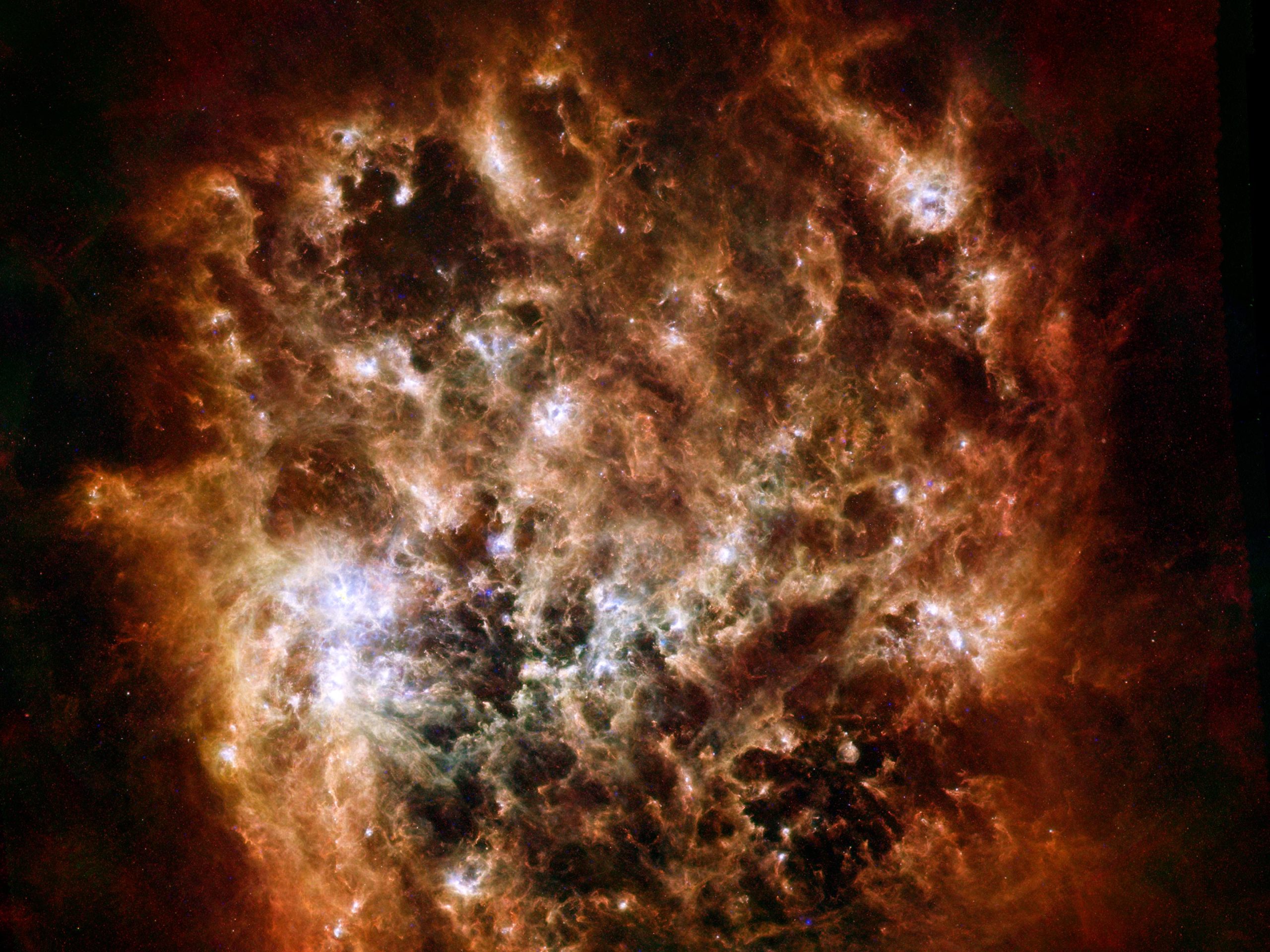
    This new image shows the Large Magellanic Cloud galaxy in infrared light as seen by the Herschel Space Observatory, a European Space Agency-led mission with important NASA contributions, and NASA’s Spitzer Space Telescope. In the instruments’ combined data, this nearby dwarf galaxy looks like a fiery, circular explosion. Rather than fire, however, those ribbons are actually giant ripples of dust spanning tens or hundreds of light-years. Significant fields of star formation are noticeable in the center, just left of center and at right. The brightest center-left region is called 30 Doradus, or the Tarantula Nebula, for its appearance in visible light. Credit: ESA/NASA/JPL-Caltech/STScI

    A European Space Agency-led mission in combination with the Herschel Space Observatory and NASA’s Spitzer Space Telescope reveal new images of the Large and Small Magellanic Clouds. The images show the dust of the two biggest nearby satellite galaxies with noticeably significant fields of star formation evident.

    The cold dust that builds blazing stars is revealed in new images that combine observations from the Herschel Space Observatory, a European Space Agency-led mission with important NASA contributions; and NASA’s Spitzer Space Telescope. The new images map the dust in the galaxies known as the Large and Small Magellanic Clouds, two of the closest neighbors to our own Milky Way galaxy.

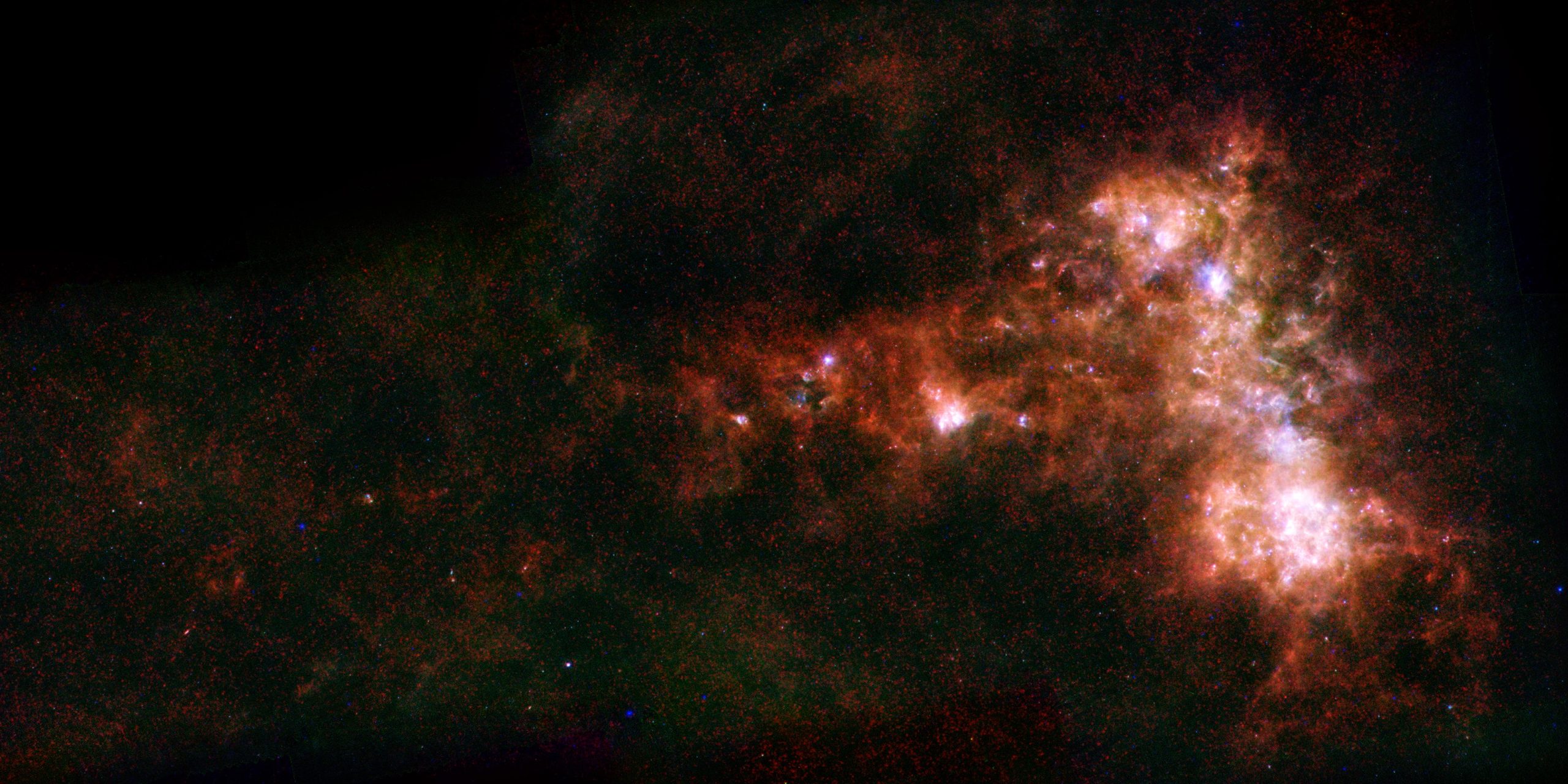
    The Large Magellanic Cloud looks like a fiery, circular explosion in the combined Herschel-Spitzer infrared data. Ribbons of dust ripple through the galaxy, with significant fields of star formation noticeable in the center, center-left and top right (the brightest center-left region is called 30 Doradus, or the Tarantula Nebula, for its appearance in visible light). The Small Magellanic Cloud has a much more irregular shape. A stream of dust extends to the left in this image, known as the galaxy’s “wing,” and a bar of star formation appears on the right.

    The colors in these images indicate temperatures in the dust that permeate the Magellanic Clouds. Colder regions show where star formation is at its earliest stages or is shut off, while warm expanses point to new stars heating dust surrounding them. The coolest areas and objects appear in red, corresponding to infrared light taken up by Herschel’s Spectral and Photometric Imaging Receiver at 250 microns, or millionths of a meter. Herschel’s Photodetector Array Camera and Spectrometer fills out the mid-temperature bands, shown in green, at 100 and 160 microns. The warmest spots appear in blue, courtesy of 24- and 70-micron data from Spitzer.
    Small Magellanic Cloud Infrared Herschel Space Observatory
    This new image shows the Small Magellanic Cloud galaxy in infrared light from the Herschel Space Observatory a European Space Agency-led mission with important NASA contributions, and NASA’s Spitzer Space Telescope. The Large and Small Magellanic Clouds are the two biggest satellite galaxies of our home galaxy, the Milky Way, though they are still considered dwarf galaxies compared to the big spiral of the Milky Way. Credit: ESA/NASA/JPL-Caltech/STScI

    “Studying these galaxies offers us the best opportunity to study star formation outside of the Milky Way,” said Margaret Meixner, an astronomer at the Space Telescope Science Institute, Baltimore, Md., and principal investigator for the mapping project. “Star formation affects the evolution of galaxies, so we hope understanding the story of these stars will answer questions about galactic life cycles.”

    The Large and Small Magellanic Clouds are the two biggest satellite galaxies of our home galaxy, the Milky Way, though they are still considered dwarf galaxies compared to the big spiral of the Milky Way. Dwarf galaxies also contain fewer metals, or elements heavier than hydrogen and helium. Such an environment is thought to slow the growth of stars. Star formation in the universe peaked around 10 billion years ago, even though galaxies contained lesser abundances of metallic dust. Previously, astronomers only had a general sense of the rate of star formation in the Magellanic Clouds, but the new images enable them to study the process in more detail.

    The results were presented today at the 219th meeting of the American Astronomical Society in Austin, Texas.

    Herschel is a European Space Agency cornerstone mission, with science instruments provided by consortia of European institutes and with important participation by NASA. NASA’s Herschel Project Office is based at NASA’s Jet Propulsion Laboratory, Pasadena, California. JPL contributed mission-enabling technology for two of Herschel’s three science instruments. The NASA Herschel Science Center, part of the Infrared Processing and Analysis Center at the California Institute of Technology in Pasadena, supports the United States’ astronomical community.

    Never miss a breakthrough: Join the SciTechDaily newsletter.
    Follow us on Google and Google News.

    California Institute of Technology Galaxy JPL Magellanic Cloud NASA Observatory
    Share. Facebook Twitter Pinterest LinkedIn Email Reddit

    Related Articles

    “Habitable Zone” Might Help Extreme Life Forms Survive on Exoplanets

    NASA’s WISE Discovers Millions of Black Holes

    Combined Image of the Pinwheel Galaxy, M101, From Four of NASA’s Space Telescopes

    Patterns of Light Appear to be From the First Stars and Galaxies

    Sombrero Galaxy Exhibits Dual Characteristics

    Searching for “Bubbles” in the Milky Way

    Extrasolar Planetary System Suggests Our Own Isn’t That Special

    Milky Way Galaxy Mosaic of Images from WISE

    NASA Plans Trajectory Maneuver for Mars Science Laboratory Spacecraft

    1 Comment

    1. Madanagopal.V.C. on October 20, 2012 11:53 am

      Our Milky Way`s satellite galaxies of Small Magellanic and Large Magellanic
      Cloud presents a picture of inwardly curled star formation and outwardly flying wings of gases. The outward wings probably confirms that it is heading towards galactic cannibalism awaiting from our Milky Way Galaxy just as Nebula Andromeda did for its neighboring galaxies. Thank You.

      Reply
    Leave A Reply Cancel Reply

    • Facebook
    • Twitter
    • Pinterest
    • YouTube

    Don't Miss a Discovery

    Subscribe for the Latest in Science & Tech!

    Trending News

    Largest-Ever Study Finds Medicinal Cannabis Ineffective for Anxiety, Depression, PTSD

    250-Million-Year-Old Egg Solves One of Evolution’s Biggest Mysteries

    Living With Roommates Might Be Changing Your Gut Microbiome Without You Knowing

    Century-Old Cleaning Chemical Linked to 500% Increased Risk of Parkinson’s Disease

    What if Your Memories Never Happened? Physicists Take a New Look at the Boltzmann Brain Paradox

    One of the Universe’s Largest Stars May Be Getting Ready To Explode

    Scientists Discover Enzyme That Could Supercharge Ozempic-Like Weight Loss Drugs

    Popular Sweetener Linked to DNA Damage – “It’s Something You Should Not Be Eating”

    Follow SciTechDaily
    • Facebook
    • Twitter
    • YouTube
    • Pinterest
    • Newsletter
    • RSS
    SciTech News
    • Biology News
    • Chemistry News
    • Earth News
    • Health News
    • Physics News
    • Science News
    • Space News
    • Technology News
    Recent Posts
    • Amazonian Chocolate Could Become the Next Superfood, Scientists Say
    • Challenging the Narrative: New Study Shows U.S. Life Expectancy Is Rising Across All States
    • Mystery Illness Kills 5 in Burundi As Doctors Scramble for Answers
    • Bone-Strengthening Discovery Could Reverse Osteoporosis
    • The Most Elusive Number in Physics Just Got Even More Mysterious
    Copyright © 1998 - 2026 SciTechDaily. All Rights Reserved.
    • Science News
    • About
    • Contact
    • Editorial Board
    • Privacy Policy
    • Terms of Use

    Type above and press Enter to search. Press Esc to cancel.