
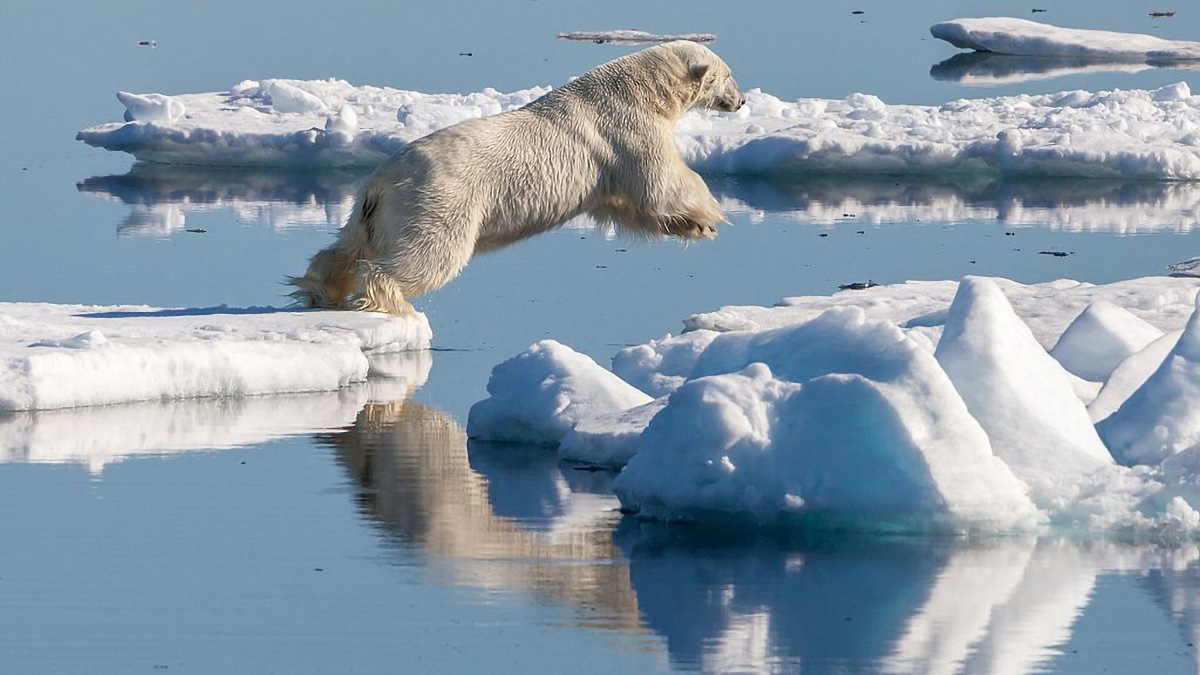
A weaker AMOC could result in less heat being transported to higher latitudes.
The Arctic is heating up three to four times faster than the global average. However, recent research indicates that a slowdown in a major ocean current could lower projected Arctic warming by as much as 2 degrees Celsius by the end of this century.
For years, scientists have warned that unchecked Arctic warming could lead to devastating consequences, threatening wildlife and ushering in an era of more frequent and extreme weather events. Amid concerns for these types of outcomes, a study led by UC Riverside offers some limited relief.
The study, published in the Proceedings of the National Academy of Sciences, examined the effects that the slowing of the Atlantic Meridional Overturning Circulation, or AMOC, may have on the climate in the Arctic. The AMOC is the current that transports heat from the tropics to higher latitudes.
Though temperatures in the Arctic are projected to rise by 10 degrees Celsius by the end of the century, the study shows that when the slowing AMOC current is factored in, Arctic temperatures will only rise by 8 degrees Celsius.
The Role of AMOC in Heat Distribution
“The AMOC is a critical component of our climate system because it moves heat around the globe,” said Yu-Chi Lee, UCR graduate student in Earth and Planetary Sciences and first author of the study. “We found that its weakening reduces the amount of heat reaching the Arctic, which slows down the rate of warming.”
Despite this potential benefit, the study highlights ongoing concerns for Arctic ecosystems. As sea ice melts, polar bears face habitat loss, which could make it more difficult for them to hunt and survive. Moreover, as the ice disappears, darker open water is exposed, which absorbs more sunlight and further accelerates warming through a process called the albedo effect.

While the slowdown may slightly reduce Arctic warming, the researchers caution that it may cause other climate disruptions. One of the most concerning is a potential shift in the Intertropical Convergence Zone, a tropical rain belt. If this rain belt moves southward, regions that depend on its rainfall could experience more frequent droughts, affecting agriculture and water supplies.
There are also misconceptions about the connection between sea ice and rising sea levels. Melting sea ice doesn’t directly cause sea levels to rise because the ice is already in the water, much like how melting ice cubes in a glass won’t cause it to overflow. However, land ice, such as glaciers, and the expansion of water as it heats up, do contribute to rising sea levels. The AMOC slowdown isn’t a major factor in sea level rise, but it brings other significant changes to the climate system.
Complex Climate Interactions and Uncertain Future
Wei Liu, UC Riverside associate professor of climate change and co-author of the paper, emphasized the complexity of the AMOC’s role in the global climate. “The AMOC slowdown may offer some temporary relief in the Arctic, but this is not a simple good-news story,” Liu said. “The overall impact on ecosystems and weather patterns, both in the Arctic and globally, could still be severe.”
The research team used a coupled climate model, which integrates interactions between the ocean, atmosphere, land, and sea ice. The researchers isolated the effect of the AMOC by running two simulations: one that allowed the AMOC to slow under the influence of rising greenhouse gases, and another that artificially maintained its strength by removing fresh water from the North Atlantic to increase salinity.
“Our simulations allowed us to clearly see how much of the future Arctic warming is tied to the AMOC slowdown,” Lee said. “Even though the slowdown reduces warming by a couple of degrees, the overall effects on Arctic ecosystems and the global climate system remain severe.”
Lee also emphasized that the slowdown began relatively recently, and there’s still debate among scientists about how long it has been happening and whether it will continue.
“Direct, in-situ observations of AMOC strength began around 2004, so it’s a relatively short timeframe from which to draw long-term conclusions,” she said. “But there are studies suggesting it could collapse by the end of this century, which would have huge implications.”
Looking ahead, Lee remains focused on the bigger picture. “While the AMOC slowdown might provide some short-term benefits, its broader impacts show us that even small shifts in ocean circulation can cause ripple effects across the planet. Climate change is far from a one-region issue,” she said. “The future of the Arctic—and the world—depends on how we respond today.”
Reference: “Impacts of Atlantic meridional overturning circulation weakening on Arctic amplification” by Yu-Chi Lee, Wei Liu, Alexey V. Fedorov, Nicole Feldl and Patrick C. Taylor, 16 September 2024, Proceedings of the National Academy of Sciences.
DOI: 10.1073/pnas.2402322121
Never miss a breakthrough: Join the SciTechDaily newsletter.
Follow us on Google and Google News.
1 Comment
So, you’re telling us every model that ignored our misused that variable is crap in terms of forecasting what will happen with the climate. Who knew…