
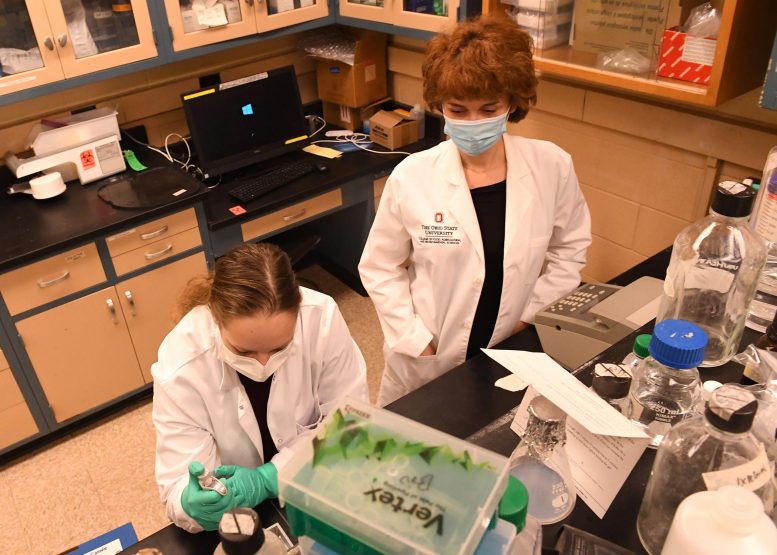
Discovery Shows the Need To Monitor Animal Viruses, Researchers Say
Scientists have identified and completed the genetic analysis of a newly discovered coronavirus – one that has evolved from a coronavirus that afflicts dogs to infect humans and may contribute to respiratory symptoms.
The discovery of the first dog coronavirus found to have crossed over to infecting people underscores the treacherous nature of coronaviruses and the need for monitoring animal viruses as a way to identify and predict possible threats to public health, researchers say.
“At this point, we don’t see any reasons to expect another pandemic from this virus, but I can’t say that’s never going to be a concern in the future,” said Anastasia Vlasova, an assistant professor at The Ohio State University College of Food, Agricultural, and Environmental Sciences (CFAES).
She conducted the study with Gregory C. Gray, a professor in the Division of Infectious Diseases of the Duke University School of Medicine, and Teck-Hock Toh, a professor at SEGi University in Sarawak, Malaysia.
In 2018, researchers analyzed the nasal swabs of 301 patients treated in an East Malaysian hospital for pneumonia. Eight patients, all but one of them children, were found to have been infected with the newly discovered coronavirus that the study’s researchers named CCoV-HuPn-2018. All eight patients were treated and released after four to six days in the hospital, where they were given oxygen to help them breathe.
Genetic Makeup
In a study published on May 20, 2021, in the journal Clinical Infectious Diseases, researchers describe the genetic characteristics of CCoV-HuPn-2018, suggesting it’s a new coronavirus that moved from infecting dogs to infecting people.
Vlasova and her colleagues plan to further study the CCoV-HuPn-2018 virus to determine how harmful it is – or could become – to people. It’s unknown if the virus can be passed from person to person, or how well the human immune system can fight it off.
“We don’t really have evidence right now that this virus can cause severe illness in adults,” Vlasova said, citing the fact that only one person in the study found to have been infected with the new coronavirus was an adult. “I cannot rule out the possibility that at some point this new coronavirus will become a prevalent human pathogen. Once a coronavirus is able to infect a human, all bets are off.”
Viruses change constantly. When a virus alters its genetic makeup enough to go from infecting only a certain type of animal to infecting people, a combination of factors determine how well the new virus can replicate and spread among people.
For an animal coronavirus to infect people, the virus must first enter the human body and recognize something on the surface of the cells, then bind to those cells.
“We know this virus can do that,” Vlasova said.
However, that transmission from a dog to a person may be a dead end for CCoV-HuPn-2018 if the virus does not replicate well once inside the person, or if the person’s immune system fends it off, Vlasova said.
Half Related to SARS-CoV-2, But Different in Impact
Only about half of the genetic makeup of the newly discovered coronavirus is similar to that of the SARS-CoV-2 virus causing the COVID-19 pandemic, Vlasova said.
Although only eight patients in the study were found to have been infected with the CCoV-HuPn-2018 virus, the study’s researchers say that this or highly similar viruses likely have circulated much further than that among dogs and people in Malaysia.
“A one-time sampling is not going to tell you with accuracy how prevalent it is,” Vlasova said. “The sampling has to be repeated and done over a period time to see how many people become infected.”
If confirmed through further epidemiological studies, this new coronavirus could be the eighth coronavirus shown to trigger illnesses in people.
“If you had mentioned this 20 years ago, that a virus that affects dogs could change to be able to infect people, many would have been skeptical,” Vlasova said.
Even though this new coronavirus comes from a dog, it may not be necessary for people to change how they interact with their dogs in light of this study, Vlasova said.
“But I would definitely be watching a little more how much I allow my babies around dogs,” she said. Seven of the eight people hospitalized in Malaysia and found to be infected with the CCoV-HuPn-2018 virus were children, one as young as 5 1/2 months old.
Different Symptoms, Same Concern
The CCoV-HuPn-2018 virus has different symptoms from the dog virus it came from, which caused gastrointestinal problems in dogs such as diarrhea and upset stomach. People infected with the CCoV-HuPn-2018 virus experience a respiratory illness that does not include the gastrointestinal issues.
“We are likely missing important animal viruses that are beginning to adapt to humans,” Gray said. “We need to conduct such virus discovery work among people with pneumonia and also among people who have intense exposure to animals so that we get early warning of a new virus which may become a future pandemic virus.”
The potential threat posed by the viruses of dogs or cats, which also suffer illnesses from coronaviruses, has not been studied widely, though it should be, Vlasova said. Monitoring animal viruses is a way of protecting public health, she said.
“We primarily put the emphasis on studying emerging disease in humans – not animals,” Vlasova said. “That’s a big flaw in the current approach.”
Reference: “Novel Canine Coronavirus Isolated from a Hospitalized Pneumonia Patient, East Malaysia” by Anastasia N Vlasova, PhD; Annika Diaz, Debasu Damtie, MS; Leshan Xiu, MS; Teck-Hock Toh, MD; Jeffrey Soon-Yit Lee, MD; Linda J Saif, PhD and Gregory C Gray, MD, 20 May 2021, Clinical Infectious Diseases.
DOI: 10.1093/cid/ciab456
Never miss a breakthrough: Join the SciTechDaily newsletter.
Follow us on Google and Google News.
1 Comment
The problem is not with bats viruses or dog viruses. It’s with misguided “scientists” engaged in “gain of function” research which created the current pandemic in the lab in Wuhan.