
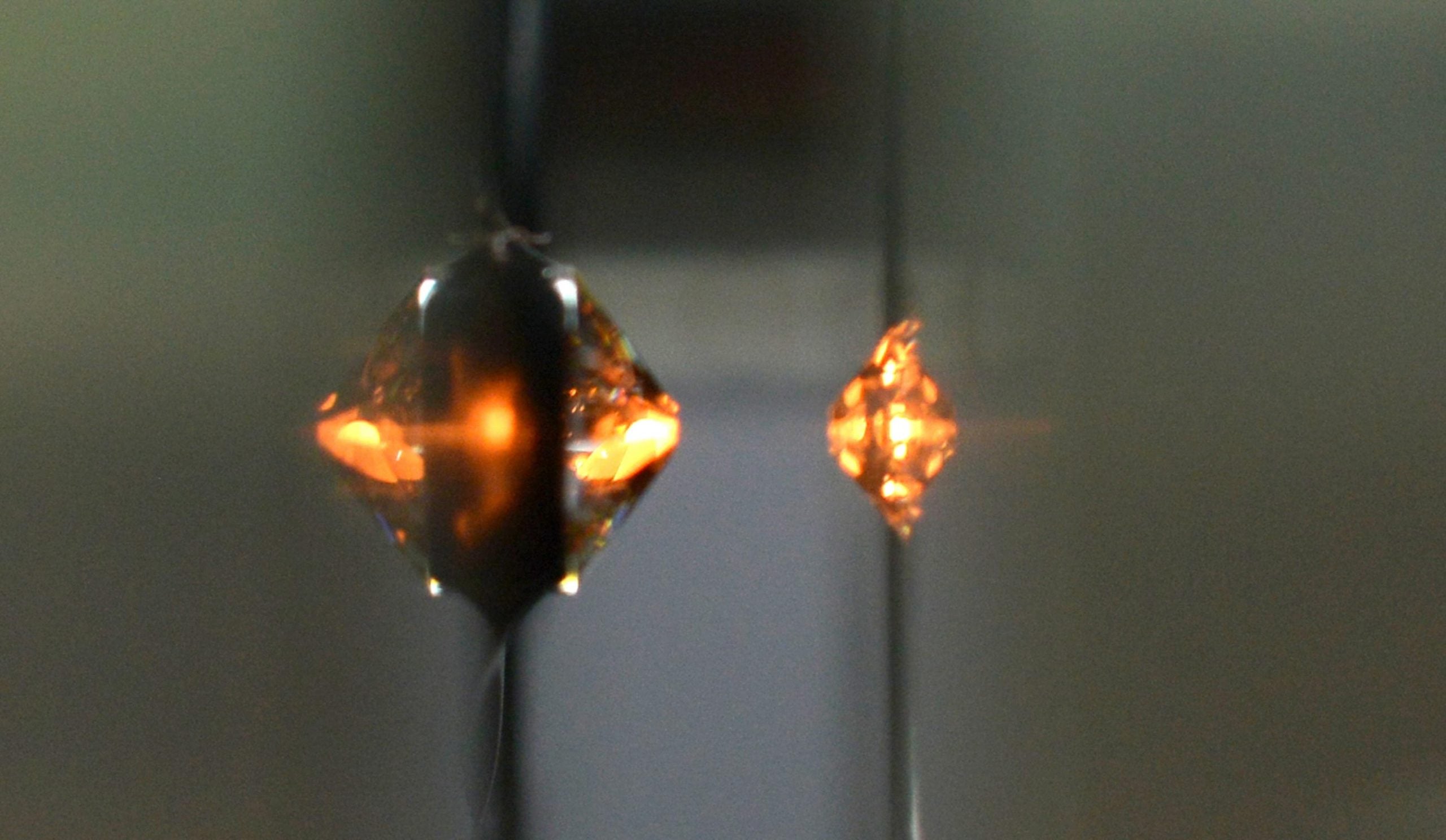
A microsecond freeze under crushing pressure has revealed Ice XXI, an entirely new form of ice.
The Korea Research Institute of Standards and Science (KRISS, President Lee Ho Seong) has recorded water repeatedly freezing and melting at pressures above 2 gigapascals (2 GPa) while still at room temperature. These rapid cycles occurred within microseconds (μs, one-millionth of a second), making it the first time scientists have directly observed this process.
This achievement led to the identification of a previously unknown crystallization pathway in water and resulted in the discovery of a new ice phase. The newly recognized structure has been named Ice XXI, making it the 21st crystalline form of ice.

How Pressure Creates New Ice Forms
Although ice usually forms below 0 °C, pressure can also trigger crystallization. Under high enough pressure, water can freeze at room temperature and even at temperatures above its normal boiling point. When water is pressurized beyond 0.96 GPa at room temperature, it changes into Ice VI.
As water freezes, hydrogen bonds reorganize in complex ways that depend on both pressure and temperature. These molecular adjustments produce a wide range of ice structures during crystallization.
Gaining insight into how these transitions occur, and learning how to control them in extreme environments, could ultimately help scientists develop new materials that do not naturally occur on Earth.

A Century of Mapping Ice Phases
Over the past hundred years, researchers have identified 20 crystalline ice phases[1] by altering pressure and temperature. These structures form across an enormous range that spans more than 2,000 K and over 100 GPa. The section of the phase diagram between 0 GPa and 2 GPa is one of the most intricate areas, containing more than ten closely packed ice phases.
Creating a Supercompressed Liquid State
The Space Metrology Group at KRISS produced a liquid state that remained stable at pressures greater than 2 GPa and room temperature, even though this is more than twice the pressure normally required for crystallization. They achieved this using their in-house dynamic diamond anvil cell (dDAC)[2], a tool designed for precise high-pressure experiments.
Standard diamond anvil cells (DACs) increase pressure by tightening bolts, a method that can introduce mechanical disturbances and uneven pressure that cause early nucleation. The KRISS dDAC reduces mechanical shock and decreases the compression time from tens of seconds to only 10 milliseconds (ms). This allowed researchers to compress water into the Ice VI pressure region while keeping it in liquid form.
Capturing the Formation of Ice XXI
In partnership with scientists from around the world, the KRISS team used the dDAC together with the European XFEL (the world’s largest X-ray free-electron laser facility) to observe the crystallization of supercompressed water with microsecond accuracy. These measurements revealed complex crystallization routes that had never been documented at room temperature. All of these transitions occurred through Ice XXI, establishing it as the 21st crystalline ice phase.
KRISS researchers also determined the internal structure of Ice XXI and documented the pathways that produce it. Ice XXI has a remarkably large and intricate unit cell, the smallest repeating pattern in a crystal lattice. The structure forms a flattened rectangular shape in which the two base edges are identical in length.

A Global Scientific Effort
This breakthrough was achieved through a collaboration of 33 scientists from South Korea, Germany, Japan, the USA, and England, working together with researchers at the European XFEL and DESY. The project was proposed and led by KRISS under the direction of principal investigator (PI) Dr. Lee Geun Woo.
The KRISS research group—including Dr. Kim Jin Kyun (co-first author, postdoctoral researcher at KRISS), Dr. Kim Yong-Jae (co-first author, formerly postdoctoral researcher at KRISS and now at Lawrence Livermore National Laboratory), Dr. Lee Yun-Hee (co-first author, Principal Research Scientist), Dr. Kim Minju (co-author, Postdoctoral Researcher), Dr. Cho Yong Chan (co-author, Principal Research Scientist), and Dr. Lee Geun Woo (corresponding author, Principal Research Scientist)—led the experiment design, data collection, and structure analysis. Their combined work made the discovery of Ice XXI possible and represents a significant advancement in high-pressure and planetary science.
Implications for Planetary Science
Dr. Lee Yun-Hee said, “The density of Ice XXI is comparable to the high-pressure ice layers inside the icy moons of Jupiter and Saturn. This discovery may provide new clues for exploring the origins of life under extreme conditions in space.”
Dr. Lee Geun Woo added, “By combining our in-house developed dDAC technology with the XFEL, we were able to capture fleeting moments that had been inaccessible with conventional instruments. Continued research into ultrahigh-pressure and other extreme environments will open new frontiers in science.”
This work was supported by the 4000 K-class Rocket Engine Ultra-High Temperature Materials and Measurement Technologies Development Project of the National Research Council of Science & Technology (NST). The findings were published in Nature Materials.
Explore Further: Scientists Discover a New Form of Ice That Shouldn’t Exist
Notes
- Previously, ice phases from Ice I to Ice XX had been reported. Ice I exists in two structural forms: the hexagonal Ice Ih and the cubic Ice Ic.
- The dDAC is a high-pressure device that uses a pair of diamonds and piezoelectric actuators to dynamically control and observe pressure changes in a microscopic water sample.
Reference: “Multiple freezing–melting pathways of high-density ice through ice XXI phase at room temperature” by Yun-Hee Lee, Jin Kyun Kim, Yong-Jae Kim, Minju Kim, Yong Chan Cho, Rachel J. Husband, Cornelius Strohm, Emma Ehrenreich-Petersen, Konstantin Glazyrin, Torsten Laurus, Heinz Graafsma, Robert P. C. Bauer, Felix Lehmkühler, Karen Appel, Zuzana Konôpková, Minxue Tang, Anand Prashant Dwivedi, Jolanta Sztuck-Dambietz, Lisa Randolph, Khachiwan Buakor, Oliver Humphries, Carsten Baehtz, Tobias Eklund, Lisa Katharina Mohrbach, Anshuman Mondal, Hauke Marquardt, Earl Francis O’Bannon, Katrin Amann-Winkel, Choong-Shik Yoo, Ulf Zastrau, Hanns-Peter Liermann, Hiroki Nada and Geun Woo Lee, 10 October 2025, Nature Materials.
DOI: 10.1038/s41563-025-02364-x
Never miss a breakthrough: Join the SciTechDaily newsletter.
Follow us on Google and Google News.
3 Comments
Ice XXI has a remarkably large and intricate unit cell, the smallest repeating pattern in a crystal lattice.
very good.
Please ask researchers to think deeply:
What is the basis for defining the smallest repeating pattern?
Based on topological vortex theory, there is no smallest repeating pattern, only smaller.
When we pursue the ultimate truth of all things, the space in which our bodies and all things exist may itself be the final and deepest puzzle we need to explore. This is not only the pursuit of physics, but also the most magnificent exploration of the origin of the universe by human reason.
Based on the Topological Vortex Theory (TVT), space is an uniformly incompressible physical entity. Space-time vortices are the products of topological phase transitions of the tipping points in space, are the point defects in spacetime. Point defects do not only impact the thermodynamic properties, but are also central to kinetic processes. They create all things and shape the world through spin and self-organization.
In today’s physics, some so-called peer-reviewed journals—including Physical Review Letters, Nature, Science, and others—stubbornly insist on and promote the following:
1. Even though θ and τ particles exhibit differences in experiments, physics can claim they are the same particle. This is science.
2. Even though topological vortices and antivortices have identical structures and opposite rotational directions, physics can define their structures and directions as entirely different. This is science.
3. Even though two sets of cobalt-60 rotate in opposite directions and experiments reveal asymmetry, physics can still define them as mirror images of each other. This is science.
4. Even though vortex structures are ubiquitous—from cosmic accretion disks to particle spins—physics must insist that vortex structures do not exist and require verification. Only the particles that like God, Demonic, or Angelic are the most fundamental structures of the universe. This is science.
5. Even though everything occupies space and maintains its existence in time, physics must still debate and insist on whether space exists and whether time is a figment of the human mind. This is science.
6. Even though space, with its non-stick, incompressible, and isotropic characteristics, provides a solid foundation for the development of physics, physics must still insist that the ideal fluid properties of space do not exist. This is science.
and go on.
Is this the counterintuitive science they widely promote? Compromising with pseudo academic publications and peer review by pseudo scholars is an insult to science and public intelligence. Some so-called scholars no longer understand what shame is. The study of Topological Vortex Theory (TVT) reminds us that the most profound problems in physics often lie at the intersection of different theories. By exploring these border regions, we can not only resolve contradictions in existing theories but also discover new physical phenomena and application possibilities.
Under the topological vortex architecture, it is highly challenging for even two hydrogen atoms or two quarks to be perfectly symmetrical, let alone counter-rotating two sets of cobalt-60. Contemporary physics and so-called peer-reviewed publications (including Physical Review Letters, Science, Nature, etc.) stubbornly believe that two sets of counter rotating cobalt-60 are two mirror images of each other, constructing a more shocking pseudoscientific theoretical framework in the history of science than the “geocentric model”. This pseudo scientific framework and system have seriously hindered scientific progress and social development.
For nearly a century, physics has been manipulated by this pseudo scientific theoretical system and the interest groups behind it, wasting a lot of manpower, funds, and time. A large amount of pseudo scientific research has been conducted, and countless pseudo scientific papers have been published, causing serious negative impacts on scientific and social progress, as well as humanistic development.
Complexity does not necessarily mean that there is no logical and architectural framework to follow. Mathematics is the language and tool that reveals the motion of spacetime, rather than the motion itself. Although the physical form of spacetime vortices is extremely simple, their interaction patterns are highly complex, and we must develop more and richer mathematical languages to describe and understand them.
The development of the Topological Vortex Theory (TVT) reflects a progression from concrete physical phenomena to abstract mathematical modeling and, ultimately, to interdisciplinary unification. Its core innovation lies in forging the continuous spacetime geometry of general relativity with the discrete interactions of quantum field theory within the same topological dynamical system.
——Excerpted from https://scitechdaily.com/microscope-spacecrafts-most-precise-test-of-key-component-of-the-theory-of-general-relativity/#comment-909171.
The researcher’s statement about a future aspect of searching for life – is the first time I believe such a statement. Maybe it’s the same ol’ funding pitch but maybe not.