
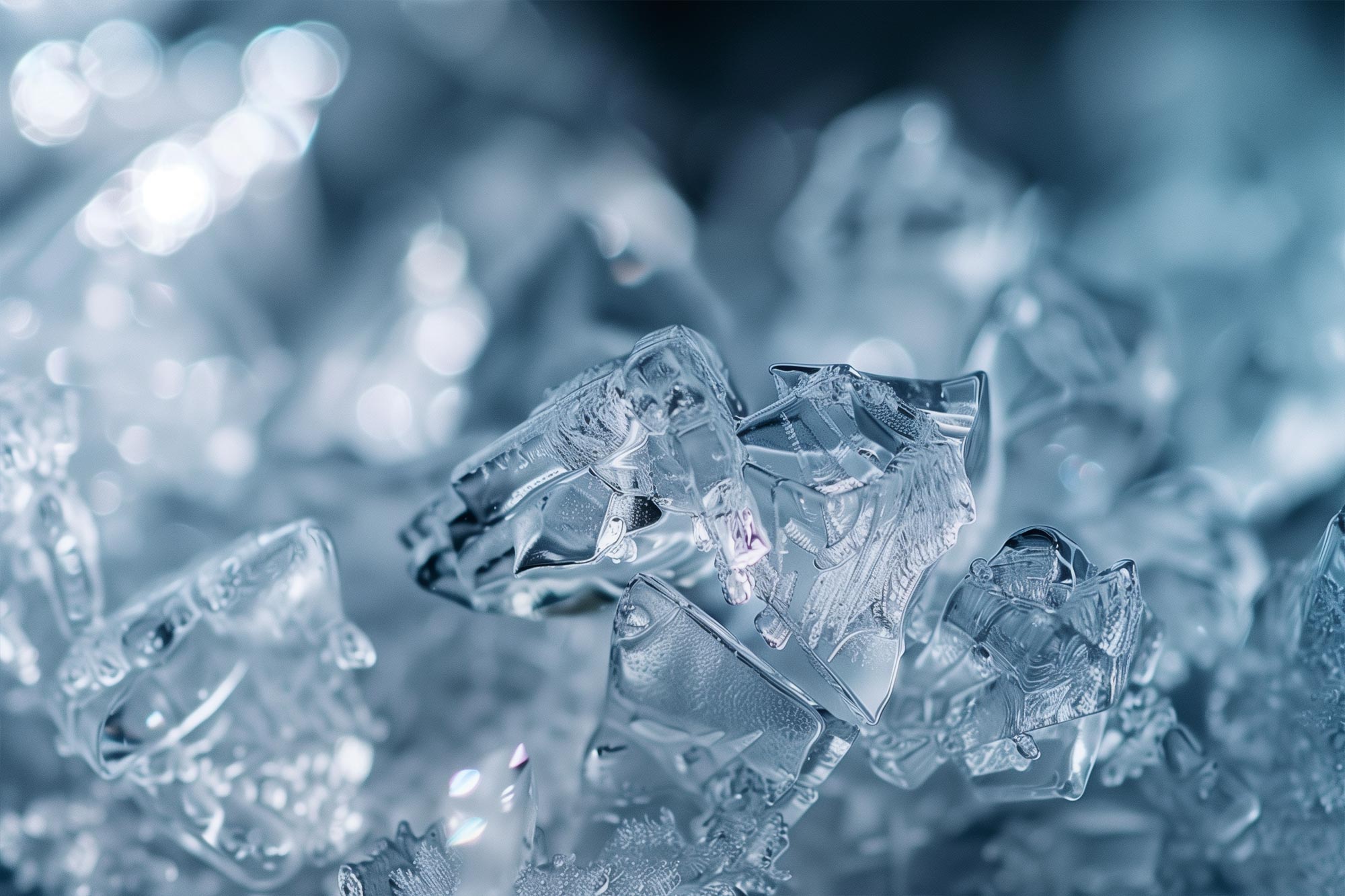
Water isn’t just liquid, ice, or vapor — under extreme conditions, it can transform into exotic phases, such as the newly observed plastic ice VII.
This hybrid phase, predicted years ago but only recently confirmed using cutting-edge neutron spectrometers, exhibits both solid-like structure and liquid-like molecular motion.
Beyond the Familiar: Water’s Many Phases
In everyday life, we usually see water in one of three familiar states: solid, liquid, or gas. However, under extreme conditions of high temperature and pressure, water can take on many other forms — some so unusual that scientists call them exotic phases. Using advanced neutron spectrometers and specialized equipment at the Institut Laue-Langevin (ILL), researchers have now experimentally observed one of these elusive states for the first time: plastic ice VII.
Discovery of Plastic Ice VII
Scientists first predicted the existence of plastic ice VII over 15 years ago through molecular dynamics (MD) simulations. “Plastic phases are hybrid states that blend properties of both solids and liquids,” explains Livia Eleonora Bove, a research director at the French National Centre for Scientific Research (CNRS), an associate professor at La Sapienza University in Rome, and an associated scientist at EPFL in Switzerland.
“In plastic ice, the water molecules form a rigid cubic lattice, like in ice VII, but they also rotate rapidly — similar to how molecules move in liquid water.”
Quasi-Elastic Neutron Scattering: Unlocking Molecular Motion
To study these rapid molecular motions, researchers used Quasi-Elastic Neutron Scattering (QENS), a technique particularly suited for detecting both translational and rotational dynamics.
“The ability of QENS to probe both the translational and rotational dynamics is a unique advantage for the exploration of such exotic phase transitions compared to other spectroscopic techniques,” explains Maria Rescigno, a PhD student at Sapienza University and lead author of the study.
By varying temperature and pressure, the team identified three distinct states of water: liquid water, where molecules move freely in both rotation and translation; solid ice, where all movement is frozen; and plastic ice VII, an intermediate phase where molecules maintain their rigid structure but continue to rotate.
Extreme Conditions: Creating Plastic Ice VII
The experiments revealing plastic ice VII were performed using the time-of-flight spectrometers IN5 and IN6-SHARP at the ILL. Temperatures as high as 450 – 600 K and pressures from 0.1 to 6 GPa (up to about 60 thousand times the normal atmospheric pressure) were required to produce this exotic state of water.
The implementation of such demanding thermodynamic conditions in neutron spectroscopy was made possible by recent technological advances achieved in collaboration between Bove, CNRS research director Stefan Klotz, and ILL scientist Michael Marek Koza as part of a long-term project at the ILL.
“The success of this study relies on the extensive expertise and unique infrastructure built over the years at the ILL, in particular in terms of complex sample environments and high pressures,” underlines Koza, “Additionally, the continuous improvement of ILL’s spectrometers – such as those made within the Endurance upgrade program – has facilitated ever more sophisticated experiments carried out by state-of-the-art instruments.”
Challenging Expectations: New Molecular Dynamics Insights
A comprehensive analysis of the neutron scattering data also revealed that the molecular dynamics of plastic ice VII could be more intricate than MD simulation had initially predicted. “The QENS measurements suggested a different molecular rotation mechanism for plastic ice VII than the free rotor behavior initially expected,” explains Rescigno.
Additional MD simulations, together with Markov chain analysis, provided a more detailed picture of the water molecule dynamics. A 4-fold rotational model, as typically observed in jump-rotor plastic crystals, was identified as the most likely mechanism.
The Transition to Superionic Ice: A Path to the Unknown
Further investigations – involving neutron and X-ray diffraction measurements, respectively, on the D20 diffractometer at the ILL and at the Institute of Mineralogy, Physics of Materials and Cosmochemistry (IMPMC) – were carried out to explore the nature of the phase transition from ice VII to plastic ice VII.
“This transition is predicted to be either first-order or continuous, depending on the simulation method used,” explains Bove. “The continuous transition scenario is very intriguing as it hints that the plastic phase could be the precursor of the elusive superionic phase – another hybrid exotic phase of water predicted at even higher temperatures and pressures, where hydrogen can diffuse freely through the oxygen crystalline structure.”
Implications for Planetary Science and Beyond
Both plastic and superionic phases are of high interest in planetary science, with potential implications in our understanding of the internal structure and glacial flow of icy moons like Ganymede and Callisto and icy planets like Uranus and Neptune, where they might dominate.
Neutron scattering hasn’t traditionally been a go-to technique in planetary science. Nevertheless, its unique ability to precisely measure the location and dynamics of hydrogen in a material, combined with the recent possibility of conducting experiments at planetary relevant pressures, has enabled neutron scattering to make a substantial impact in this domain. And there may be more exotic phases yet to be uncovered.
Reference: “Observation of Plastic Ice VII by Quasi-Elastic Neutron Scattering” by Maria Rescigno, Alberto Toffano, Umbertoluca Ranieri, Leon Andriambariarijaona, Richard Gaal, Stefan Klotz, Michael Marek Koza, Jacques Ollivier, Fausto Martelli, John Russo, Francesco Sciortino, Jose Teixeira and Livia Eleonora Bove, 12 February 2025, Nature.
DOI: 10.1038/s41586-025-08750-4
Never miss a breakthrough: Join the SciTechDaily newsletter.
Follow us on Google and Google News.
2 Comments
If you can’t ice skate on that, forget about it.
Both plastic and superionic phases had been of high interest in planetary science.
VERY GOOD!
Ask the researchers:
WHY? Scientific research guided by correct theories can enable researchers to think more.
A topological vortex is a concept in physics that describes the natural gravitational field or the fluid-body coupled system. A topological vortex is formed by the interaction and balance of vortex and anti-vortex field pairs, which can be set into resonance by the body motion and interaction. A topological vortex is the foundation of the evolution of spacetime material motion.
According to the Topological Vortex Theory (TVT), spins create everything, spins shape the world. There are substantial distinctions between Topological Vortex Theory (TVT) and traditional physical theories. Grounded in the inviscid, incompressible, and isotropic spaces, TVT introduces the concept of topological phase transitions and employs topological principles to elucidate the formation and evolution of matter in the universe, as well as the impact of interactions between topological vortices and anti-vortices on spacetime dynamics and thermodynamics.
Within TVT, low-dimensional spacetime matter serves as the foundation for high-dimensional spacetime matter, and the hierarchical structure of matter and its interaction mechanisms challenge conventional macroscopic and microscopic interpretations. The conflict between Quantum Physics and Classical Physics can be attributed to their differing focuses: Quantum Physics emphasizes low-dimensional spacetime matter, whereas Classical Physics centers on high-dimensional spacetime matter.
Subatomic particles in the quantum world often defy the familiar rules of the physical world. The fact repeatedly suggests that the familiar rules of the physical world are pseudoscience. In the familiar rules of the physical world, two sets of cobalt-60 can form the mirror image of each other by rotating in opposite directions, and should receive the Nobel Prize for physics.
Please witness the grand performance of some so-called peer review publications (including PRL, PNAS, Nature, Science, etc.). https://scitechdaily.com/microscope-spacecrafts-most-precise-test-of-key-component-of-the-theory-of-general-relativity/#comment-854286. Some so-called academic publications (including PRL, PNAS, Nature, Science, etc.) are addicted to their own small circles and have deviated from science for a long time.
As the background of various material interactions and movements, space exhibits inviscid, absolutely incompressible and isotropic physical characteristics. It may form various forms of spacetime vortices through topological phase transitions. Hence, vortex phenomena are ubiquitous in cosmic space, from vortices of quantum particles and living cells to tornados and black holes. Stars and radioactive elements are one of the most active topological nodes in spacetime. Utilizing them is more valuable and meaningful than simulating them. Small or micro power topology intelligent batteries may be the direction of future energy research and development for human society.
Under the topological vortex architecture, science and pseudoscience are clear at a glance. Topological Vortex Theory (TVT) can play a crucial role in elucidating the foundations of physics, establishing its principles, and combating pseudoscience. Therefore, TVT has been strongly opposed and boycotted by traditional so-called peer review publications (such as PRL, PNAS, Nature, Science, etc.).
These so-called peer review publications (including PRL, PNAS, Nature, Science, etc.) mislead the direction of science and are known for their various absurdities and wonders. They collude together, reference each other, and use so-called Impact Factor (IF) or the Nobel Prize to deceive people around.
Ask the so-called peer review publications (including PRL, PNAS, Nature, Science, etc.):
1. What are your criteria for distinguishing science from pseudoscience?
2. Is your Impact Factor (IF) the standard for distinguishing science from pseudoscience?
3. Is the Nobel Prize the standard for distinguishing science from pseudoscience?
4. What is the most important aspect of academic publications?
5. Is the most important aspect of academic publications being flashy and impractical articles?
Pseudo academic publications (including PRL, PNAS, Nature, Science, etc.) are neither inclusivity nor openness, nor transparency and fairness, and have already had a serious negative impact on the progress of science and technology. Some so-called peer review publications (including PRL, PNAS, Nature, Science, etc.) are addicted to their own small circle and no longer know what science is. They hardly know what is dirty and ugly.
Publications that mislead the public under the guise of scholarship are more reprehensible than ordinary publications. The field of physics faces an ongoing challenge in maintaining scientific rigor and integrity in the face of pervasive pseudoscientific claims. Fighting against rampant pseudoscience, physics still has a long way to go.
While my comments may be lengthy, they are necessary to combat the proliferation of rampant pseudoscience and to promote the advancement of science and technology, and also is all I can do.
Appreciate the SciTechDaily for its inclusivity, openness, transparency, and fairness. If the researchers are truly interested in cosmic matter, please read: A Brief History of the Evolution of Cosmic Matter (https://scitechdaily.com/microscope-spacecrafts-most-precise-test-of-key-component-of-the-theory-of-general-relativity/#comment-873523).