
An international research team, led by the Complutense University of Madrid, has used computer simulations to study the movement of a solid sliding over ice at the atomic level. The simulation confirms the existence of a self-lubricating layer on the surface of the ice.
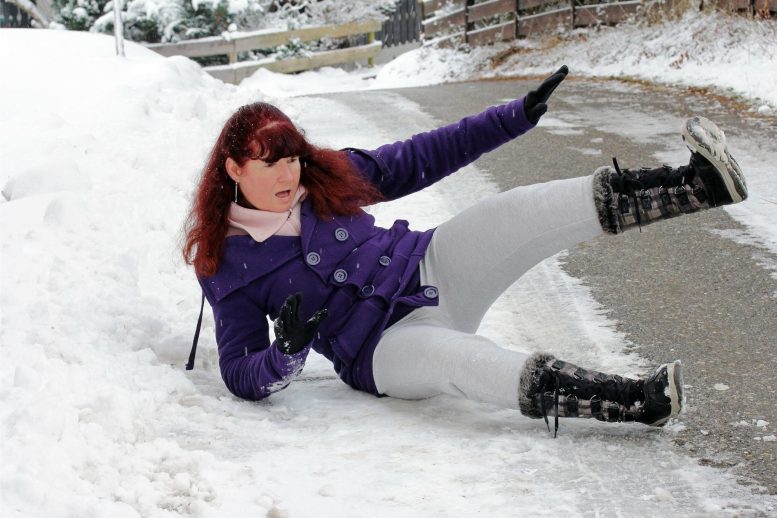
According to international research led by the Complutense University of Madrid (UCM), the surface of ice when in contact with a solid object melts and creates a self-perpetuating lubricant layer. This lubricant layer makes the ice slipperier, and therefore more likely to cause accidents involving skating or cars.
The study, which was published in Proceedings of the National Academy of Science, involved the use of computer simulations to analyze the movement of solid objects over the surface of ice at the atomic level.
“Our analysis of how the ice molecules are collectively organized to give them their peculiar lubricant power offers us a privileged insight into the process that could not be achieved through conventional experiments, given the huge difficulty in conducting an experimental observation of a lubricating layer of a thickness of a billionth of a meter”, stresses Luis González MacDowell, a researcher at the UCM Physical Chemistry Department.
The slippery properties of ice have in some cases been exploited for leisure purposes (such as in ice skating), and in others as a means of transport.
“It is important to understand the origin of this widely known property of ice, both in order to improve the performance of Olympic athletes, and to ensure vehicle safety during the winter,” the expert indicates.
Aside from the UCM, the study also involves the Autonomous University of Madrid (UAM) and Marie Curie-Skłodowska University (MCSU) of Lublin, Poland.
Compatible Hypotheses Which Pave the Way for Energy Savings
Scientists have spent two centuries wondering why ice is slippery, and what causes the liquid layer which forms on top of it. Over the decades, figures including Michael Faraday, James Thomson, Osborne Reynolds, and Philip Browden have come up with divergent hypotheses.
However, this study has served to demonstrate that they are in truth compatible, and operate simultaneously. “What we in fact find is that the key principles of the slippery nature of ice are the surface melting phenomenon proposed by Faraday; the gradual melting caused by pressure, reminiscent of Thomson’s hypothesis, and the melting caused by friction, as proposed by Bowden”, the UCM chemist points out.
This combination of factors gives the surface of the ice an exceptional self-repairing lubrication layer. “The problem with lubrication is that as the pressure increases, the lubricant is expelled from between the opposing faces, which leaves them in direct contact. In the case of ice, Le Chatelier’s principle operates, and as the lubricating layer is driven away by the pressure, the ice itself melts and repairs the loss,” indicates Lukasz Baran, the MCSU researcher who worked on the simulation technique during a six-month placement at the UCM.
Aside from preventing sporting and traffic accidents, the results of this study could be applied in designing better lubricants in other systems.
“It is important to remember that more than half the energy generated worldwide is lost through friction. Improved lubrication processes would mean a huge saving in fuel, money, and environmental impact,” concludes Pablo Llombart, a researcher at the UAM’s Nicolás Cabrera Institute.
Reference: “Ice friction at the nanoscale” by Łukasz Baran, Pablo Llombart, Wojciech Rżysko and Luis G. MacDowell, 28 November 2022, Proceedings of the National Academy of Sciences.
DOI: 10.1073/pnas.2209545119
Never miss a breakthrough: Join the SciTechDaily newsletter.
Follow us on Google and Google News.
2 Comments
Question for someone who knows more than I:
If friction is instrumental, then wouldn’t the leading edge of a skate experience more friction than the rear? Why doesn’t that produce a spin-out condition as occassional experienced by front wheel drive cars?
This reads like an article from The Onion.