
Scientists have developed a portable, radiation-free imaging technology called Magnetic Particle Imaging (MPI), which uses magnetic nanoparticles to visualize biological processes like blood flow.
Technologies like computed tomography, magnetic resonance imaging, positron emission tomography, and ultrasound are now integral parts of the medical domain, offering exclusive insights into human anatomy. These techniques not only provide detailed imaging of the human body but also help physicians identify abnormalities or analyze functional processes within.
A group comprising physicists and medical experts from Julius-Maximilians-Universität Würzburg (JMU) has successfully developed an innovative, radiation-free imaging technique that’s suitable for human use called Magnetic Particle Imaging (MPI). Their newly invented portable scanner is capable of, among other things, visualizing dynamic processes in the human body, such as blood flow.
Professor Volker Behr and Dr. Patrick Vogel from the University’s Institute of Physics are responsible for this study; they have now published the results in the journal Nature Scientific Reports.
A Sensitive and Fast Alternative
Magnetic particle imaging is a technique based, as the name suggests, on the direct visualization of magnetic nanoparticles. Such nanoparticles do not occur naturally in the human body and must be administered as markers. “As with positron emission tomography, which relies on the administration of radioactive substances as markers, this method has the great advantage of being sensitive and fast without ‘seeing’ interfering background signals from tissue or bone,” explains Volker Behr.
MPI is not based on the detection of gamma rays from a radioactive marker like positron emission tomography but on the response signal of the magnetic nanoparticles to magnetic fields that change over time.
“In this process, the magnetization of nanoparticles is specifically manipulated with the help of external magnetic fields, whereby not only their presence but also their spatial position in the human body can be detected,” says physicist Patrick Vogel, first author of the publication.
A Small Scanner for Big Insights
The MPI idea is not new. As early as 2005, the Philips company was able to show the first images of this novel approach in a small demonstrator, which, however, could only take samples a few centimeters in size. And the development of devices suitable for examining humans proved more difficult than expected, leading to large, heavy and expensive constructions.
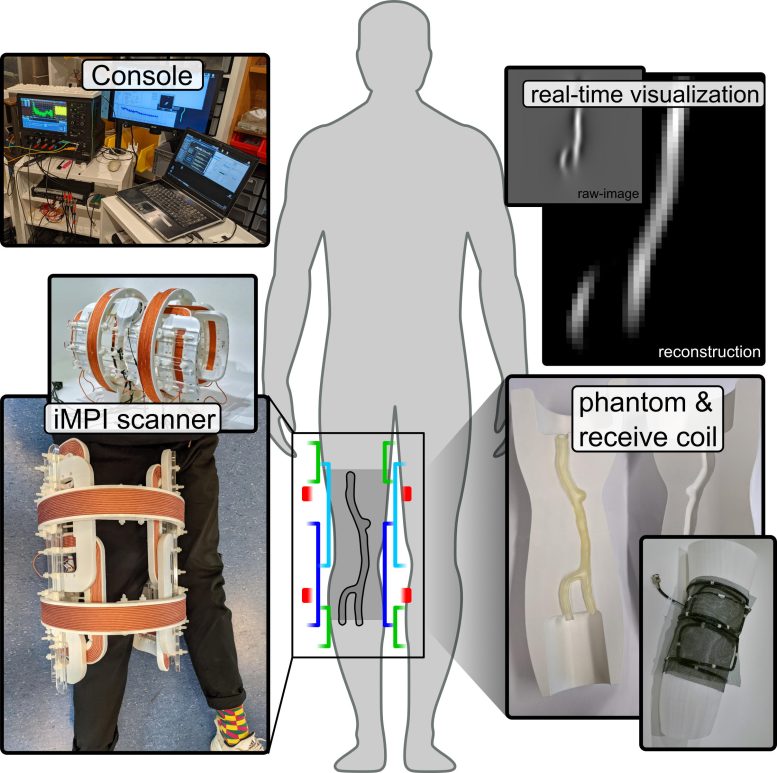
In 2018, the team led by Professor Volker Behr and Patrick Vogel found a new way to implement the complex magnetic fields required for imaging in a much smaller design. In a multi-year research project funded by the German Research Foundation (DFG), the scientists succeeded in implementing the novel concept in an MPI scanner (interventional Magnetic Particle Imaging – iMPI) specifically designed for intervention.
“Our iMPI scanner is so small and light that you can take it almost anywhere,” Vogel explains. The authors impressively demonstrate this mobility of the scanner in a simultaneous real-time measurement in comparison with a special X-ray device, which is the standard device in angiography in university hospitals. The team led by Professor Thorsten Bley and Dr. Stefan Herz of the Interventional Radiology Department of the Würzburg University Hospital, which accompanied this project from the beginning, carried out the measurements on a realistic vascular phantom and evaluated the first images.
“This is a first important step towards radiation-free intervention. MPI has the potential to change this field for good,” said Dr. Stefan Herz, senior author of the publication.
Next Steps in Research
In addition to further exciting measurements with the iMPI device, the two physicists are now working on further developing their scanner. The main goal is to further improve the image quality.
Reference: “iMPI: portable human-sized magnetic particle imaging scanner for real-time endovascular interventions” by P. Vogel, M. A. Rückert, C. Greiner, J. Günther, T. Reichl, T. Kampf, T. A. Bley, V. C. Behr and S. Herz, 28 June 2023, Scientific Reports.
DOI: 10.1038/s41598-023-37351-2
Never miss a breakthrough: Join the SciTechDaily newsletter.
Follow us on Google and Google News.