
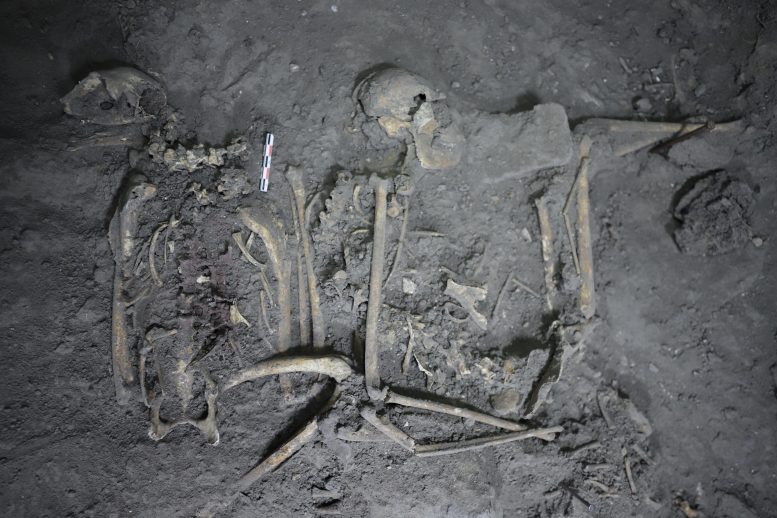
A team of researchers has uncovered an ancient monkey skeleton at the ruins of Teotihuacán, Mexico, that suggests the earliest evidence of primate captivity, translocation, and gift diplomacy between the elite of Teotihuacán and the Mayans.
The discovery of the complete skeletal remains of a spider monkey – an exotic curiosity in pre-Hispanic Mexico – provides new evidence of the social and political connections between the ancient civilizations of Teotihuacán and the Maya Indigenous rulers.
The finding was made by Nawa Sugiyama, a University of California, Riverside anthropological archaeologist, and a team of archaeologists and anthropologists who since 2015 have been excavating at Plaza of Columns Complex, in Teotihuacán, Mexico. The remains of other animals were also discovered, as well as thousands of Maya-style mural fragments and over 14,000 ceramic sherds from a grand feast. These pieces are more than 1,700 years old.
The spider monkey is the earliest evidence of primate captivity, translocation, and gift diplomacy between Teotihuacán and the Maya. Details of the discovery will be published in the journal PNAS. This finding allows researchers to piece evidence of high diplomacy interactions and debunks previous beliefs that Maya presence in Teotihuacán was restricted to migrant communities, said Sugiyama, who led the research.
“Teotihuacán attracted people from all over, it was a place where people came to exchange goods, property, and ideas. It was a place of innovation,” said Sugiyama, who is collaborating with other researchers, including Professor Saburo Sugiyama, co-director of the project and a professor at Arizona State University, and Courtney A. Hofman, a molecular anthropologist with the University of Oklahoma. “Finding the spider monkey has allowed us to discover reassigned connections between Teotihuacán and Maya leaders. The spider monkey brought to life this dynamic space, depicted in the mural art. It’s exciting to reconstruct this live history.”
Researchers applied a multimethod archaeometric (zooarchaeology, isotopes, ancient DNA, paleobotany, and radiocarbon dating) approach to detail the life of this female spider monkey. The animal was likely between 5 and 8 years old at the time of death.
Rituals and Symbolic Offerings in Teotihuacán
Its skeletal remains were found alongside a golden eagle and several rattlesnakes, surrounded by unique artifacts, such as fine greenstone figurines made of jade from the Motagua Valley in Guatemala, copious shell/snail artifacts, and lavish obsidian goods such as blades and projectiles points. This is consistent with the evidence of live sacrifice of symbolically potent animals participating in state rituals observed in Moon and Sun Pyramid dedicatory caches, researchers stated in the paper.
Results from the examination of two teeth, the upper and lower canines, indicate the spider monkey in Teotihuacán ate maize and chili peppers, among other food items. The bone chemistry, which offers insight into the diet and environmental information, indicates at least two years of captivity. Prior to arriving in Teotihuacán, it lived in a humid environment, eating primarily plants and roots.
The research is primarily funded by grants awarded to Sugiyama from the National Science Foundation and National Endowment for the Humanities. Teotihuacán is a pre-Hispanic city recognized as a UNESCO World Heritage site and receives more than three million visitors annually.
In addition to studying ancient rituals and uncovering pieces of history, the finding allows for a reconstruction of greater narratives, of understanding how these powerful, advanced societies dealt with social and political stressors that very much reflect today’s world, Sugiyama said.
Lessons from Teotihuacán’s Resilience
“This helps us understand principles of diplomacy, to understand how urbanism developed … and how it failed,” Sugiyama said. “Teotihuacán was a successful system for over 500 years, understanding past resilience, its strengths and weaknesses are relevant in today’s society. There are many similarities then and now. Lessons can be seen and modeled from past societies; they provide us with cues as we go forward.”
Reference: “Earliest evidence of primate captivity and translocation supports gift diplomacy between Teotihuacan and the Maya” by Nawa Sugiyama, Saburo Sugiyama, Clarissa Cagnato, Christine A. M. France, Atsushi Iriki, Karissa S. Hughes, Robin R. Singleton, Erin Thornton and Courtney A. Hofman, 21 November 2022, Proceedings of the National Academy of Sciences.
DOI: 10.1073/pnas.2212431119
The study was funded by the National Science Foundation and the National Endowment for the Humanities.
Never miss a breakthrough: Join the SciTechDaily newsletter.
Follow us on Google and Google News.