
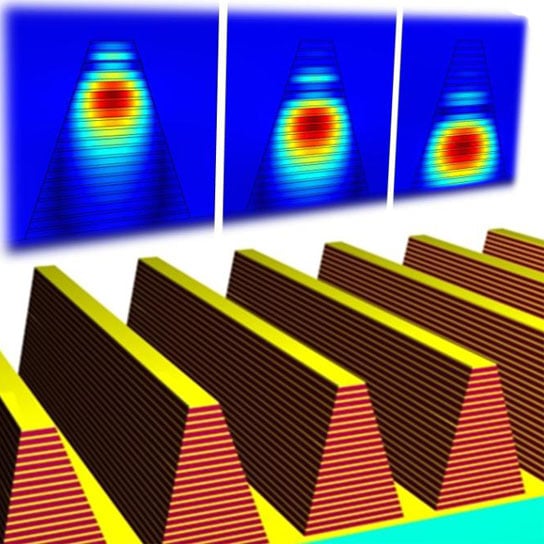
Based on computer simulations, new research shows that a new metamaterial design is able to absorb a wide range of light with extremely high efficiency. The scientists involved in this project believe this material would be both a very efficient emitter and absorber of photons and could be used in new kinds of solar cells, infrared detectors and as devices for generating electricity from heat.
Metamaterials are a new class of artificial substances with properties unlike anything found in the natural world. Some have been designed to act as invisibility cloaks; others as superlenses, antenna systems or highly sensitive detectors. Now, researchers at MIT and elsewhere have found a way to use metamaterials to absorb a wide range of light with extremely high efficiency, which they say could lead to a new generation of solar cells or optical sensors.
Nicholas X. Fang, the Brit (1961) and Alex (1949) d’Arbeloff Career Development Associate Professor in Engineering Design in MIT’s Department of Mechanical Engineering, says that most thin materials used to fully capture light are limited to a very narrow range of wavelengths and angles of incidence. The new design uses a pattern of wedge-shaped ridges whose widths are precisely tuned to slow and capture light of a wide range of wavelengths and angles of incidence.
These metamaterials can be extremely thin, saving weight and cost. Fang compares the tapered structures to the cochlea of the inner ear, which responds to different frequencies of sound at different points along its narrowing structure. “Our ears separate different frequencies and gather them at different depths,” he says; similarly, the metamaterial wedges harvest photons at different depths.
The actual structure of the material is etched from alternating layers of metal and an insulating material called a dielectric, whose response to polarized light can be varied by changing an electric field applied to the material. The creation of this new material is described in a paper to be published in a forthcoming issue of the journal Nano Letters. A preliminary version of Fang’s paper — co-authored with researchers at Zhejiang University and Taiyuan University in China, and the University of Illinois at Urbana-Champaign — is available online now.
Kin Hung Fung, an MIT postdoc and co-author of the Nano Letters paper, says, “What we have done is to design a multilayer sawtooth structure that can absorb a wide range of frequencies” with an efficiency of more than 95 percent. Previously, such efficiency could only be achieved with materials tuned to a very narrow band of wavelengths. “High-efficiency absorption has been achieved before, but this design has an extremely wide window” for colors of light, Fung says.
Metamaterials have been “a very hot topic this decade,” he says, “because they can help us to design functional materials that interact with light in unconventional ways.” By using the tuned metamaterial, he says, his team was able to slow light to less than one-hundredth of its normal speed in a vacuum, making it much easier to trap inside the material. “When something is going very fast, it’s difficult to catch it,” he says, “so we slow it down so it’s easier to absorb.”
The material can easily be fabricated using equipment that is already standard in conventional photovoltaic-cell manufacturing. Although the initial work was based on computer simulations, the team is now working on lab experiments to confirm their findings.
Besides solar cells, the design could be used to make efficient infrared detectors for a selected range of wavelengths. “We can selectively enhance the material’s interaction with infrared light at the wavelengths we want,” Fung says.
Fang says that by its nature, the material would be both a very efficient emitter and absorber of photons — so in addition to potential uses in new kinds of solar cells or infrared detectors, the material could be used for infrared-light emitting applications, such as devices for generating electricity from heat. In addition, the researchers say the principle can be scaled so that it could be used to capture or emit electromagnetic radiation at other wavelengths, such as microwave and terahertz frequencies. It could even be used to produce visible light with extremely low energy loss, creating a new kind of high-efficiency light bulb.
Richard Averitt, a professor of physics at Boston University who was not involved in this research, calls the sawtooth-shaped structure developed by this team “a unique and impressive approach toward realizing functional broadband absorbers” that could have applications in thermal detection and in light harvesting for energy applications. He cautions that further work is needed to ease fabrication and integration of the materials, but adds, “This is an intriguing slow-wave structure that should inspire new developments in this field.”
Reference: “Ultrabroadband Light Absorption by a Sawtooth Anisotropic Metamaterial Slab” by Yanxia Cui, Kin Hung Fung, Jun Xu, Hyungjin Ma, Yi Jin, Sailing He and Nicholas X. Fang, 6 February 2012, Nano Letters.
DOI: 10.1021/nl204118h
The work was supported by grants from the U.S. National Science Foundation, the National Natural Science Foundation of China and the Asian Office of Aerospace Research and Development.
Never miss a breakthrough: Join the SciTechDaily newsletter.
Follow us on Google and Google News.