
A team of researchers has developed a new method to speed up the stabilization of chaotic systems.
When chaos threatens, speed is essential; for example, when a pacemaker needs to stabilize an irregular heartbeat or a robot has to react to the information received from its environment. Both cases require imposing a stable, organized state on a chaotic system. Scientists from the Max Planck Institute for Dynamics and Self-Organization in Göttingen, the Bernstein Center for Computational Neuroscience Göttingen, and the University of Göttingen have developed a method for accelerating control. The key to success: A less invasive approach that cleverly exploits the natural behavior of the system.
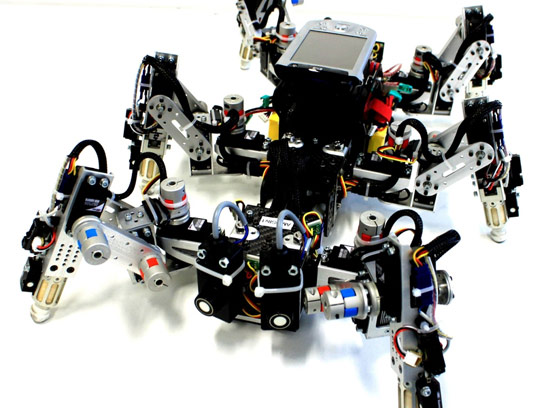
When the ground beneath Amos starts to rise, the insectoid robot can skilfully adapt to the changing conditions. After only a moment’s hesitation, he autonomously switches gait and selects a different movement pattern for his six legs, suitable for climbing the slope. To do this, Amos’ “brain”, a comparatively tiny network with few circuits, has to work at full tilt. Can this “thought process” be accelerated? Scientists in Göttingen think so. Their calculations show how Amos’ reaction times can be significantly reduced.
The autonomous six-legged robot was developed three years ago and subsequently optimized by a team led by theoretical physicist Marc Timme, who, together with his Research Group, works at the Max Planck Institute for Dynamics and Self-Organization and headed the new study along with robotics expert Poramate Manoonpong from the University of Göttingen. However, the new method is not just suitable for robots such as Amos; basically, it can be applied to any chaotic system where a certain degree of control is required. “Every chaotic system is very susceptible to interference”, Marc Timme explains. Even the smallest external change may trigger a completely different behavior. In Amos’ case, chaos means that his “brain” would produce a chaotic activity pattern with signals flying in all directions.
Given the occasional nudge, a chaotic system will stabilize itself
In order to organize this chaotic pattern, the system requires help. Scientists speak of “chaos control”. The most common methods used begin by trying to calculate the behavior of the system in the near future. The second step is to transform this information into a control signal which is used to correct the development of the system – a gentle nudge to bring it back on track.
However, the Göttingen-based research team has demonstrated that less intervention can be more effective. “The trick is to limit the number of times we push the system towards the required stable state”, says Max Planck researcher Christian Bick. “By giving the system the freedom to develop on its own from time to time, we achieve the desired result faster.” Physicists call this a self-organized process.
“At first glance, this method may seem roundabout”, Bick admits. However, the self-stabilization of the system is actually very efficient and fast. Only occasional external interventions are required to make sure that the path chosen by the system does not deviate from the right track.
The new method can be a thousand times faster
Depending on the system, the new method may easily be 100 or 1000 times faster, and requires significantly fewer interventions. “What’s more, theoretically this would permit stabilization of very complex movement patterns for Amos”, Timme adds. Until now, the more complex the string of movements and thereby the respective activity patterns are, the harder the pattern to stabilize. “Our method implies that Amos can select new gaits which were not feasible before.”
So far, the new method is only a theoretical concept. However, the next step is to try it out on Amos behaving in the real world. Other applications are also plausible, for example, where chaos control is used to stabilize cardiac rhythms or to operate chaotic lasers.
Reference: “Stalling chaos control accelerates convergence” by Christian Bick, Christoph Kolodziejski and Marc Timme, 26 June 2013, New Journal of Physics.
DOI: 10.1088/1367-2630/15/6/063038
Never miss a breakthrough: Join the SciTechDaily newsletter.
Follow us on Google and Google News.