
Study questions popular COVID test, proposes new marker of disease severity.
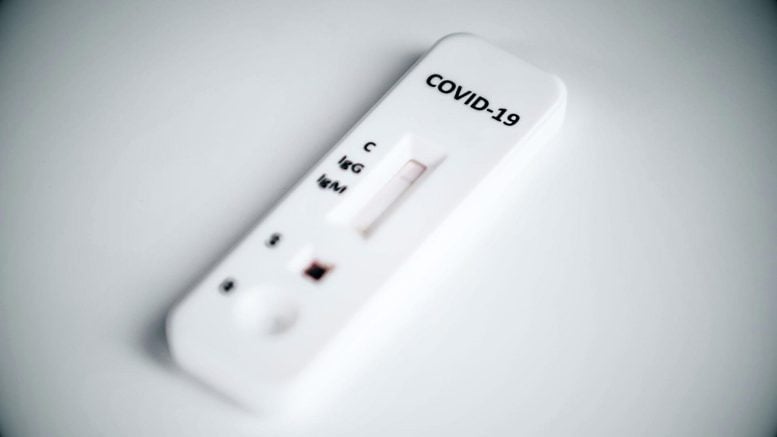
Researchers from Skoltech, U.S. companies VirIntel and Argentys Informatics, and two Russian Academy of Sciences institutes have studied the immune response to COVID-19 in patients with different levels of disease severity. The team found that half of the patients without symptoms did not actually produce significant amounts of IgG antibodies of a kind targeted by many popular test kits. That said, nearly all patients produced another kind of antibodies, whose count was sometimes even higher in asymptomatic cases, leading the researchers to suggest the ratio between the two counts as an indicator of disease severity. The study was published in the journal Viruses.
Blood tests for detecting prior infection with the coronavirus rely on antibodies called immunoglobulins G. IgGs usually develop a few weeks after infection and come in multiple varieties, depending on which part of the virus they attach to. Two common kinds are the antibodies targeting the nucleocapsid protein and the receptor-binding domain, or RBD, of the spike protein of the coronavirus. The recent Russian-U.S. study reports the levels of these two antibodies in patients at various times following recovery from COVID-19. It accounts for mild and asymptomatic cases, as well as serious ones.
“Our main finding is that asymptomatic COVID-19 patients often have no IgG antibodies to an internal component of the virus known as the nucleocapsid protein. Yet tests detecting that very kind of antibodies are often recommended to check whether someone has had COVID-19,” commented the study’s first author Maria Tutukina of Skoltech, the Institute of Cell Biophysics and the Institute for Information Transmission Problems of RAS.
“But regardless of disease severity, every patient we tested but one exhibited IgG antibodies to the RBD of the spike protein, which is located on the surface of the viral particle,” said study co-author Anna Kaznadzey of IITP RAS and VirIntel.
The researchers say it might therefore be more reasonable to check the level of antibodies to RBD to determine if a person has had the infection.
But why would it ever be the case that someone has IgGs to RBD but not to the nucleocapsid protein? This might have to do with whether the antibody in question targets the inside or the outside of the virus particle.
The team hypothesizes that if a patient is having an asymptomatic case of COVID-19, their immunity must have done such a great job warding off the infection early on that the virus did not really have a chance to enter the phase of active reproduction. That stage involves cells ripping apart, with unassembled viral spare parts flying every which way. It is only in this tougher scenario that antibodies to the internal parts of the virus — such as its nucleocapsid protein — can form. But as long as the virus does not penetrate into the cell, only antibodies to RBD are produced, since they are the ones targeting the virus’s exterior.
Anti-RBD antibodies are often described as “neutralizing” since they can prevent the binding of the viral spike protein with the receptor it seeks to attach to. Indeed, the researchers showed that the amount of anti-RBD IgG correlated with the serum capacity to inhibit the RBD-receptor interaction.
Intriguingly, the team found RBD levels not just to persist but to exhibit an average increase in the sample studied. According to the researchers, while this finding may seem to contradict some earlier studies that reported the concentration of antibodies to RBD falling with time, this might actually depend on what the patients in the respective samples have been up to following their recovery.
“It seems reasonable to expect that a patient who has recovered from COVID-19 will experience a surge of antibodies when re-exposed to the pathogen. I mean, that’s how immunity works: It is not some kind of a protective bubble you carry around. It is rather the potential to fight back against the virus effectively, should it find its way into the body again. Whether it does, and how often, might affect the subsequent dynamics of the antibody count,” Kaznadzey explained.
Based on the different dynamics of the two kinds of IgG antibodies, the team suggested that the ratio between their counts could serve as a marker of disease severity. “It might make sense in a situation where a patient believes they had no pneumonia and so does not do a CT scan. If the blood test indicates that their antibody balance is skewed in favor of the IgG to the nucleocapsid protein, it might be a good idea to arrange for a CT scan and possibly enter rehabilitation,” Tutukina said.
For those vaccinated, elevated anti-RBD levels can indicate that the patient has already encountered the virus after getting the shot and is therefore in no need of revaccination, because a more recent immune response has occurred.
The study addresses one of the gaps in the reports on the immune response of COVID-19 patients: With patients experiencing milder symptoms often not seeking medical attention, they inevitably become underrepresented in the research.
Reference: “IgG Antibodies Develop to Spike but Not to the Nucleocapsid Viral Protein in Many Asymptomatic and Light COVID-19 Cases” by Maria Tutukina, Anna Kaznadzey, Maria Kireeva and Ilya Mazo, 28 September 2021, Viruses.
DOI: 10.3390/v13101945
The paper reported in this story was co-authored by researchers from the Skolkovo Institute of Science and Technology, the Institute of Cell Biophysics and the Institute for Information Transmission Problems of the Russian Academy of Sciences, VirIntel LLC, and Argentys Informatics LLC.
Never miss a breakthrough: Join the SciTechDaily newsletter.
Follow us on Google and Google News.
1 Comment
Should be noted that the authors are the developers of this test. This does not appear to be clearly disclosed in this paper.