
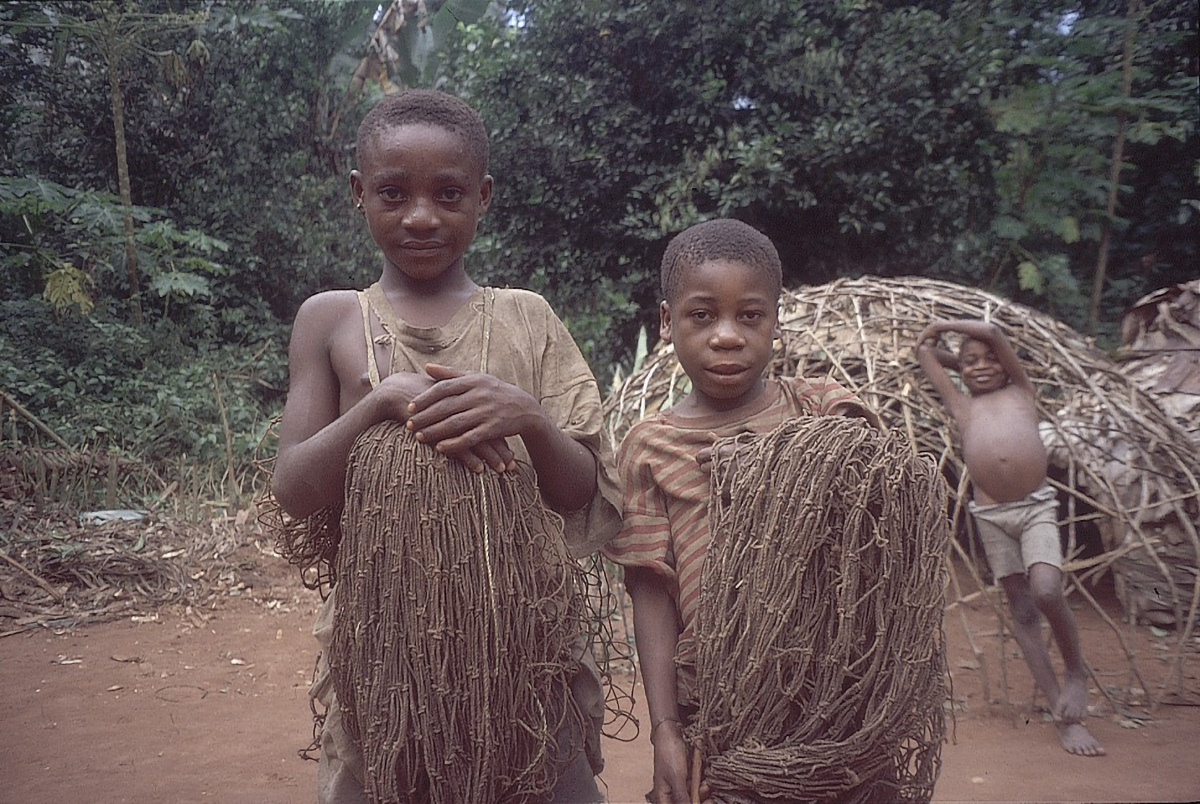
Hunter-gatherer children acquire life skills early through community-based learning, demonstrating how egalitarianism and diverse social interactions preserve cultural knowledge across generations.
Unlike children in the United States, hunter-gatherer kids in the Congo Basin often master skills like hunting, identifying edible plants, and caring for babies by the age of six or seven.
This rapid learning is facilitated by a unique social environment where cultural knowledge is passed down not just from parents but from the broader community, according to a new Washington State University-led study in the Proceedings of the National Academy of Sciences.
The research helps explain how many cultural traits have been preserved for thousands of years among hunter-gatherer groups across a wide range of natural environments in Africa.
“We focus on hunter-gatherers because this way of life characterized 99% of human history,” said Barry Hewlett, a professor of anthropology at WSU and lead author of the study. “Our bodies and minds are adapted to this intimate, small group living, rather than to contemporary urban life. By examining how children in these societies learn, we aim to uncover the mechanisms that have allowed humans to adapt to diverse environments across the globe.”

For the study, Hewlett and colleagues use observational and ethnographic data to examine nine different modes of cultural transmission, meaning from whom and how children learn, in hunter-gatherer societies.
Broader Learning Networks
Their analysis reveals that members related to a child’s extended family have likely played a greater role in transmitting knowledge to children than previously thought. Additionally, the study shows about half of the cultural knowledge hunter-gatherer children and adolescents acquire comes from people they are not related to. This contrasts with previous studies on the topic that have more heavily emphasized the transmission of knowledge from parent to child.
Hewlett explains that the findings are likely due in large part to how children in hunter-gatherer societies learn from a variety of sources, including parents, peers, and even unrelated adults in the community. This contrasts with the Western nuclear family model, where learning is often centered around parents or teachers in a formalized school setting.

The broad informal learning network in hunter-gatherer societies is made possible by intimate living conditions. Small camps, usually consisting of 25-35 individuals living in homes a few feet from each other, create an environment where children can observe and interact with a wide range of people. This allows them to learn essential skills, including caring for infants and cooking as well as hunting and gathering, through a process that is often subtle and nonverbal.
The study also highlights the importance of egalitarianism, respect for individual autonomy, and extensive sharing in shaping how cultural knowledge is passed down among hunter-gatherers. For example, children learn the importance of equality and autonomy by observing the behavior of adults and children around them. They are not coerced into learning but are given the freedom to explore and practice skills on their own, fostering a deep understanding of their culture.
Cumulative Culture and Human Innovation
“This approach to learning contributes to what we call ‘cumulative culture’—the ability to build on existing knowledge and pass it down through generations,” Hewlett said. “Unlike in many non-human animals, where social learning is limited to a few skills, humans have developed complex mental and social structures that allow for the transmission of thousands of cultural traits. This has enabled us to innovate and adapt to various environments, from dense forests to arid deserts.”
Moving forward, Hewlett hopes that this research offers a more nuanced understanding of the nature of social learning in humans and how cultures in general are conserved and change over time.
Reference: “Cultural transmission among hunter-gatherers” by Barry S. Hewlett, Adam H. Boyette, Sheina Lew-Levy, Sandrine Gallois and Samuel Jilo Dira, 18 November 2024, Proceedings of the National Academy of Sciences.
DOI: 10.1073/pnas.2322883121
His coauthors on the study are Adam Boyette, Max Planck Institute for Evolutionary Anthropology, Sheina Lew-Levy, Durham University Department of Anthropology, Sandrine Gallois, Autonomous University of Barcelona Institute of Environmental Science and Technology, and Samuel Dira, Hawassa University Department of Anthropology.
Never miss a breakthrough: Join the SciTechDaily newsletter.
Follow us on Google and Google News.