
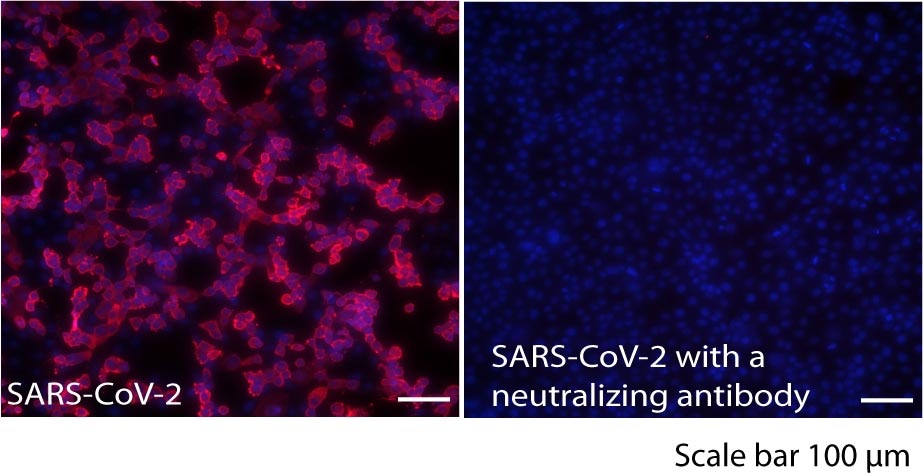
The majority of the population can produce neutralizing antibodies against severe acute respiratory syndrome coronavirus 2 (SARS-CoV-2) in severe cases of coronavirus disease 2019 (COVID-19), according to a study published today (February 11, 2021) in the open-access journal PLOS Pathogens by Michael Mor of Tel Aviv University, and colleagues. Moreover, the results support the use of combination antibody therapy to prevent and treat COVID-19.
The COVID-19 pandemic, caused by SARS-CoV-2, has had a profound impact on global public health. Neutralizing antibodies that specifically target the receptor-binding domain (RBD) of the SARS-CoV-2 spike protein are thought to be essential for controlling the virus. RBD-specific neutralizing antibodies have been detected in convalescent patients – those who have recovered from COVID-19. Some of the recoverees tend to have robust and long-lasting immunity, while others display a waning of their neutralizing antibodies. The factors associated with an effective, durable antibody response are still unclear.
To address this gap in knowledge, Mor and colleagues used molecular and bioinformatics techniques to compare B-cell responses in eight patients with severe COVID-19 and 10 individuals with mild symptoms, 1.5 months after infection. Very ill patients showed higher concentrations of RBD-specific antibodies and increased B-cell expansion. Among 22 antibodies cloned from two of these patients, six exhibited potent neutralization against SARS-CoV-2.
Bioinformatics analysis suggests that most people would be capable of readily producing neutralizing antibodies against SARS-CoV-2 in severe cases of COVID-19. Moreover, combinations of different types of neutralizing antibodies completely blocked the live virus from spreading. According to the authors, these antibody cocktails can be further tested in clinical settings as a useful means to prevent and treat COVID-19.
“Even with a vaccine at our doorstep, arming clinicians with specific anti-SARS-CoV-2 therapeutics is extremely important,” the authors add. “Combinations of neutralizing antibodies represent a promising approach towards effective and safe treatment of severe COVID-19 cases, especially in the elderly population or chronically ill people, who will not be able to so easily produce these antibodies upon infection or vaccination.”
Reference: “Multi-clonal SARS-CoV-2 neutralization by antibodies isolated from severe COVID-19 convalescent donors” by Michael Mor, Michal Werbner, Joel Alter, Modi Safra, Elad Chomsky, Jamie C. Lee, Smadar Hada-Neeman, Ksenia Polonsky, Cameron J. Nowell, Alex E. Clark, Anna Roitburd-Berman, Noam Ben-Shalom, Michal Navon, Dor Rafael, Hila Sharim, Evgeny Kiner, Eric R. Griffis, Jonathan M. Gershoni, Oren Kobiler, Sandra Lawrynowicz Leibel, Oren Zimhony, Aaron F. Carlin, Gur Yaari, Moshe Dessau, Meital Gal-Tanamy, David Hagin, Ben A. Croker and Natalia T. Freund, 11 February 2021, PLOS Pathogens.
DOI: 10.
Funding: This research was funded by the Israeli Science Foundation grant 3711/20 (N. T. F.) and by the Tel Aviv University Vice President of Research and Development. N.T.F is also funded by the ISF grant number 41222/18, and Israeli Innovation Authority grant number 68972. This work was also supported by NIH Grant RO1 HL124209 (B.C.), the American Asthma Foundation (B.C.), and the BSF 2017176 (B.C.), and a Career Award for Medical Scientists from the Burroughs Welcome Fund (A.F.C.). The funders had no role in study design, data collection and analysis, decision to publish, or preparation of the manuscript.
Never miss a breakthrough: Join the SciTechDaily newsletter.
Follow us on Google and Google News.