
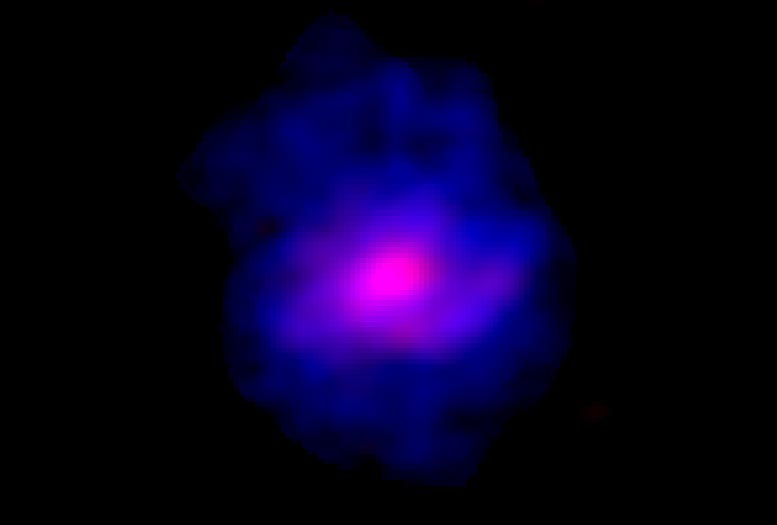
Scientists from Cardiff University peer 12 billion years into the past to reveal distant galaxy with an unexpected appearance.
Scientists have challenged our current understanding of how galaxies form by unveiling pictures of a young galaxy in the early life of the Universe which appears surprisingly mature.
The galaxy, dubbed ALESS 073.1, appears to have all of the features expected of a much more mature galaxy and has led the team of scientists to question how it grew so fast.
The new research will be published tomorrow (February 12, 2021) in Science.
Galaxies come in a variety of shapes, sizes, and colors, and are made up of different components such as rotating disks, spiral arms, and “bulges.”
A major goal of present-day astronomy is understanding why different galaxies look the way they are today and when their different components formed.
The team, led by scientists at Cardiff University, used the Atacama Large Millimeter/submillimeter Array (ALMA) telescope as a ‘time machine’ to peer into the remote past, revealing how ALESS 073.1 looked just 1.2 billion years after the Big Bang.
Because the light emitted from the galaxy took billions of years to reach our telescopes on Earth, the team were able to explore how the galaxy looked during its infancy and determine how it was initially formed.
Unexpected Features Found in a Young Galaxy
The result was one of the sharpest, direct images of a primordial galaxy ever produced which allowed the team to undertake a detailed study of its internal structure.
“We discovered that a massive bulge, a regular rotating disk, and possibly spiral arms were already in place in this galaxy when the Universe was just 10% of its current age,” said lead author of the study Dr. Federico Lelli, who undertook the work at Cardiff University’s School of Physics and Astronomy.
“In other words, this galaxy looks like a grown adult, but it should be just a little child.”
A Challenge to Galaxy Formation Theories
Co-author of the study Dr. Timothy Davis, from the School of Physics and Astronomy, said: “This spectacular discovery challenges our current understanding of how galaxies form because we believed these features only arose in “mature” galaxies, not in young ones.”
One key feature of a galaxy is the presence of a so-called bulge — a tightly packed group of stars usually situated within the center of the galaxy.
It was believed that massive bulges formed slowly by the merger of smaller galaxies or by specific processes that occurred within the galaxy itself; however, the kinematic properties of ALESS 073.1 have revealed that the formation of massive bulges can occur extremely fast — around half of the stars in the galaxy were shown to be in a bulge.
Similarly, some mature galaxies, like our own Milky Way, have been known to have spiral arms extending from their central parts, giving them a distinctive spiral shape.
Similar features were also unexpectedly spotted in ALESS 073.1, much to the team’s amazement, as early galaxies are generally thought to be chaotic and turbulent rather than having regular, well-organized structures like spiral arms.
“A galaxy like ALESS 073.1 just defies our understanding of galaxy formation,” concluded Dr. Lelli.
Reference: “A massive stellar bulge in a regularly rotating galaxy 1.2 billion years after the Big Bang” by Federico Lelli, Enrico M. Di Teodoro, Filippo Fraternali, Allison W. S. Man, Zhi-Yu Zhang, Carlos De Breuck, Timothy A. Davis and Roberto Maiolino, 12 February 2021, Science.
DOI: 10.1126/science.abc1893
Never miss a breakthrough: Join the SciTechDaily newsletter.
Follow us on Google and Google News.
4 Comments
So it must be the galaxy that’s wrong… can’t possibly be the Big Bang model!
If you can’t explain how the galaxy, which “defies our understanding of galaxy formation” somehow problematizes an accepted model for *universe” formation – which the paper is published under; “a regularly rotating galaxy 1.2 billion years after the Big Bang” – well, no, it can’t possibly be that.
On one hand it will be harder to explain the growth, black hole growth and the well defined structure – though a supermassive black hole can help with the latter – but on the other hand it will be easier to explain the general maturity of the universe which is also seen in early reinozation as galaxies started to light up.
The gripping hand is of course that cosmologists will have a “distant field” day! The earlier mature galaxies, assuming it isn’t a one off (but it seems like an early discovery suggesting these may be common), the earlier we can look back. From the paper:
“Although we observe only a single object, we conclude that the Universe produced regularly rotating galaxy disks with prominent bulges at <10% of its current age. This implies that the formation of massive galaxies and their central bulges must be a fast and efficient process."
The only concluusion that can be drawn from this finding (if it is indeed accurate) is that the Big Bang model is fundamentally flawed. Observation beats hypothesis. Big Bang is dead.