
Close Menu
    Facebook X (Twitter) Instagram
    SciTechDaily
    • Biology
    • Chemistry
    • Earth
    • Health
    • Physics
    • Science
    • Space
    • Technology
    Facebook X (Twitter) Pinterest YouTube RSS
    SciTechDaily
    Home»Technology»New Research on Optomechanical Technology That Can Enhance Gravitational-Wave Detectors
    Technology

    New Research on Optomechanical Technology That Can Enhance Gravitational-Wave Detectors

    By OzGravJune 26, 2020No Comments2 Mins Read
    Facebook Twitter Pinterest Telegram LinkedIn WhatsApp Email Reddit
    Share
    Facebook Twitter LinkedIn Pinterest Telegram Email Reddit
    Gravitational Waves
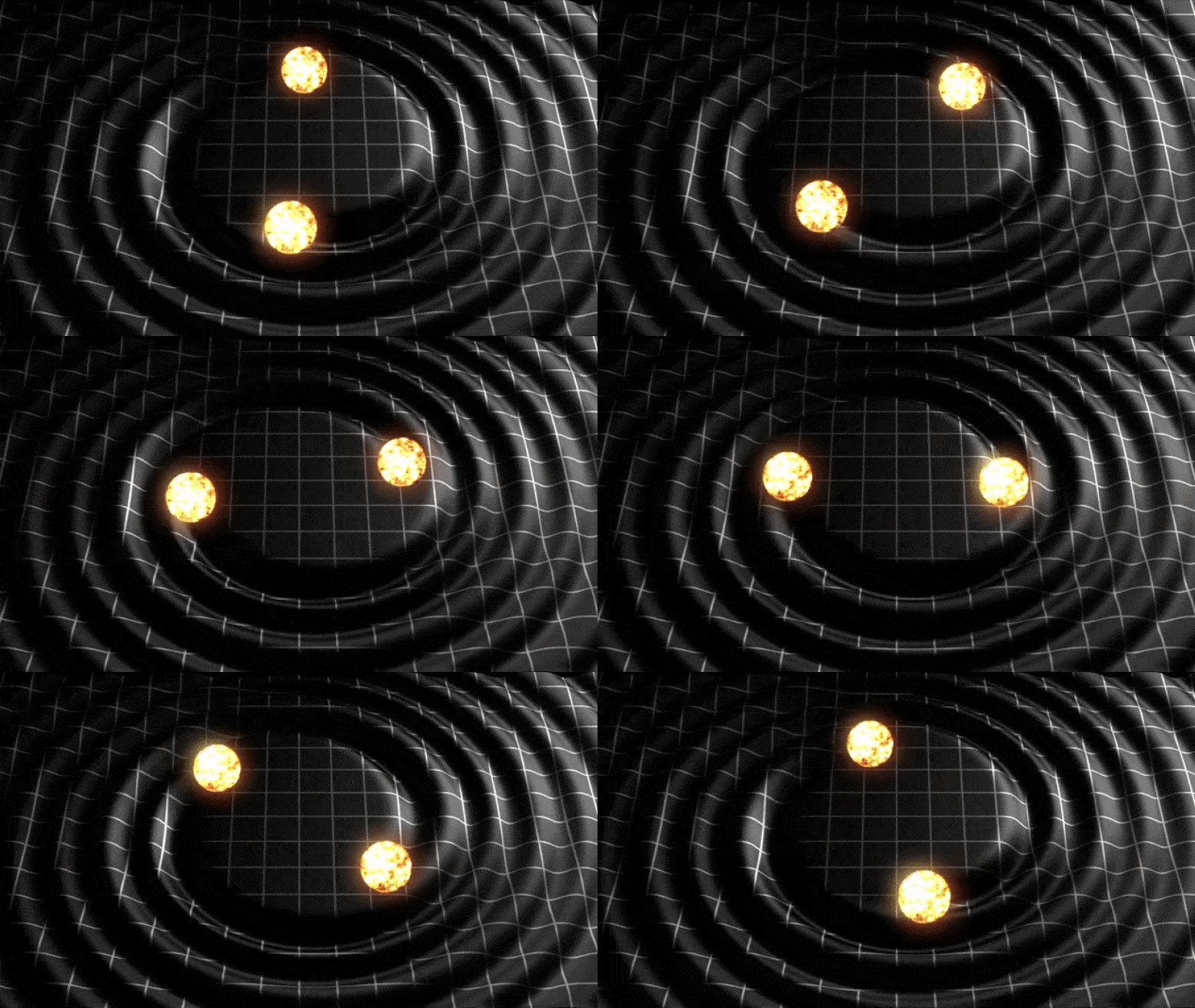
    Illustration of gravitational waves.

    Gravitational wave detectors are extremely complex instruments of precision measurement. They use interference as the physical mechanism to measure passing gravitational waves (GWs)—ripples in space-time—from different astronomical sources and events, like two neutron stars merging. The passing wave signal gets encoded into a wave of light and is read-out after exiting the interferometer. The issue is that the signal is so weak that any movement from the optical components will degrade the signal strength. For example, the random motion of particles that make up the material is called ‘thermal noise’.

    In the design of GW detectors, ‘optomechanical’ cavities are used to enhance the signal from GW detectors. These cavities, or ‘resonators’, typically have two, moving-end mirrors which trap and amplify light. There is one problem however: the mirrors can move too much due to thermal noise! If we can minimize the thermal noise of these resonators, it will improve the GW sensitivity.
    Optomechanical Technology Gravitational Wave Detectors
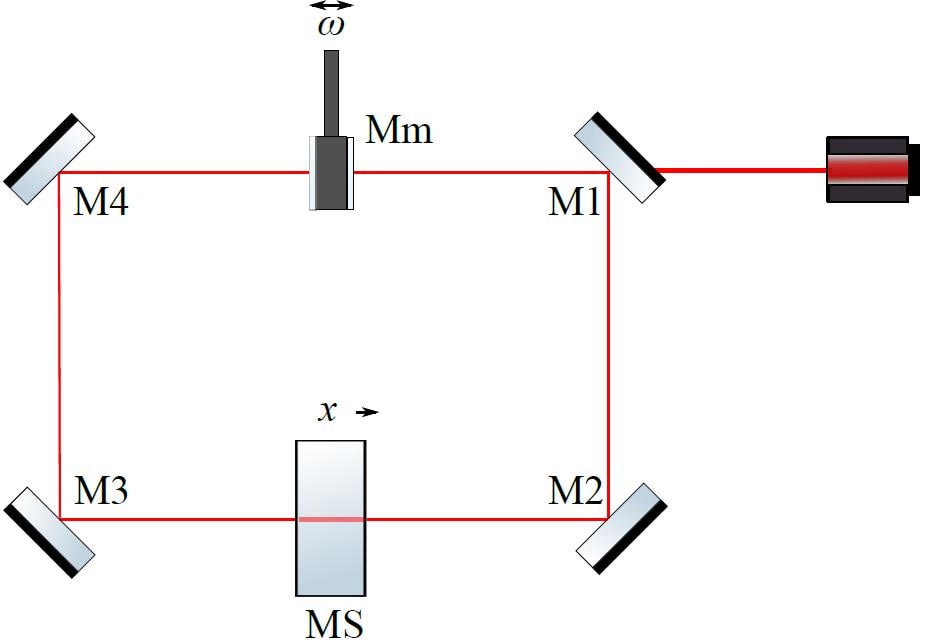
    Figure 1. Credit: OzGrav

    The Double-End-Mirror-Sloshing (DEMS) cavity—shown in Figure 1—is a special type of optomechanical cavity which consists of four mirrors, a transmitting sloshing mirror, and a resonator which reflects light from both sides (double-end-mirror). Using the DEMS cavity, the resonator exhibits very low levels of thermal noise through a process called ‘optical dilution’, which works by trapping the resonator in a potential well using radiation pressure. This keeps the resonator tightly bound, so it’s not easily disturbed from the random thermal fluctuations.

    In a study led by the OzGrav, researchers explain that, although the optical spring is not unique to the DEMS cavity, the troublesome impact of radiation pressure noise and anti-damping effects are circumvented in the DEMS cavity, but are unavoidable in a two-mirror cavity.
    Optomechanical Technology Results
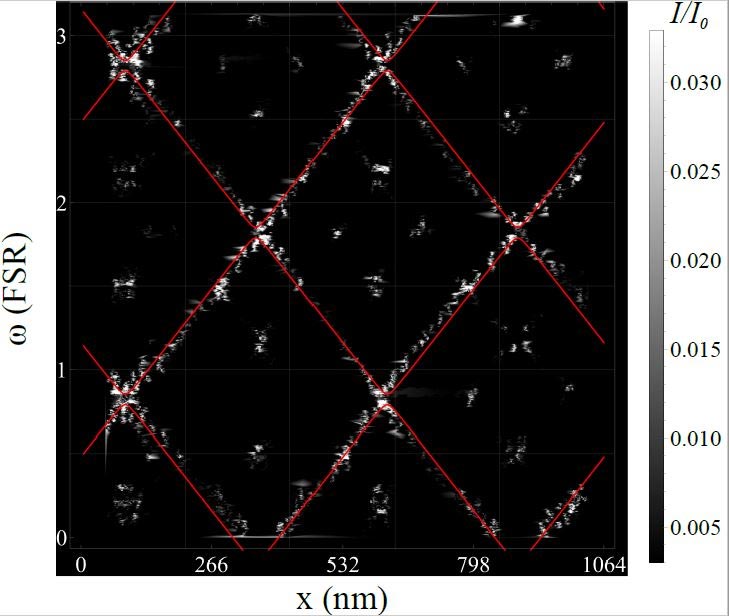
    Figure 2. Credit: OzGrav

    First author and OzGrav research assistant Parris Trahanas explains: ‘The key mechanism that allows the DEMS cavity these qualities is the transmissive sloshing mirror component—it turns the DEMS cavity into a coupled optical resonator, which is the optical equivalent of connecting two spring mass systems together with a third spring.’

    The results in Figure 2 show the avoided crossing of the optical resonances which is characteristic of a coupled oscillator—this will be an extremely useful tool for GW detectors, but could be more broadly applied to any field requiring low thermal noise in mechanical resonators.

    Never miss a breakthrough: Join the SciTechDaily newsletter.
    Follow us on Google and Google News.

    Gravitational Waves Optics OzGrav Popular
    Share. Facebook Twitter Pinterest LinkedIn Email Reddit

    Related Articles

    Russian Scientists Break Google’s Quantum Algorithm

    New Flat Lens Enables Focus-Free Cameras With Drastically Reduced Weight, Complexity & Cost

    New Camera Combines Lasers and Terahertz Waves to Reveal ‘Unseen’ Detail and ‘See Inside’ Objects

    “Perfect” Solar Energy Absorber Created by Laser Etching Metal With Nanoscale Structures

    New Flexible Transparent Solar Cells Could Be Used in Buildings, Vehicles and Portable Electronics

    Blanket of Entangled Light Pulses for Larger and More Powerful Quantum Computers

    Prototype Large-Scale Quantum Processor Made Entirely of Light

    New Tunable Optical Chips Can Be Used As Building-Blocks for Next Generation Quantum Computers

    Engineers Develop a Telescopic Contact Lens

    Leave A Reply Cancel Reply

    • Facebook
    • Twitter
    • Pinterest
    • YouTube

    Don't Miss a Discovery

    Subscribe for the Latest in Science & Tech!

    Trending News

    Largest-Ever Study Finds Medicinal Cannabis Ineffective for Anxiety, Depression, PTSD

    250-Million-Year-Old Egg Solves One of Evolution’s Biggest Mysteries

    Living With Roommates Might Be Changing Your Gut Microbiome Without You Knowing

    Century-Old Cleaning Chemical Linked to 500% Increased Risk of Parkinson’s Disease

    What if Your Memories Never Happened? Physicists Take a New Look at the Boltzmann Brain Paradox

    One of the Universe’s Largest Stars May Be Getting Ready To Explode

    Scientists Discover Enzyme That Could Supercharge Ozempic-Like Weight Loss Drugs

    Popular Sweetener Linked to DNA Damage – “It’s Something You Should Not Be Eating”

    Follow SciTechDaily
    • Facebook
    • Twitter
    • YouTube
    • Pinterest
    • Newsletter
    • RSS
    SciTech News
    • Biology News
    • Chemistry News
    • Earth News
    • Health News
    • Physics News
    • Science News
    • Space News
    • Technology News
    Recent Posts
    • Scientists Say This Overlooked Organ Could Hold the Key to Longer Life
    • Want Less Stress? Landmark Study Points to a Simple Habit
    • Scientists Reveal Eating Fruits and Vegetables May Increase Your Risk of Lung Cancer
    • AI Reveals Explosive Growth of Floating Algae Across the World’s Oceans
    • 5.5 Million Bees Discovered Living Beneath a New York Cemetery
    Copyright © 1998 - 2026 SciTechDaily. All Rights Reserved.
    • Science News
    • About
    • Contact
    • Editorial Board
    • Privacy Policy
    • Terms of Use

    Type above and press Enter to search. Press Esc to cancel.