

A recent review article examines the effects of plant-based meat alternatives (PBMAs) on cardiovascular disease risk factors, including cholesterol levels and blood pressure.
Although there is considerable variation in the composition and nutritional profiles of plant-based meat alternatives (PBMAs), they generally align with a heart-healthy diet. A review article in the Canadian Journal of Cardiology, which examines studies comparing plant-based and animal-based meats, consistently indicates that plant-based options can enhance cardiovascular risk factors.
PBMAs are highly processed plant-based food products that typically replace meat in the diet. In Canada, the growing demand for PBMAs coincides with public health recommendations to reduce ultra-processed food consumption, which prompts the need to investigate the long-term health implications of PBMAs.
Research on PBMA Impact
Lead author Matthew Nagra, ND, Vancouver, BC, Canada, says, “While the plant-based meat market has experienced significant growth in recent years and more and more Canadians are enjoying plant-based burgers, surprisingly little is known about how these meat alternatives may impact health and in particular cardiovascular disease risk. Thus, we sought to review the available literature on the topic to identify what is currently known and to provide direction for future research.”
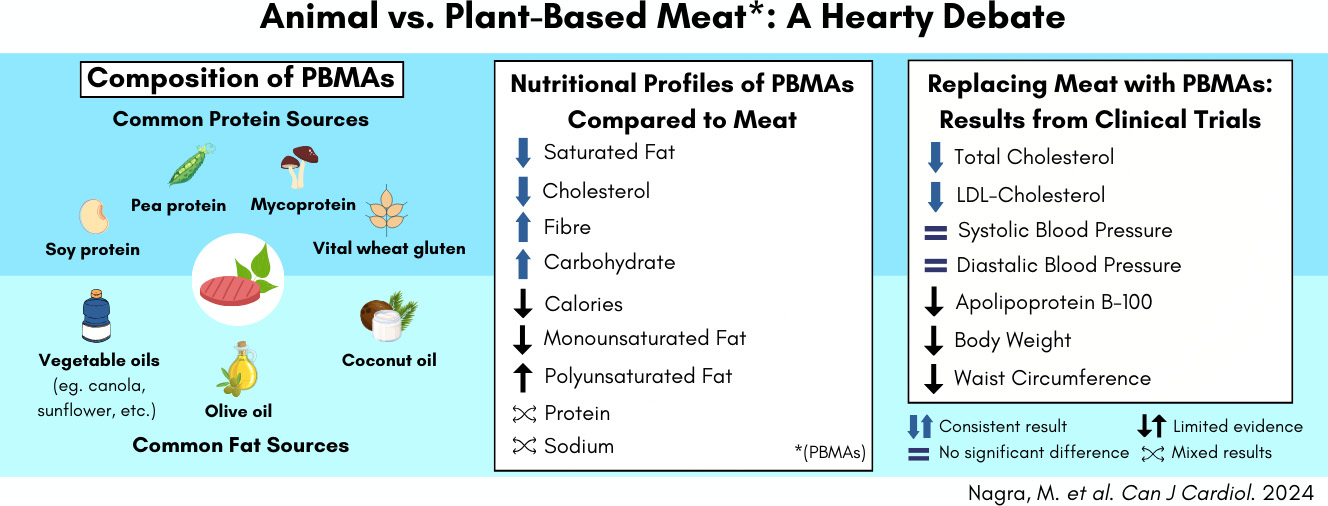
The authors of the article reviewed the research published from 1970 to 2023 on PBMAs, their contents, nutritional profiles, and their impact on cardiovascular disease risk factors, such as cholesterol levels and blood pressure. Their analysis shows:
- There is substantial variability in the contents and nutritional profiles of PBMAs.
- On average, PBMAs tend to have a more heart-healthy nutritional profile than meat, although the high sodium content of some products may be of concern.
- PBMAs have been shown to improve some cardiovascular risk factors, including cholesterol levels, in several randomized controlled trials.
- PBMAs have not been shown to raise blood pressure, despite the high sodium content of some products.
- There is currently a lack of long-term research evaluating how these alternatives may affect the risk of developing a heart attack or stroke.
- There is currently little research on the healthfulness of some common components of PBMAs, such as vital wheat gluten (seitan).
Gaps in Research
The authors of the review article were surprised to find that there is a near complete lack of research on vital wheat gluten, which is the primary protein source incorporated into many popular PBMAs, and cardiovascular risk factors.
Dr. Nagra continues, “Further, the lack of research on cardiovascular outcomes as of 2023 is shocking, given that there are randomized controlled trials evaluating risk factors dating back to 1990. More detailed research is needed in light of the increasing consumption of PBMAs and our lack of knowledge of how these products impact risk.”
In an accompanying editorial, J. David Spence, CM, MD, FRCPC, FAHA, Professor Emeritus of Neurology & Clinical Pharmacology, Western University, and Director, Stroke Prevention & Atherosclerosis Research Centre, Robarts Research Institute, London, ON, Canada, notes, “In an excellent review of PBMAs, Nagra et al. focus on reduction of cardiovascular risk factors, and the effects of various individual dietary factors on cardiovascular risk.”
However, Professor Spence points out that, “What really matters is not the effect of individual components of a diet, nor the effect of diet on cardiovascular risk factors; it is the effect of diet on the actual risk of cardiovascular events such as myocardial infarction and stroke. Most physicians markedly underestimate the cardiovascular benefit of diet and place far too little emphasis on diet in the management of patients at high risk of cardiovascular events.”
Senior author of the review article Ehud Ur, MB, FRCPC, Professor, Division of Endocrinology & Metabolism, University of British Columbia, Vancouver, BC, Canada, concludes, “For those looking to reduce their meat intake, especially if it’s red meat, replacing that with PBMAs is likely a heart-healthy choice. For those who already limit their meat intake, PBMAs can be incorporated into a healthy dietary pattern as an excellent protein source; however, it may be beneficial to choose options that are lower in saturated fat and sodium if consuming them regularly.”
Finally, Dr. Spence adds a note of caution regarding the dietary implications of egg consumption, saying, “Persons at risk of cardiovascular disease should limit meat intake and avoid egg yolk, so plant-based meat substitutes and egg substitutes are helpful to patients wishing to reduce their cardiovascular risk. Their effect on reducing actual cardiovascular risk is undoubtedly much greater than their effect on cardiovascular risk factors.”
References:
“Animal vs Plant-Based Meat: A Hearty Debate” by Matthew Nagra, Felicia Tsam, Shaun Ward and Ehud Ur, 26 June 2024, Canadian Journal of Cardiology.
DOI: 10.1016/j.cjca.2023.11.005
“Reducing Cardiovascular Risk: The Potential of Plant-Based Meat Alternatives and Egg Substitutes” by J. David Spence, 26 June 2024, Canadian Journal of Cardiology.
DOI: 10.1016/j.cjca.2023.12.026
Never miss a breakthrough: Join the SciTechDaily newsletter.
Follow us on Google and Google News.
8 Comments
Nonsense…
This is COMPLETELY at odds with your own article here:
https://scitechdaily.com/the-unexpected-villain-in-plant-based-diets/
SciTechDaily probably just churns them out as they go, without anything like oversight.
Let me guess who financed that research… it couldn’t be plant-based-meat manufacturers, could it?
I mean, science is by now just a tool of marketing. Everyone with cash can pay someone with a PhD to do a research, and cash-hungry universities are ever happy to put out.
Bought and paid for “research”
I say FO you SoB’s.
Ansel Keys was no John Gofman, who had the original diet-heart lipid hypothesis. Gorman factored in carbs. 60 years later we have actuarial tables on mortality. High LDL is meaningless. It’s the ratio of LDL to total cholesterol. Likewise saturated fat is not proven bad like unsaturated fat, and carbs are the real problem leading to insulin resistance and 2-4 times greater odds of heart disease. You only use 1960s orthodoxy over 2020 research to give bad advic here’s some good advice. Meat has several million years of evolutionary adaptation and highly processed food is bad for you.
“Meat has several million years of evolutionary adaptation and highly processed food is bad for you.”
Exactly!