
Close Menu
    Facebook X (Twitter) Instagram
    SciTechDaily
    • Biology
    • Chemistry
    • Earth
    • Health
    • Physics
    • Science
    • Space
    • Technology
    Facebook X (Twitter) Pinterest YouTube RSS
    SciTechDaily
    Home»Biology»New Research Uncovers Why Bats Excel As Viral Reservoirs Without Getting Sick
    Biology

    New Research Uncovers Why Bats Excel As Viral Reservoirs Without Getting Sick

    By Duke-NUS Medical SchoolOctober 27, 2020No Comments3 Mins Read
    Facebook Twitter Pinterest Telegram LinkedIn WhatsApp Email Reddit
    Share
    Facebook Twitter LinkedIn Pinterest Telegram Email Reddit
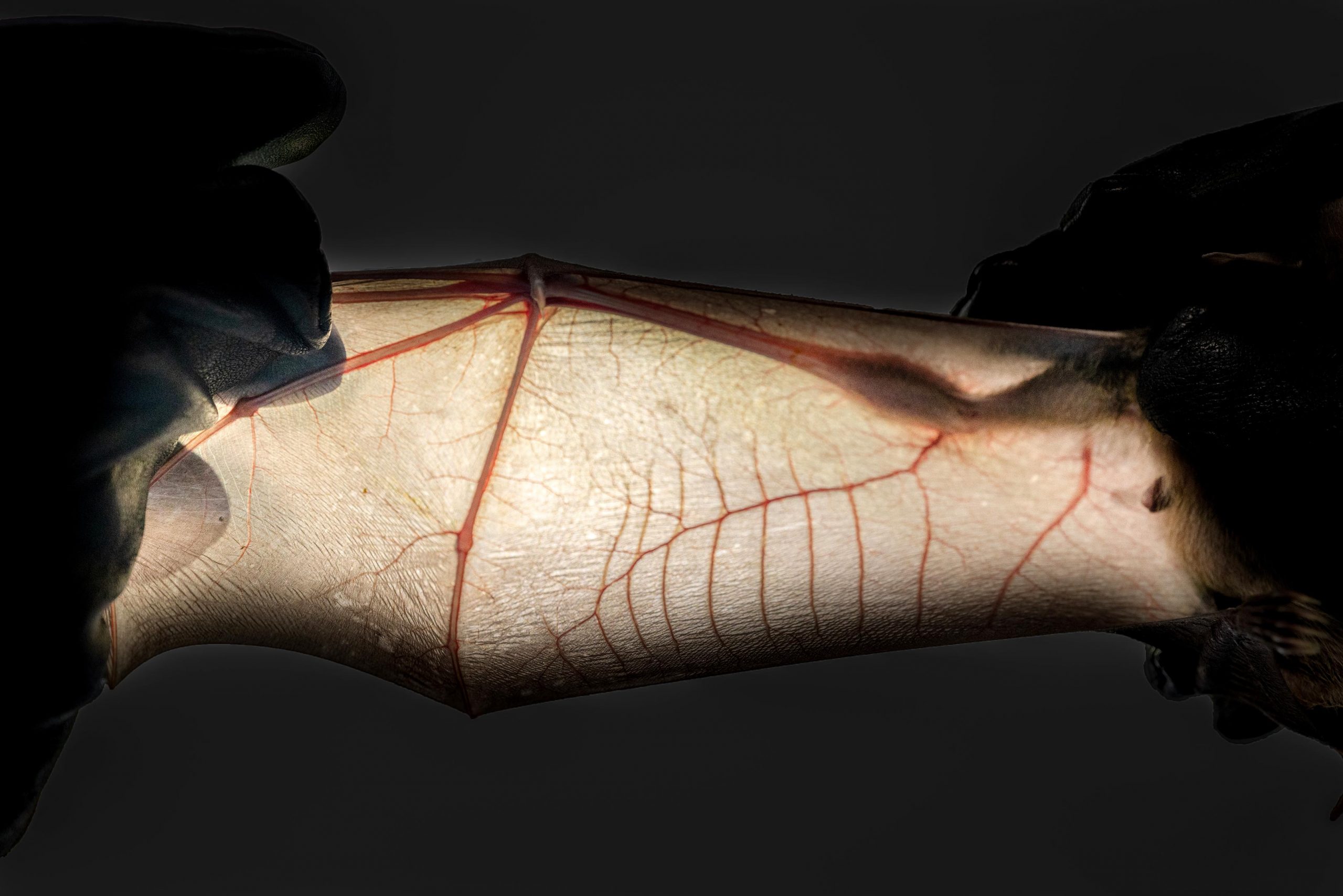
    Bat Wing
    Right wing of a cave nectar bat (Eonycteris spelaea) extended to show the forearm, plagiopatagium, and supplying vasculature. Credit: Zhu Feng, Duke-NUS Medical School

    Study confirms bats adopt multiple strategies to reduce pro-inflammatory responses, thus mitigating potential immune-mediated tissue damage and disease. Findings provide important insights for medical research on human diseases.

    Bats act as reservoirs of numerous zoonotic viruses, including SARS-CoV, MERS CoV, Ebola virus, and—most likely—SARS-CoV-2, the pathogen behind the ongoing coronavirus pandemic. However, the molecular mechanisms bats deploy to tolerate pathogenic viruses has remained unclear.

    Now scientists from Duke-NUS Medical School, Singapore, have discovered novel molecular mechanisms that allow bats to tolerate zoonotic viruses without getting sick. Published this week in the Proceedings of the National Academy of Sciences (PNAS), the study suggests that bats adopt unique strategies to prevent overactive immune responses, which protects them against diseases caused by zoonotic viruses.

    The team examined three bat species—Pteropus alecto (black fruit bat), Eonycteris spelaea (cave nectar bat), and Myotis davidii (David’s myotis bat)—and identified mechanisms that balance the activity of key proteins that play a major role in mediating immunity and inflammatory responses in mammals. These mechanisms enable bats to harbour and transmit zoonotic pathogens without setting off the detrimental consequences of immune activation.

    One of the mechanisms bats use is to reduce the levels of caspase-1, a protein that triggers a key inflammatory cytokine protein, interleukin-1 beta (IL-1β). Another mechanism they employ hampers the maturation of interleukin-1 beta cytokines through a finely-tuned balancing between caspase-1 and IL-1β.

    “Suppression of overactive inflammatory responses improves longevity and prevents age-related decline in humans. Our findings may offer potential insights to the development of new therapeutic strategies that can control and treat human infectious diseases,” said Professor Wang Linfa, senior and corresponding author of the study from Duke-NUS’ Emerging Infectious Diseases (EID) Programme.

    “This study exemplifies the world-class research led by our talented faculty to advance fundamental scientific knowledge. Professor Wang’s research is all the more important in the context of COVID-19, by contributing to a greater understanding of how zoonotic diseases persist in nature, and potentially aiding new approaches to managing future outbreaks,” said Professor Patrick Casey, Senior Vice-Dean for Research, Duke-NUS Medical School.

    Reference: “Complementary regulation of caspase-1 and IL-1β reveals additional mechanisms of dampened inflammation in bats” by Geraldine Goh, Matae Ahn, Feng Zhu, Lim Beng Lee, Dahai Luo, Aaron T. Irving, and Lin-Fa Wang, 26 October 2020, Proceedings of the National Academy of Sciences.
    DOI: 10.1073/pnas.2003352117

    Never miss a breakthrough: Join the SciTechDaily newsletter.
    Follow us on Google and Google News.

    Bats Cell Biology Duke-NUS Medical School Infectious Diseases Virology
    Share. Facebook Twitter Pinterest LinkedIn Email Reddit

    Related Articles

    New Research Finds SARS-CoV-2 (the Virus That Causes COVID-19) Jumped From Bats to Humans Without Much Change

    SARS vs. COVID-19: Why Some Coronavirus Strains Are More Infectious Than Others

    First Global Atlas of How the COVID Coronavirus Interacts With Human Cells

    New Insights Into Why COVID-19 Infects Some Animals, but Not Others

    Live Capture: Researchers Develop Virus Live Stream to Study Viral Infections

    SARS-CoV-2 Infection Revealed in “Mini-Lungs” Shows How COVID-19 Damages the Lungs

    Vampire Bats Social Distance When They Get Sick, Slowing Disease Spread

    Advanced Cryo-EM Reveals Viral RNA Replication Complex Structure in “Game-Changing” Detail

    Bats Offer Clues to Treating COVID-19 – Secrets to Longevity and Disease Tolerance

    Leave A Reply Cancel Reply

    • Facebook
    • Twitter
    • Pinterest
    • YouTube

    Don't Miss a Discovery

    Subscribe for the Latest in Science & Tech!

    Trending News

    Breakthrough Bowel Cancer Trial Leaves Patients Cancer-Free for Nearly 3 Years

    Natural Compound Shows Powerful Potential Against Rheumatoid Arthritis

    100,000-Year-Old Neanderthal Fossils in Poland Reveal Unexpected Genetic Connections

    Simple “Gut Reset” May Prevent Weight Gain After Ozempic or Wegovy

    2.8 Days to Disaster: Scientists Warn Low Earth Orbit Could Suddenly Collapse

    Common Food Compound Shows Surprising Power Against Superbugs

    5 Simple Ways To Remember More and Forget Less

    The Atomic Gap That Could Cost the Semiconductor Industry Billions

    Follow SciTechDaily
    • Facebook
    • Twitter
    • YouTube
    • Pinterest
    • Newsletter
    • RSS
    SciTech News
    • Biology News
    • Chemistry News
    • Earth News
    • Health News
    • Physics News
    • Science News
    • Space News
    • Technology News
    Recent Posts
    • Bowel and Ovarian Cancers Are Dramatically Rising in Young Adults and Scientists Aren’t Sure Why
    • Alzheimer’s May Begin Decades Earlier Than You Think, New Mayo Clinic Study Finds
    • The Hidden Risk of Taking Breaks From Weight-Loss Drugs Like Ozempic
    • Total Solar Eclipse Made Cities Go Eerily Quiet Beneath the Surface
    • This Common Plant Could Be an Unexpected New Source of Protein
    Copyright © 1998 - 2026 SciTechDaily. All Rights Reserved.
    • Science News
    • About
    • Contact
    • Editorial Board
    • Privacy Policy
    • Terms of Use

    Type above and press Enter to search. Press Esc to cancel.