
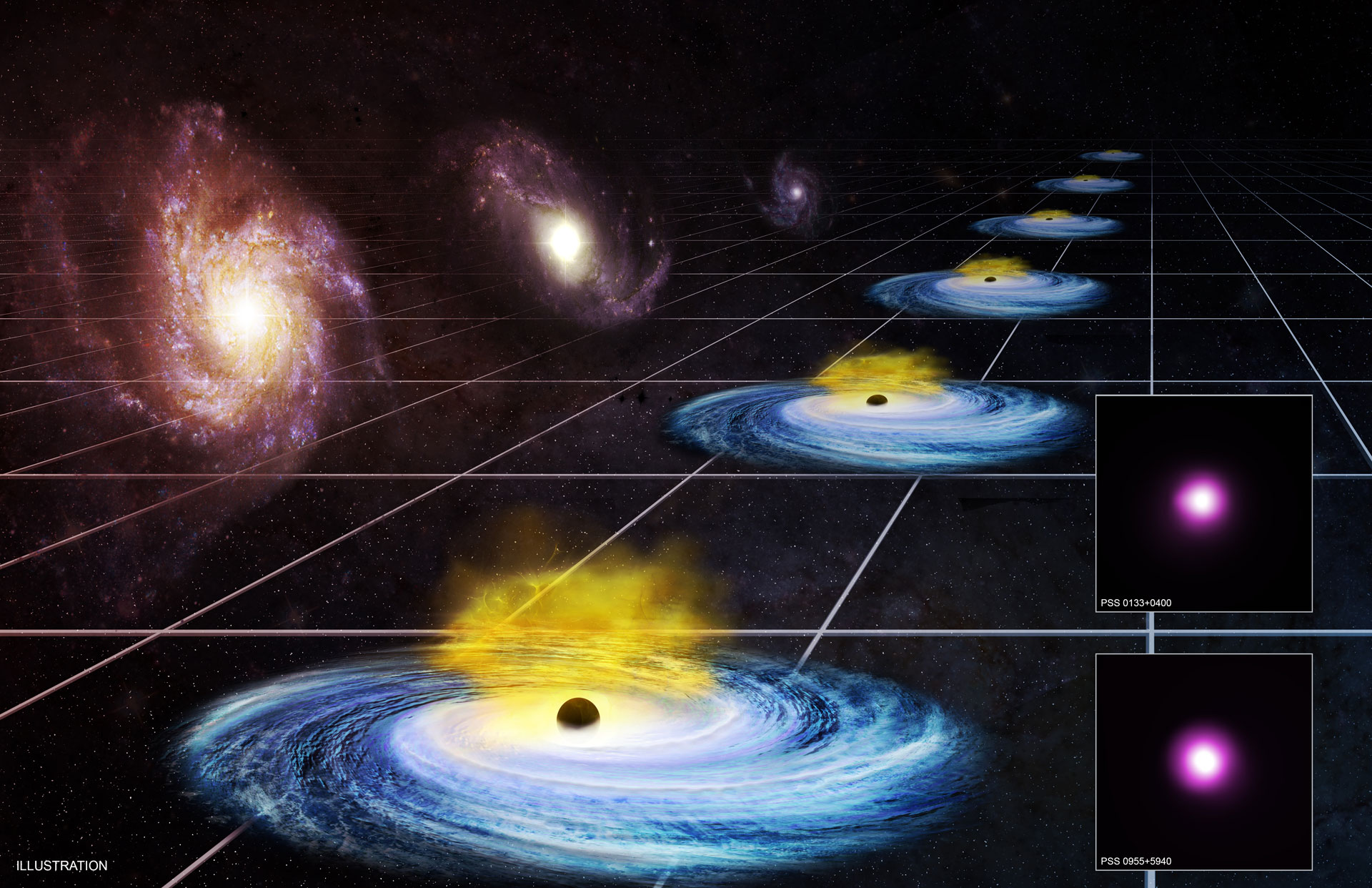
A new study using data from NASA’s Chandra X-ray Observatory and ESA’s XMM-Newton suggests that dark energy may have varied over cosmic time. This artist’s illustration helps explain how astronomers tracked the effects of dark energy to about one billion years after the Big Bang by determining the distances to quasars, rapidly growing black holes that shine extremely brightly.
First discovered about 20 years ago by measuring the distances to exploded stars called supernovas, dark energy is a proposed type of force, or energy, that permeates all space and causes the expansion of the Universe to accelerate. Using this method, scientists tracked the effects of dark energy out to about 9 billion years ago.
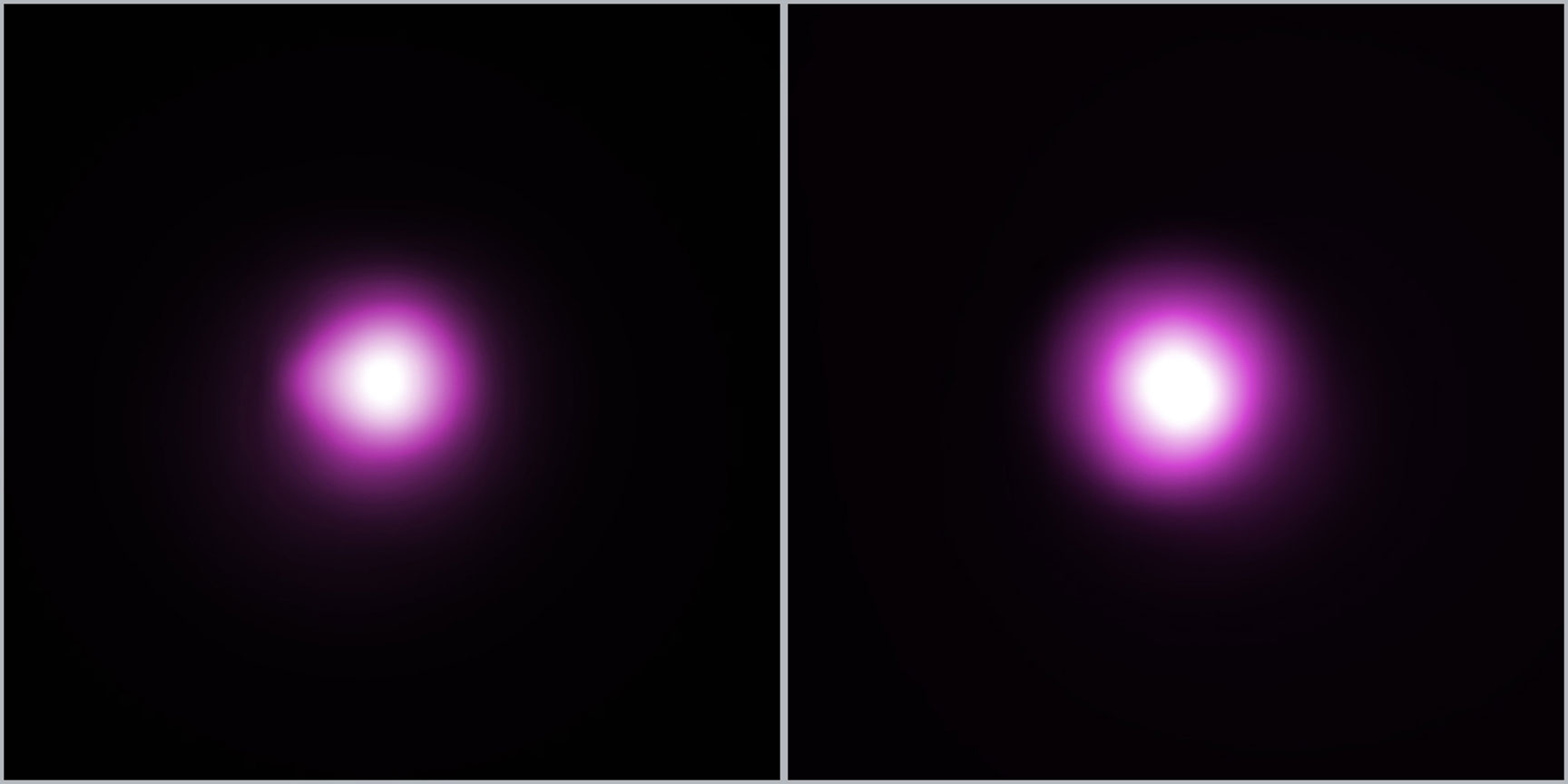
The latest result stems from the development of a new method to determine distances to about 1,598 quasars, which allows the researchers to measure dark energy’s effects from the early Universe through to the present day. Two of the most distant quasars studied are shown in Chandra images in the insets.
The new technique uses ultraviolet (UV) and X-ray data to estimate the quasar distances. In quasars, a disk of matter around the supermassive black hole in the center of a galaxy produces UV light (shown in the illustration in blue). Some of the UV photons collide with electrons in a cloud of hot gas (shown in yellow) above and below the disk, and these collisions can boost the energy of the UV light up to X-ray energies. This interaction causes a correlation between the amounts of observed UV and X-ray radiation. This correlation depends on the luminosity of the quasar, which is the amount of radiation it produces.
Using this technique the quasars become standard candles, as implied by the artist’s illustration. Once the luminosity is known, the distance to the quasars can be calculated from the observed amount of radiation.
The researchers compiled UV data for 1,598 quasars to derive a relationship between UV and X-ray fluxes, and the distances to the quasars. They then used this information to study the expansion rate of the universe back to very early times, and found evidence that the amount of dark energy is growing with time.
Since this is a new technique, the astronomers took extra steps to show that this method gives reliable results. They showed that results from their technique match up with those from supernova measurements over the last 9 billion years, giving them confidence that their results are reliable at even earlier times. The researchers also took great care in how their quasars were selected, to minimize statistical errors and to avoid systematic errors that might depend on the distance from Earth to the object.
A paper on these results appears in Nature Astronomy on January 28, 2019, by Guido Risaliti (University of Florence, Italy) and Elisabeta Lusso (Durham University, United Kingdom).
NASA’s Marshall Space Flight Center in Huntsville, Alabama, manages the Chandra program for NASA’s Science Mission Directorate in Washington. The Smithsonian Astrophysical Observatory in Cambridge, Massachusetts, controls Chandra’s science and flight operations.
Paper: Cosmological constraints from the Hubble diagram of quasars at high redshifts
Never miss a breakthrough: Join the SciTechDaily newsletter.
Follow us on Google and Google News.
1 Comment
I’m puzzled by this notion of “Dark Energy”. The idea comes about because it has been found that the expansion of the universe (as measured by looking at visible objects within the universe) is increasing the further back in time one measures the rate. But surely there are two expansions to consider – the rate of separation of the visible matter distributed within the universe, and the expansion of the universe itself? If one looks at two objects one can measure the rate at which they are moving relative to one another, but one cannot measure the rate at which they are moving relative to the universe itself, which is invisible. If we assume that all visible objects are expanding uniformly relative to one another after the big bang, then no matter how far apart the objects move one should observe the same rate of separation. But the objects are moving within a universe that is itself expanding. So when one measures a “local” pair of objects to see how fast they are moving apart, one measures their true relative separation rate plus a small contribution from the expansion of the universe itself. If one then looks at more distant pairs of objects, one should measure the same rate of separation of the objects but a greater contribution from the larger amount of the expanding universe that is being measured at the same time. Could this not explain why the further back in time one looks to measure the rate of expansion of the “universe” (the proxy for this being the expansion of a group of visible objects within it) the greater the rate one finds, making it LOOK as if the rate of expansion is increasing over time?
Sorry if this sounds over-simplistic or naive, but I am not an astronomer or a theoretical physicist, just an interested observer.