
Close Menu
    Facebook X (Twitter) Instagram
    SciTechDaily
    • Biology
    • Chemistry
    • Earth
    • Health
    • Physics
    • Science
    • Space
    • Technology
    Facebook X (Twitter) Pinterest YouTube RSS
    SciTechDaily
    Home»Technology»A New Self-Assembly Method for Fabricating Graphene Nanoribbons
    Technology

    A New Self-Assembly Method for Fabricating Graphene Nanoribbons

    By Shaun Mason, University of California - Los AngelesOctober 22, 2014No Comments3 Mins Read
    Facebook Twitter Pinterest Telegram LinkedIn WhatsApp Email Reddit
    Share
    Facebook Twitter LinkedIn Pinterest Telegram Email Reddit
    New Method for Fabricating Graphene Nanoribbons Brings Scientists Closer to Revolutionizing Electronics
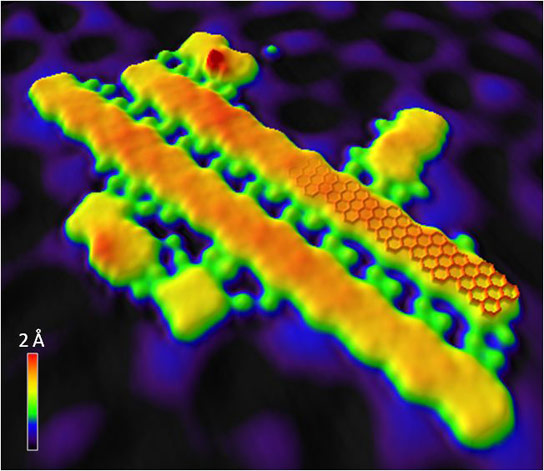
    A cluster of graphene nanoribbons imaged by scanning tunneling microscopy. The longest ribbon is just 12.5 nanometers long. The overlapped red model structure highlights the periodic zigzag edges of a ribbon. Credit: Patrick Han

    Scientists from UCLA and Tohoku University have discovered a new self-assembly method for producing defect-free graphene nanoribbons, bringing them one step closer to revolutionizing electronics.

    First characterized in 2004, graphene is a two-dimensional material with extraordinary properties. The thickness of just one carbon atom, and hundreds of times faster at conducting heat and charge than silicon, graphene is expected to revolutionize high-speed transistors in the near future.

    Graphene’s exotic electronic and magnetic properties can be tailored by cutting large sheets of the material down to ribbons of specific lengths and edge configurations — scientists have theorized that nanoribbons with zigzag edges are the most magnetic, making them suitable for spintronics applications. (Spintronics devices, unlike conventional electronics, use electrons’ spins rather than their charge.)

    But this “top-down” fabrication approach is not yet practical, because current lithographic techniques for tailoring the ribbons always produce defects.

    Now, scientists from UCLA and Tohoku University have discovered a new self-assembly method for producing defect-free graphene nanoribbons with periodic zigzag-edge regions. In this “bottom-up” technique, researchers use a copper substrate’s unique properties to change the way the precursor molecules react to one another as they assemble into graphene nanoribbons. This allows the scientists to control the nanoribbons’ length, edge configuration, and location on the substrate.

    This new method of graphene fabrication by self-assembly is a stepping stone toward the production of self-assembled graphene devices that will vastly improve the performance of data storage circuits, batteries, and electronics.

    Paul Weiss, a distinguished professor of chemistry and biochemistry and a member of UCLA’s California NanoSystems Institute, developed the method for producing the nanoribbons with Patrick Han and Taro Hitosugi, professors at the Advanced Institute of Materials Research at Tohoku University in Sendai, Japan, of which Weiss is also a member. The study was published recently in the journal ACS Nano.

    “To make devices out of graphene, we need to control its geometric and electronic structures,” Weiss said. “Making zigzag edges does both of these simultaneously, as there are some special properties of graphene nanoribbons with zigzag edges. Having these in hand will enable us to test theoretical predictions about them, such as magnetic properties.”

    Other bottom-up methods of fabricating graphene have been attempted, but they have produced bundles of ribbons that need to be subsequently isolated and positioned for use in devices.

    “Previous strategies in bottom-up molecular assemblies used inert substrates, such as gold or silver, to give molecules a lot of freedom to diffuse and react on the surface,” Han said. “But this also means that the way these molecules assemble is completely determined by the intermolecular forces and by the molecular chemistry. Our method opens the possibility for self-assembling single-graphene devices at desired locations, because of the length and the direction control.”

    Reference: “Bottom-Up Graphene-Nanoribbon Fabrication Reveals Chiral Edges and Enantioselectivity” by Patrick Han, Kazuto Akagi, Filippo Federici Canova, Hirotaka Mutoh, Susumu Shiraki, Katsuya Iwaya, Paul S. Weiss, Naoki Asao and Taro Hitosugi, 27 August 2014, ACS Nano.
    DOI: 10.1021/nn5028642


    Never miss a breakthrough: Join the SciTechDaily newsletter.
    Follow us on Google and Google News.

    Graphene Nanotechnology Spintronics Tohoku University UCLA
    Share. Facebook Twitter Pinterest LinkedIn Email Reddit

    Related Articles

    Light-Speed Advances: Graphene Nanoprocessing With a Femtosecond Laser

    Graphene Nanoribbon Breakthrough Could Lead to High-Speed, Low-Power Nanoscale Data Storage

    Quantum Materials Cut Closer Than Ever for Faster, More Energy-Efficient Electronics

    Towards 2D Spin-Logic Memory Technology Using Magnetic Graphene

    Artificial “Magnetic Texture” Induced in Graphene – May Lead to Powerful Quantum Computers

    Energy-Efficient Tuning of Spintronic Neurons to Imitate the Non-linear Oscillatory Neural Networks of the Human Brain

    Progressing Electronics Beyond Moore’s Law With Graphene and 2D Materials

    Nanoscale Structures Could Yield Higher-Performance Computer Memory

    A Cost-Effective Fabrication Method for Micro-Scale Graphene-Based Supercapacitors

    Leave A Reply Cancel Reply

    • Facebook
    • Twitter
    • Pinterest
    • YouTube

    Don't Miss a Discovery

    Subscribe for the Latest in Science & Tech!

    Trending News

    Artificial Sweeteners May Harm Future Generations, Study Suggests

    Splashdown! NASA Artemis II Returns From Record-Breaking Moon Mission

    What If Consciousness Exists Beyond Your Brain

    Scientists Finally Crack the 100-Million-Year Evolutionary Mystery of Squid and Cuttlefish

    Beyond “Safe Levels”: Study Challenges What We Know About Pesticides and Cancer

    Researchers Have Found a Dietary Compound That Increases Longevity

    Scientists Baffled by Bizarre “Living Fossil” From 275 Million Years Ago

    Your IQ at 23 Could Predict Your Wealth at 27, Study Finds

    Follow SciTechDaily
    • Facebook
    • Twitter
    • YouTube
    • Pinterest
    • Newsletter
    • RSS
    SciTech News
    • Biology News
    • Chemistry News
    • Earth News
    • Health News
    • Physics News
    • Science News
    • Space News
    • Technology News
    Recent Posts
    • What if Dark Matter Has Two Forms? Bold New Hypothesis Could Explain a Cosmic Mystery
    • Researchers Expose Hidden Chemistry of “Ore-Forming” Elements in Biology
    • Geologists Reveal the Americas Collided Earlier Than We Thought
    • 20x Difference: Study Reveals True Source of Airborne Microplastics
    • Scientists Uncover Hidden Force Powering Yellowstone’s Supervolcano
    Copyright © 1998 - 2026 SciTechDaily. All Rights Reserved.
    • Science News
    • About
    • Contact
    • Editorial Board
    • Privacy Policy
    • Terms of Use

    Type above and press Enter to search. Press Esc to cancel.