
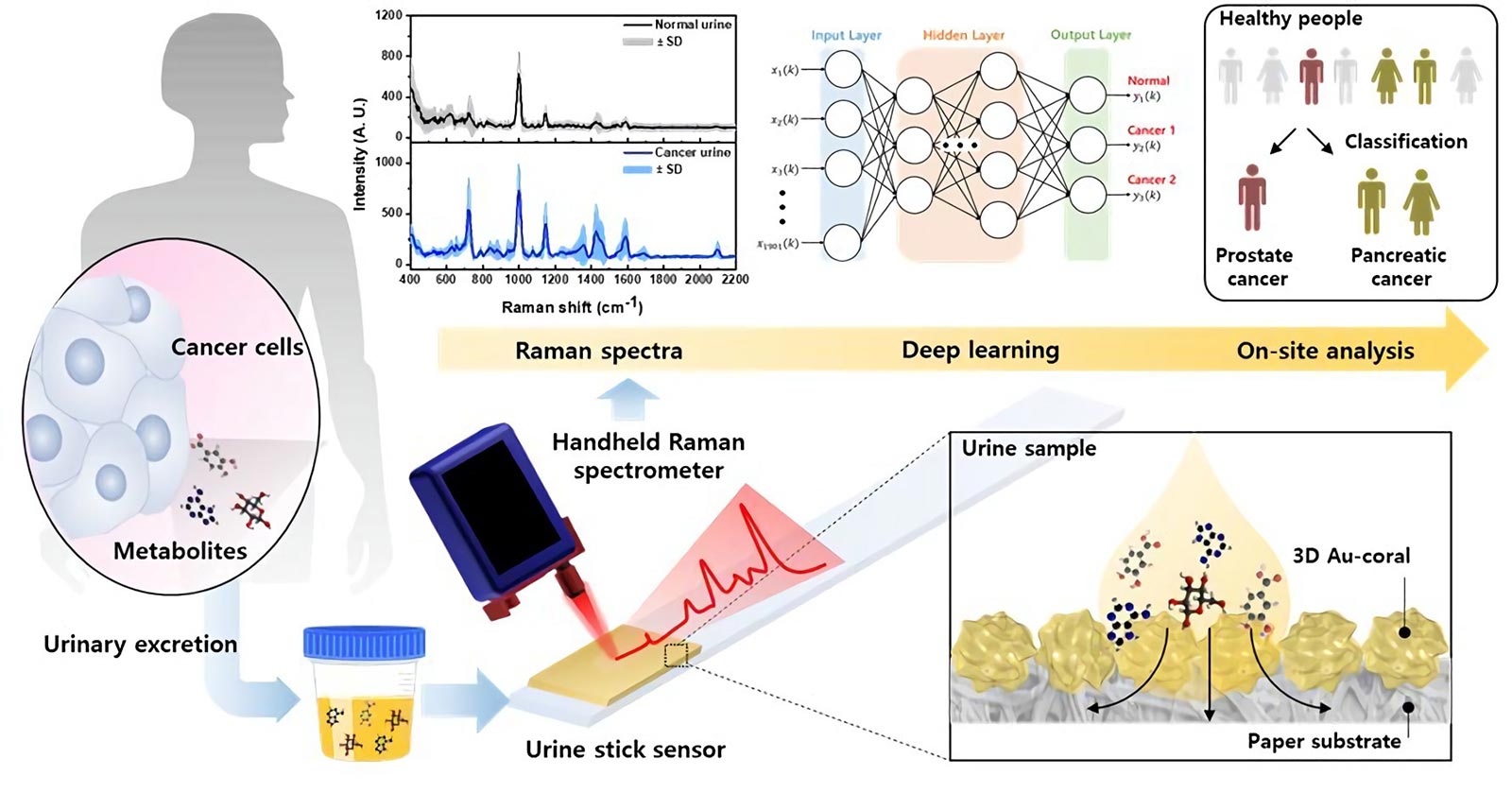
A novel urine sensor enables rapid, cost-effective cancer screening by amplifying metabolite signals with advanced nanotechnology and AI. It achieves near-perfect accuracy and offers a breakthrough solution for early cancer detection.
A research team has succeeded in developing a strip-type urine sensor that can amplify the light signal of metabolites in urine and in diagnosing cancer in the field. This result came from an effort to find metabolites in urine that was led by Dr. Ho Sang Jung of the Surface & Nano Materials Divison of the Korea Institute of Materials Science (KIMS), a government-funded research institute under the Ministry of Science and ICT in joint research conducted with Professor Junsuk Rho of POSTECH and Professor Samjin Choi of Kyung Hee University Medical School.
This technology can be applied for the examination of prostate cancer and pancreatic cancer without an additional analysis process by only irradiating light after a small volume (10uL) of urine dropping at the time of need for a test. The test device is manufactured in the form of a strip so that cancer can be diagnosed quickly and with high sensitivity in the field.
The research team paid attention to the difference in metabolomic components present in the urine of cancer patients and normal people. When cancer cells proliferate in the body, they secrete different metabolites into urine due to abnormal metabolism. In order to classify this as an existing technology, expensive and large equipment was required, limiting on-site field application. The research team developed a surface-enhanced Raman scattering sensor that amplifies the optical signal of metabolites in urine more than 1 billion times by forming a coral-shaped plasmonic nanomaterial on porous paper. When urine is dropped into the sensor and light is irradiated, cancer metabolite signals are amplified on the sensor surface, making it possible to diagnose cancer. The research team applied an artificial intelligence-based analysis method to the acquired spectral signal and succeeded in distinguishing up to 99% of prostate cancer and pancreatic cancer patients from normal people.
Affordable and Accessible Cancer Screening
A number of currently used cancer diagnosis techniques detect the presence of cancer through blood tests or radiological methods and diagnose cancer through histological analysis. Many people try to track the occurrence of cancer through annual health checkups, but in many cases, cancer is detected late and treatment is delayed or death occurs. In particular, it is difficult for people who are in the medical blind spot to receive regular checkups, so it is often discovered after cancer has already advanced considerably. This study used urine, a biological sample that anyone can easily obtain. It can be used for a new cancer diagnosis method using urine, on-site rapid cancer patient screening, and recurrence monitoring technology after cancer patient treatment. In addition, since the production price of the strip-type sensor is less than KRW 100 per unit, it is expected that it can be used for mass inspection.
Senior researcher Ho Sang Jung, who is in charge of the research, said, “In the case of cancers where the diagnosis method is not well known, such as pancreatic cancer, it is difficult to detect and the survival rate after initial diagnosis is low. It is known that 14 pancreatic cancer patients die every day in Korea, and the economic cost per person is about 63 million won per year.”He continued, “Since early diagnosis is the most important for incurable diseases such as cancer, we expect this technology to provide a new diagnostic method.”
This work was supported by the Fundamental Research Program of the Korea Institute of Materials Science (KIMS) and the National Research Foundation of Korea. In addition, the research results were published on January 9th in ‘Biosensors and Bioelectronics (If: 12.5, JCR top < 3%)’, a world-renowned journal in the field of biosensors. The research team applied for related patents in Korea and the United States.
Currently, the research team is gradually increasing the types of cancer that can be diagnosed by analyzing the urine of prostate cancer, pancreatic cancer, colorectal cancer, and lung cancer patients.
Reference: “3D plasmonic coral nanoarchitecture paper for label-free human urine sensing and deep learning-assisted cancer screening” by Vo Thi Nhat Linh, Min-Young Lee, Jungho Mun, Yeseul Kim, Hongyoon Kim, In Woong Han, Sung-Gyu Park, Samjin Choi, Dong-Ho Kim, Junsuk Rho and Ho Sang Jung, 9 January 2023, Biosensors and Bioelectronics.
DOI: 10.1016/j.bios.2023.115076
Never miss a breakthrough: Join the SciTechDaily newsletter.
Follow us on Google and Google News.