
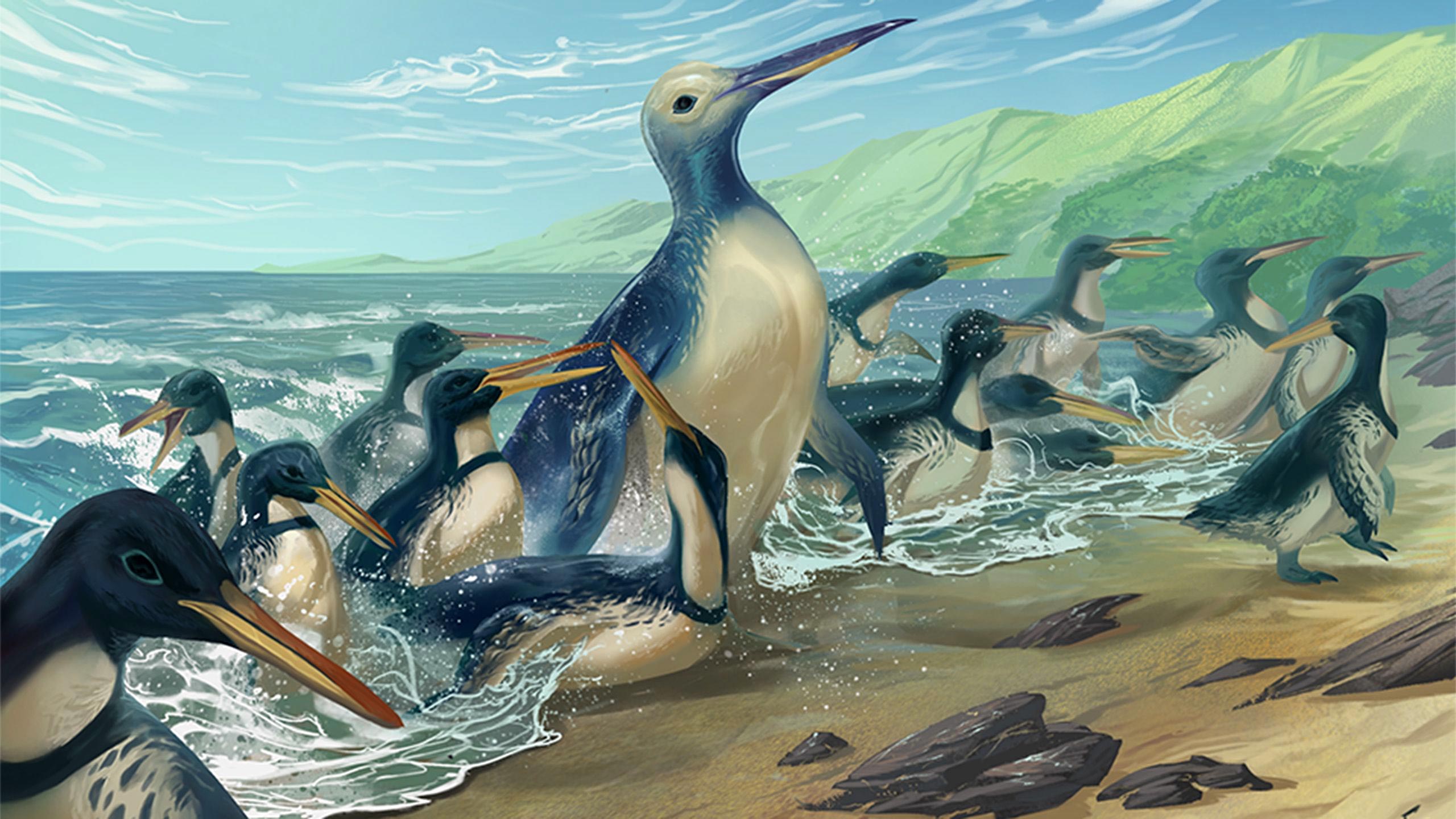
Fossil bones from two newly-described penguin species, one of them thought to be the largest penguin to ever live – weighing more than 340 pounds, more than three times the size of the largest living penguins – have been unearthed in New Zealand.
An international team, including researchers from the University of Cambridge, reported the discovery in the Journal of Paleontology. The paper’s senior author, Alan Tennyson from the Museum of New Zealand Te Papa Tongarewa, discovered the fossils in 57 million-year-old beach boulders in North Otago, on New Zealand’s South Island, between 2016 and 2017.
The fossils were then exposed from within the boulders by Al Manning. They have been identified as being between 59.5 and 55.5 million years old, marking their existence as roughly five to 10 million years after the end-Cretaceous extinction which led to the extinction of non-avian dinosaurs.
The team used laser scanners to create digital models of the bones and compare them to other fossil species, flying diving birds like auks, and modern penguins. To estimate the size of the new species, the team measured hundreds of modern penguin bones and calculated a regression using flipper bone dimensions to predict weight.
Kumimanu fordycei’s Astonishing Size
They concluded that the largest flipper bones belong to a penguin that tipped the scales at an astounding 340 pounds (154 kg). In comparison, emperor penguins, the tallest and heaviest of all living penguins, typically weigh between 50 and 100 pounds (22 and 45 kg).
“Fossils provide us with evidence of the history of life, and sometimes that evidence is truly surprising,” said co-author Dr. Daniel Field from Cambridge’s Department of Earth Sciences. “Many early fossil penguins attained enormous sizes, easily dwarfing the largest penguins alive today. Our new species, Kumimanu fordycei, is the largest fossil penguin ever discovered—at approximately 350 pounds, it would have weighed more than Shaquille O’Neal at the peak of his dominance!”
The team named the new species Kumimanu fordycei in honor of Dr. R. Ewan Fordyce, Professor Emeritus at the University of Otago. “Ewan Fordyce is a legend in our field, but also one of the most generous mentors I have ever known,” said first author Dr. Daniel Ksepka from the Bruce Museum in Greenwich, Connecticut. “Without Ewan’s field program, we wouldn’t even know that many iconic fossil species existed, so it is only right he have his own penguin namesake.”
Multiple specimens of a second penguin species were also found, providing a detailed view of the skeleton. Dubbed Petradyptes stonehousei, it weighed in at 50kg, smaller than Kumimanu fordycei but still well above the weight of an emperor penguin. The name combines the Greek ‘petra’ for rock and ‘dyptes’ for diver, a play on the diving bird being preserved in a boulder. ‘Stonehousei’ honors the late Dr. Bernard Stonehouse (1926-2014), the first person to observe the full breeding cycle of the emperor penguin, a major milestone in penguin biology.
Early Penguins: Size and Evolutionary Advantages
These two newly-described species show that penguins got very large early in their evolutionary history, millions of years before they fine-tuned their flipper apparatus. The team observed that the two species retained primitive features such as more slender flipper bones and muscle attachment points that resemble those of flying birds.
When asked why early penguins grew to titanic proportions, Ksepka speculated it made them more efficient in the water. “Size conveys many advantages,” he said. “A bigger penguin could capture larger prey, and more importantly it would have been better at conserving body temperature in cold waters. It is possible breaking the 100lb size barrier allowed the earliest penguins to spread from New Zealand to other parts of the world.”
“When we start thinking of these finds not as isolated bones but as parts of a whole living animal then a picture begins to form,” said co-author Dr. Daniel Thomas from Massey University in Auckland. “Large, warm-blooded marine animals living today can dive to great depths. This raises questions about whether Kumimanu fordycei had an ecology that penguins today don’t have, by being able to reach deeper waters and find food that isn’t accessible to living penguins.”
“Kumimanu fordycei would have been an utterly astonishing sight on the beaches of New Zealand 57 million years ago, and the combination of its sheer size and the incomplete nature of its fossil remains makes it one of the most intriguing fossil birds ever found,” said Field, who is also the Curator of Ornithology at Cambridge’s Museum of Zoology. “Hopefully future fossil discoveries will shed more light on the biology of this amazing early penguin.”
Reference: “Largest-known fossil penguin provides insight into the early evolution of sphenisciform body size and flipper anatomy” by Daniel T. Ksepka, Daniel J. Field, Tracy A. Heath, Walker Pett, Daniel B. Thomas, Simone Giovanardi and Alan J.D. Tennyson, 8 February 2023, Journal of Paleontology.
DOI: 10.1017/jpa.2022.88
The research was supported in part by the National Science Foundation, UK Research and Innovation (UKRI) and the Te Papa Collection Development Fund. Daniel Field is a Fellow of Christ’s College, Cambridge.
Never miss a breakthrough: Join the SciTechDaily newsletter.
Follow us on Google and Google News.
1 Comment
the largest on earth… You don’t know about space penguins, or even multiverse penguins… Could be humongous.