
Experts Suggest That DNA Found in Sedimentary Deposits Likely Originated From Long-Deceased Animals
The mystery surrounding the exact timing of the extinction of mammoths has long captivated paleontologists, as the decline of these giant ice age creatures seemed to coincide with the arrival of humans in North and South America.
This has led many to question if human activity played a role in the extinction of mammoths over 10,000 years ago.
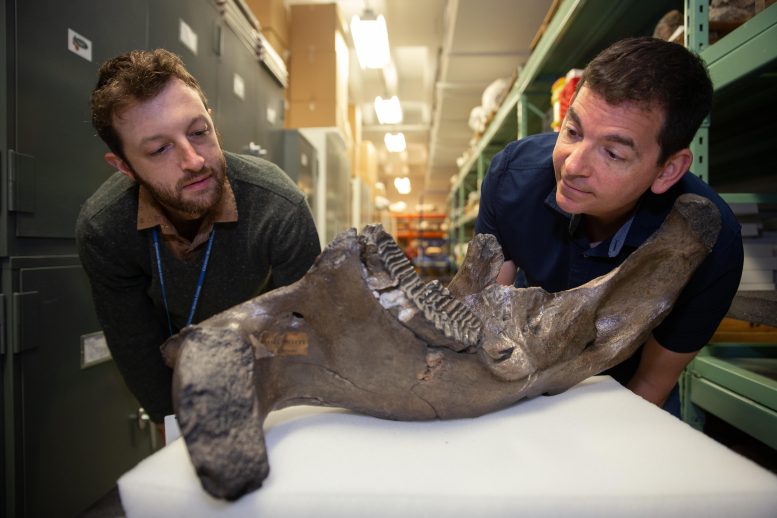
A University of Cincinnati paleontologist refutes the latest timeline published in 2021 in the journal Nature that suggested mammoths met their end much more recently than we believed. An international team of researchers examined the environmental DNA of mammoth remains and more than 1,500 arctic plants to conclude that a wetter climate quickly changed the landscape from tundra grassland steppe to forested wetlands that could not support many of these big grazing animals, driving mammoths to extinction as recently as 3,900 years ago.
But in a rebuttal paper in Nature, UC College of Arts and Sciences assistant professor Joshua Miller and co-author Carl Simpson at the University of Colorado Boulder argue that the environmental DNA used to establish their updated timeline is more complex than previously recognized.

“The issue is you have no idea how old that DNA is,” Miller said. “Sedimentary deposits are complex. Materials of different ages are routinely buried together.”
Researchers have many tools to date sedimentary deposits and the materials contained in them. But not everything can be dated, Miller said.
“We can radiocarbon date all kinds of things: bones, teeth, charcoal, leaves. That’s very powerful. But currently, we can’t independently date DNA found in sediments,” Miller said.
Slow Arctic Decomposition and DNA Preservation
From recent discoveries like the baby mammoth found in Canada this year, we know that many ice-age animals that died tens of thousands of years ago can become mummified in the arctic’s dry, cold environment. Miller said researchers can’t tell whether environmental DNA preserved in sediment was shed from a living or dead animal.
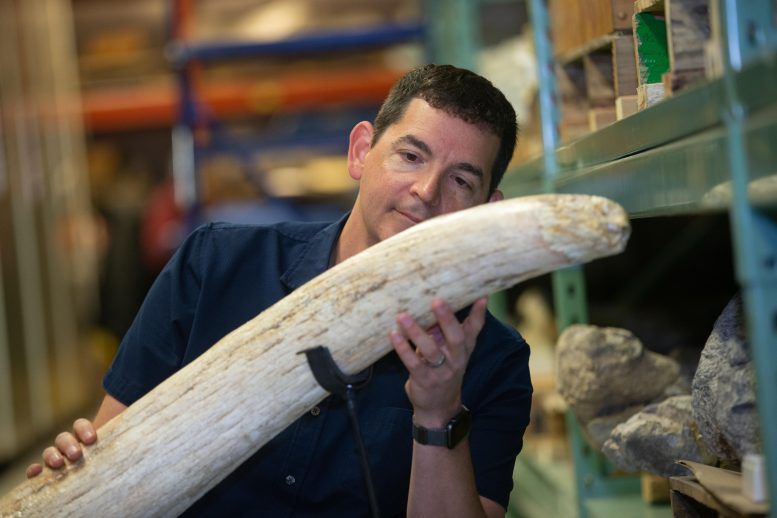
“DNA is shed from organisms all the time,” Miller said. “In fact, DNA continues to be shed long after the animal dies. In places where decomposition is slow, that means long-dead and even long-extinct species can continue to make their way into surrounding sediments. In the arctic and other cold-weather places, it can take thousands of years for something to decompose.”
The researchers say the slow decomposition of animals in arctic regions could explain how mammoth DNA is showing up thousands of years later than the most recent mammoth fossil discovered. The paper notes that the mummified remains of elephant seals near Antarctica can be more than 5,000 years old.
Simpson said his work studying marine environments from recently eroded hillsides demonstrates how difficult it is to date ancient specimens.
“Seashells can sit on the seafloor for thousands of years. When you see shells on the beach, some could be from animals that died recently while others might be from shellfish that died millennia ago,” Simpson said. “This happens in the vertebrate record as well.”
Human Influence on Mammoth Decline
Miller said the question remains what impact, if any, humans had on the global decline and extinction of mammoths. Humans were known to use fire to alter landscapes in profound ways, Miller said. They also hunted mammoths and made use of their ivory tusks.
So when did the last mammoths die off? Scientists say most mammoths went extinct more than 10,000 years ago, but remnant populations lived on islands such as Russia’s Wrangel Island until much more recently.
This cohabitation with modern humans is one reason mammoths capture our imaginations, researchers said.
“They’re tantalizingly similar to animals that live among us today,” Miller said. “We can almost touch them. That makes mammoths really alluring. For many people, they are the poster children of ice age megafauna.”
Simpson noted that mammoths once lived on the Channel Islands of California near where he grew up. The islands were home to a pygmy mammoth weighing 2,000 pounds. Today, the biggest mammal on the island is a tiny endemic fox.
“I think about how amazing it would have been to grow up with all of those big animals walking around,” Simpson said. “But I just missed them.”
Reference: “When did mammoths go extinct?” by Joshua H. Miller and Carl Simpson, 30 November 2022, Nature.
DOI: 10.1038/s41586-022-05416-3
Never miss a breakthrough: Join the SciTechDaily newsletter.
Follow us on Google and Google News.
4 Comments
Yes. Very much true, since the creation of the world and of time took place 5783 years ago previously time did not exist.
Your an idiot.
Wow. 5,783 years ago. Seriously? And the Earth is flat, and the center of the universe, right? It simply amazes me that in a day and age that we carry around a piece of tech able to access a compendium of all human knowledge, that people continue to get less intelligent by the minute.
By the way, could you enlighten us and let us know what day of the week all existence began on 5,783 years ago?
Unless your part of the peer review process or the actual study then you have to refute using evidence, data,and facts not opinions. The reason they refute the late extinction is because it calls into question their own studies wich are funded by grants. If it were in Africa or Europe or Asia no one bat’s an eye. But if it’s Australia or the America’s its suspect. I’m tired of these scientist who refute without a study of their own. They should be censured for making their opinions pretend to be facts.