
Close Menu
    Facebook X (Twitter) Instagram
    SciTechDaily
    • Biology
    • Chemistry
    • Earth
    • Health
    • Physics
    • Science
    • Space
    • Technology
    Facebook X (Twitter) Pinterest YouTube RSS
    SciTechDaily
    Home»Health»New T Cell Subsets Have Potential to Improve Cellular Therapy for Cancer
    Health

    New T Cell Subsets Have Potential to Improve Cellular Therapy for Cancer

    By Yale Cancer CenterSeptember 14, 2016No Comments2 Mins Read
    Facebook Twitter Pinterest Telegram LinkedIn WhatsApp Email Reddit
    Share
    Facebook Twitter LinkedIn Pinterest Telegram Email Reddit

    Researchers Identify New T cell Subsets with Potential to Improve Cellular Therapy for Cancer

    Researchers from the Yale Cancer Center have identified that two genes, NR4A1 and ABC transporters, mark a distinct subset of quiescent T cells within human tissues, and have developed methods to mobilize them into circulation for potential application in adoptive T cell therapy of cancer.

    The study is published in the Journal of Clinical Investigation.

    Adoptive cellular therapy uses the body’s own T cells to boost its immune system to target cancer. The adoptive transfer of T cells has emerged as a promising treatment strategy for cancer, but improvements on enhanced longevity and infiltration to tumor tissue, particularly in solid tumors, are needed.

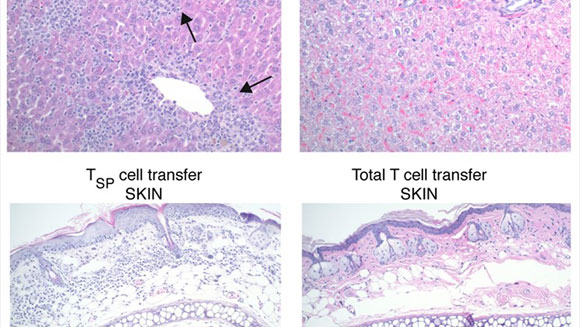
    “Expression of ABC transporters allowed a simple “side population (SP)” assay to detect these cells. Our studies showed that human SP cells were capable of greater engraftment and tissue infiltration than unselected T cells upon adoptive transfer. Further, the finding that these cells could be mobilized into circulation sets the stage for their potential application to improve adoptive T cell therapy,” said Madhav V. Dhodapkar, MBBS, Chief of Hematology and the Arthur H. and Isabel Bunker Professor of Hematology at Yale Cancer Center and Smilow Cancer Hospital at Yale New Haven.

    “We know that tissue-resident memory (Trm) T cells maintain a highly regional network and persist over decades of life with little turnover. The ability to transfer SP cells and create Trm cells to boost the immune system against a patient’s cancer could be of therapeutic benefit and needs to be further investigated,” explained Dr. Chandra Sekhar Boddupalli, a post-doctoral associate in the Dhodapkar lab and first author of the paper.

    Other Yale authors include Shiny Nair, Simon Gray, Rakesh Verma, Joanna Gibson, Clara Abraham, Deepak Narayan, Juan Vasquez, Richard Flavell, Susan Kaech, and Kavita Dhodapkar. Heba Nowyhed and Catherine Hedrick from La Jolla Institute for Allergy and Immunology also contributed to the research.

    The work was supported in part by funds from the National Institutes of Health.

    Reference: “ABC transporters and NR4A1 identify a quiescent subset of tissue-resident memory T cells” by Chandra Sekhar Boddupalli, Shiny Nair, Simon M. Gray, Heba N. Nowyhed, Rakesh Verma, Joanna A. Gibson, Clara Abraham, Deepak Narayan, Juan Vasquez, Catherine C. Hedrick, Richard A. Flavell, Kavita M. Dhodapkar, Susan M. Kaech and Madhav V. Dhodapkar, 12 September 2016, Journal of Clinical Investigation.
    DOI: 10.1172/JCI85329.

    Never miss a breakthrough: Join the SciTechDaily newsletter.
    Follow us on Google and Google News.

    Cancer Disease Immune System Yale University
    Share. Facebook Twitter Pinterest LinkedIn Email Reddit

    Related Articles

    Researchers Identify a New Way to Suppress Lung Tumors

    Yale Study Finds Racial Differences in Smoking Patterns

    Yale Examines How Bacteria Might Trigger and Treat Autoimmune Disease

    Yale Researchers Discover New Complexities Behind Drug Resistance

    New Strategy to Better Protect Cancer Patients from the Flu

    Rare ALK Genetic Mutation Extends Cancer Survival

    Yale Researchers Develop Method to Attack Cancer at Its Source

    Unique Drug Combinations Show Positive Results in Fighting Late-Stage Melanoma

    New Antibody Drug Boosts the Immune System’s Capacity to Fight Cancer

    Leave A Reply Cancel Reply

    • Facebook
    • Twitter
    • Pinterest
    • YouTube

    Don't Miss a Discovery

    Subscribe for the Latest in Science & Tech!

    Trending News

    Even Occasional Binge Drinking May Triple Liver Damage Risk

    Liftoff! NASA’s Artemis II Launch Sends Astronauts Around the Moon for First Time in 50 Years

    Scientists Discover New Way To Eliminate “Zombie Cells” Driving Aging

    This New Quantum Theory Could Change Everything We Know About the Big Bang

    This One Vitamin May Help Protect Your Brain From Dementia Years Later

    Stopping Weight-Loss Drugs Like Ozempic Can Quickly Erase Heart Benefits

    A 500-Million-Year-Old Surprise Is Forcing Scientists to Rethink Spider Evolution

    Coffee and Blood Pressure: What You Need To Know Before Your Next Cup

    Follow SciTechDaily
    • Facebook
    • Twitter
    • YouTube
    • Pinterest
    • Newsletter
    • RSS
    SciTech News
    • Biology News
    • Chemistry News
    • Earth News
    • Health News
    • Physics News
    • Science News
    • Space News
    • Technology News
    Recent Posts
    • Atomic Chains Turn Electric Fields into Measurable Quantum Signals
    • 12,000-Year-Old Native American Dice Rewrite the History of Gambling
    • Researchers Break a 150-Year-Old Math Law With a Surprising Donut Discovery
    • Are You Adding Too Much Salt? New Study Identifies Who’s Most at Risk
    • Scientists Finally Crack Decades-Old Mystery Behind Statins’ Painful Side Effects
    Copyright © 1998 - 2026 SciTechDaily. All Rights Reserved.
    • Science News
    • About
    • Contact
    • Editorial Board
    • Privacy Policy
    • Terms of Use

    Type above and press Enter to search. Press Esc to cancel.