
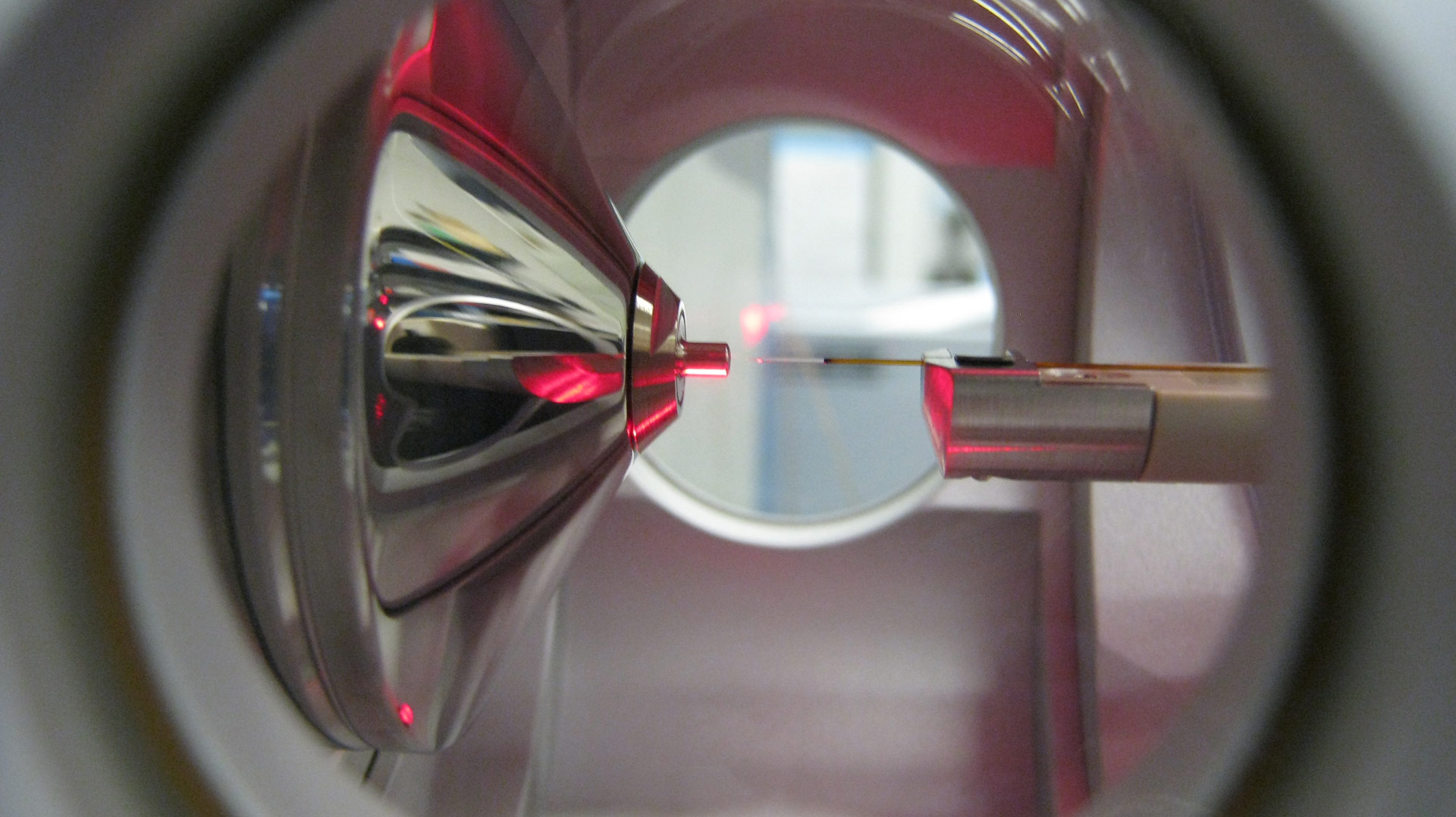
Researchers at Goddard’s Astrobiology Analytical Laboratory have developed a new technique to search space dust for molecules that are critical for life.
While the origin of life remains mysterious, scientists are finding more and more evidence that material created in space and delivered to Earth by comet and meteor impacts could have given a boost to the start of life. Some meteorites supply molecules that can be used as building blocks to make certain kinds of larger molecules that are critical for life.
Researchers have analyzed carbon-rich meteorites (carbonaceous chondrites) and found amino acids, which are used to make proteins. Proteins are among the most important molecules in life, used to make structures like hair and skin, and to speed up or regulate chemical reactions. They have also found components used to make DNA, the molecule that carries the instructions for how to build and regulate a living organism, as well as other biologically important molecules like nitrogen heterocycles, sugar-related organic compounds, and compounds found in modern metabolism.
However, these carbon-rich meteorites are relatively rare, comprising less than five percent of recovered meteorites, and meteorites make up just a portion of the extraterrestrial material that comes to Earth. Also, the building-block molecules found in them usually have been at low concentrations, typically parts-per-million or parts-per-billion. This raises the question of how significant their supply of raw material was. However, Earth constantly receives other extraterrestrial material – mostly in the form of dust from comets and asteroids.
“Despite their small size, these interplanetary dust particles may have provided higher quantities and a steadier supply of extraterrestrial organic material to early Earth,” said Michael Callahan of NASA’s Goddard Space Flight Center in Greenbelt, Maryland. “Unfortunately, there have been limited studies examining their organic composition, especially with regards to biologically relevant molecules that may have been important for the origin of life, due to the miniscule size of these samples.”
Callahan and his team at Goddard’s Astrobiology Analytical Laboratory have recently applied advanced technology to inspect extremely small meteorite samples for the components of life. “We found amino acids in a 360 microgram sample of the Murchison meteorite,” said Callahan. “This sample size is 1,000 times smaller than the typical sample size used.” A microgram is one millionth of a gram; 360 micrograms is about the weight of a few eyebrow hairs. 28.35 grams equals an ounce.
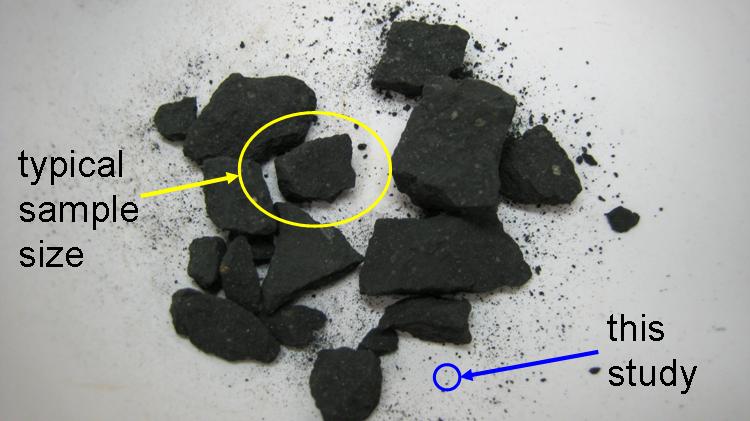
“Our study was for proof-of-concept,” adds Callahan. “Murchison is a well-studied meteorite. We got the same results looking at a very small fragment as we did a much larger fragment from the same meteorite. These techniques will allow us to investigate other small-scale extraterrestrial materials such as micrometeorites, interplanetary dust particles, and cometary particles in future studies.” Callahan is the lead author of a paper on this research available online in the Journal of Chromatography A.
Analyzing such tiny samples is extremely challenging. “Extracting much less meteorite powder translates into having much lower amino acid concentration for analyses,” said Callahan. “Therefore we need the most sensitive techniques available. Also, since meteorite samples can be highly complex, techniques that are highly specific for these compounds are necessary too.”
The team used a nanoflow liquid chromatography instrument to sort the molecules in the meteorite sample, then applied nanoelectrospray ionization to give the molecules an electric charge and deliver them to a high-resolution mass spectrometer instrument, which identified the molecules based on their mass. “We are pioneering the application of these techniques for the study of meteoritic organics,” said Callahan. “These techniques can be highly finicky, so just getting results was the first challenge.”
“I’m particularly interested in analyzing cometary particles from the Stardust mission,” adds Callahan. “It’s one of the reasons why I came to NASA. When I first saw a photo of the aerogel used to capture particles for the Stardust mission, I was hooked.”
“This technology will also be extremely useful to search for amino acids and other potential chemical biosignatures in samples returned from Mars and eventually plume materials from the outer planet icy moons Enceladus and Europa,” said Daniel Glavin of the Astrobiology lab at Goddard, a co-author on the paper.
This technology and the laboratory techniques that the Goddard lab develops to apply it to analyze meteorites will be valuable for future sample-return missions since the amount of samples likely will be limited. “Missions involving the collection of extraterrestrial material for sample return to Earth usually collect only a very small amount and the samples themselves can be extremely small as well,” said Callahan. “The traditional techniques used to study these materials usually involve inorganic or elemental composition. Targeting biologically relevant molecules in these samples is not routine yet. We are not there either, but we are getting there.”
Reference: “Amino acid analysis of a microgram meteorite sample by nanoliquid chromatography high resolution mass spectrometry” by Michael P. Callahan, Mildred G. Martin, Aaron S. Burton, Daniel P. Glavin and Jason P. Dworkin, 17 January 2014, Journal of Chromatography A.
DOI: 10.1016/j.chroma.2014.01.032
The research was funded by the NASA Astrobiology Institute, the Goddard Center for Astrobiology and the NASA Cosmochemistry Program.
Never miss a breakthrough: Join the SciTechDaily newsletter.
Follow us on Google and Google News.