
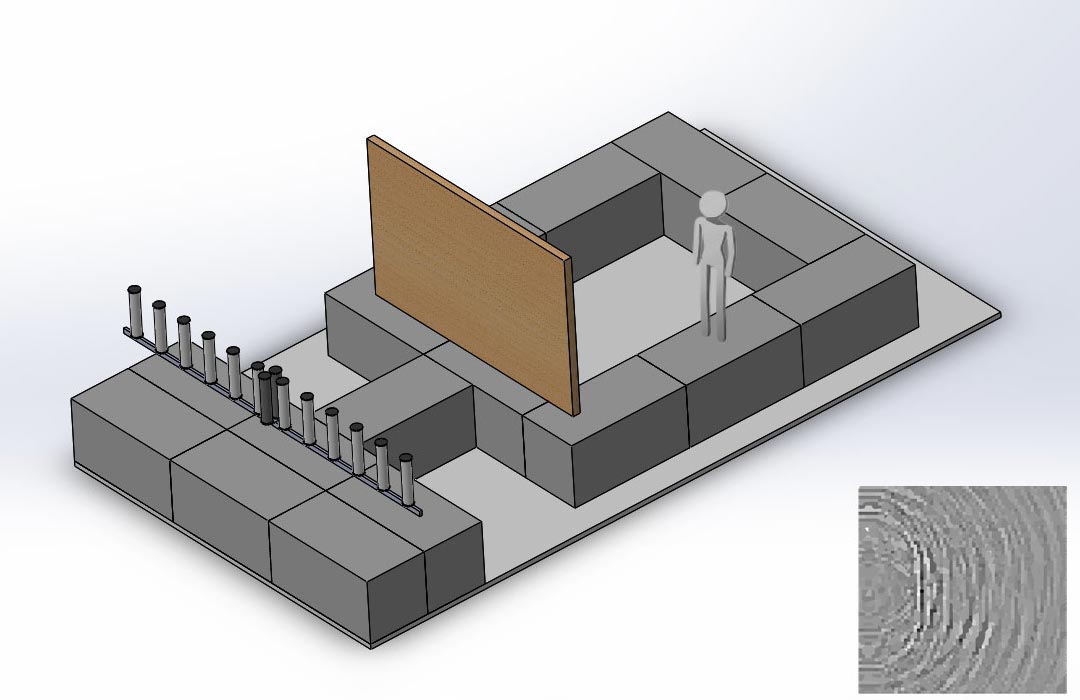
A new radio-based imaging method developed by NIST enables real-time visualization through walls and smoke.
Researchers at the National Institute of Standards and Technology (NIST) and Wavsens LLC have developed a method for using radio signals to create real-time images and videos of hidden and moving objects, which could help firefighters find escape routes or victims inside buildings filled with fire and smoke. The technique could also help track hypersonic objects such as missiles and space debris.
The new method, described in Nature Communications, could provide critical information to help reduce deaths and injuries. Locating and tracking first responders indoors is a prime goal for the public safety community. Hundreds of thousands of pieces of orbiting space junk are considered dangerous to humans and spacecraft.
“Our system allows real-time imaging around corners and through walls and tracking of fast-moving objects such as millimeter-sized space debris flying at 10 kilometers per second, more than 20,000 miles per hour, all from standoff distances,” said physicist Fabio da Silva, who led the development of the system while working at NIST.
This demonstration of the m-Widar (micro-Wave image detection, analysis and ranging) system shows, in the video on the left, a person walking and later crouching and lying down in an anechoic chamber. The transmitters and receiver are in a vertical line on the right side of the chamber. The second video on the right shows the instrument’s view of the same scene. About 21 seconds into the video, a wallboard is inserted between the person and the instrument in the anechoic chamber, to show that m-Widar can “see” through walls. Credit: NIST
“Because we use radio signals, they go through almost everything, like concrete, drywall, wood, and glass,” da Silva added. “It’s pretty cool because not only can we look behind walls, but it takes only a few microseconds of data to make an image frame. The sampling happens at the speed of light, as fast as physically possible.”
The NIST imaging method is a variation on radar, which sends an electromagnetic pulse, waits for the reflections, and measures the round-trip time to determine distance to a target. Multisite radar usually has one transmitter and several receivers that receive echoes and triangulate them to locate an object.
“We exploited the multisite radar concept but in our case use lots of transmitters and one receiver,” da Silva said. “That way, anything that reflects anywhere in space, we are able to locate and image.”
Da Silva explains the imaging process like this:
“To image a building, the actual volume of interest is much smaller than the volume of the building itself because it’s mostly empty space with sparse stuff in it. To locate a person, you would divide the building into a matrix of cubes. Ordinarily, you would transmit radio signals to each cube individually and analyze the reflections, which is very time consuming. By contrast, the NIST method probes all cubes at the same time and uses the return echo from, say, 10 out of 100 cubes to calculate where the person is. All transmissions will return an image, with the signals forming a pattern and the empty cubes dropping out.”
Da Silva has applied for a patent, and he recently left NIST to commercialize the system under the name m-Widar (microwave image detection, analysis, and ranging) through a startup company, Wavsens LLC (Westminster, Colorado).
The NIST team demonstrated the technique in an anechoic (non-echoing) chamber, making images of a 3D scene involving a person moving behind drywall. The transmitter power was equivalent to 12 cellphones sending signals simultaneously to create images of the target from a distance of about 10 meters (30 feet) through the wallboard.
Da Silva said the current system has a potential range of up to several kilometers. With some improvements the range could be much farther, limited only by transmitter power and receiver sensitivity, he said.
The basic technique is a form of computational imaging known as transient rendering, which has been around as an image reconstruction tool since 2008. The idea is to use a small sample of signal measurements to reconstruct images based on random patterns and correlations. The technique has previously been used in communications coding and network management, machine learning, and some advanced forms of imaging.
Signal Patterns Build 3D Images
Da Silva combined signal processing and modeling techniques from other fields to create a new mathematical formula to reconstruct images. Each transmitter emits different pulse patterns simultaneously, in a specific type of random sequence, which interfere in space and time with the pulses from the other transmitters and produce enough information to build an image.
The transmitting antennas operated at frequencies from 200 megahertz to 10 gigahertz, roughly the upper half of the radio spectrum, which includes microwaves. The receiver consisted of two antennas connected to a signal digitizer. The digitized data were transferred to a laptop computer and uploaded to the graphics processing unit to reconstruct the images.
The NIST team used the method to reconstruct a scene with 1.5 billion samples per second, a corresponding image frame rate of 366 kilohertz (frames per second). By comparison, this is about 100 to 1,000 times more frames per second than a cellphone video camera.
With 12 antennas, the NIST system generated 4096-pixel images, with a resolution of about 10 centimeters across a 10-meter scene. This image resolution can be useful when sensitivity or privacy is a concern. However, the resolution could be improved by upgrading the system using existing technology, including more transmitting antennas and faster random signal generators and digitizers.
Quantum Possibilities on the Horizon
In the future, the images could be improved by using quantum entanglement, in which the properties of individual radio signals would become interlinked. Entanglement can improve sensitivity. Radio-frequency quantum illumination schemes could increase reception sensitivity.
The new imaging technique could also be adapted to transmit visible light instead of radio signals — ultrafast lasers could boost image resolution but would lose the capability to penetrate walls — or sound waves used for sonar and ultrasound imaging applications.
In addition to imaging of emergency conditions and space debris, the new method might also be used to measure the velocity of shock waves, a key metric for evaluating explosives, and to monitor vital signs such as heart rate and respiration, da Silva said.
Reference: “Continuous Capture Microwave Imaging” by Fabio C. S. da Silva, Anthony B. Kos, Grace E. Antonucci, Jason B. Coder, Craig W. Nelson and Archita Hati, 25 June 2021, Nature Communications.
DOI: 10.1038/s41467-021-24219-0
This work was funded in part by the Public Safety Trust Fund, which provides funding to organizations across NIST leveraging NIST expertise in communications, cybersecurity, manufacturing and sensors for research on critical, lifesaving technologies for first responders.
Never miss a breakthrough: Join the SciTechDaily newsletter.
Follow us on Google and Google News.