
New research from UMass Amherst shines light on poorly understood processes of how carbon dissolved in Arctic rivers affects our world.
In a pair of recently published papers, Michael Rawlins, a professor in the University of Massachusetts Amherst’s geosciences department and associate director of the Climate System Research Center, has made significant gains in filling out our understanding of the Arctic’s carbon cycle—or the way that carbon is transferred between the land, ocean, and atmosphere. In order to better understand future trends in atmospheric carbon dioxide, and its associated global warming, we need a fuller picture of how carbon cycles between reservoirs in our world.
“There’s been a lot of research that has looked at the vertical flow of carbon from land to the atmosphere,” says Rawlins. This vertical flow includes things like burning fossil fuels, forest fires, leaking methane gas, and emissions from thawing permafrost. But there’s another part of the cycle—the horizontal. “Far less attention has been paid to how carbon is transferred from land to the ocean via rivers,” says Rawlins.
As water flows over the land, into streams and rivers, it picks up carbon, eventually carrying it all the way to the sea. A small, but not insignificant amount of this dissolved organic carbon (DOC) is “out-gassed” from the river water and into the atmosphere as a greenhouse gas. What remains flows into the ocean, where it becomes a key part of coastal foodwebs.
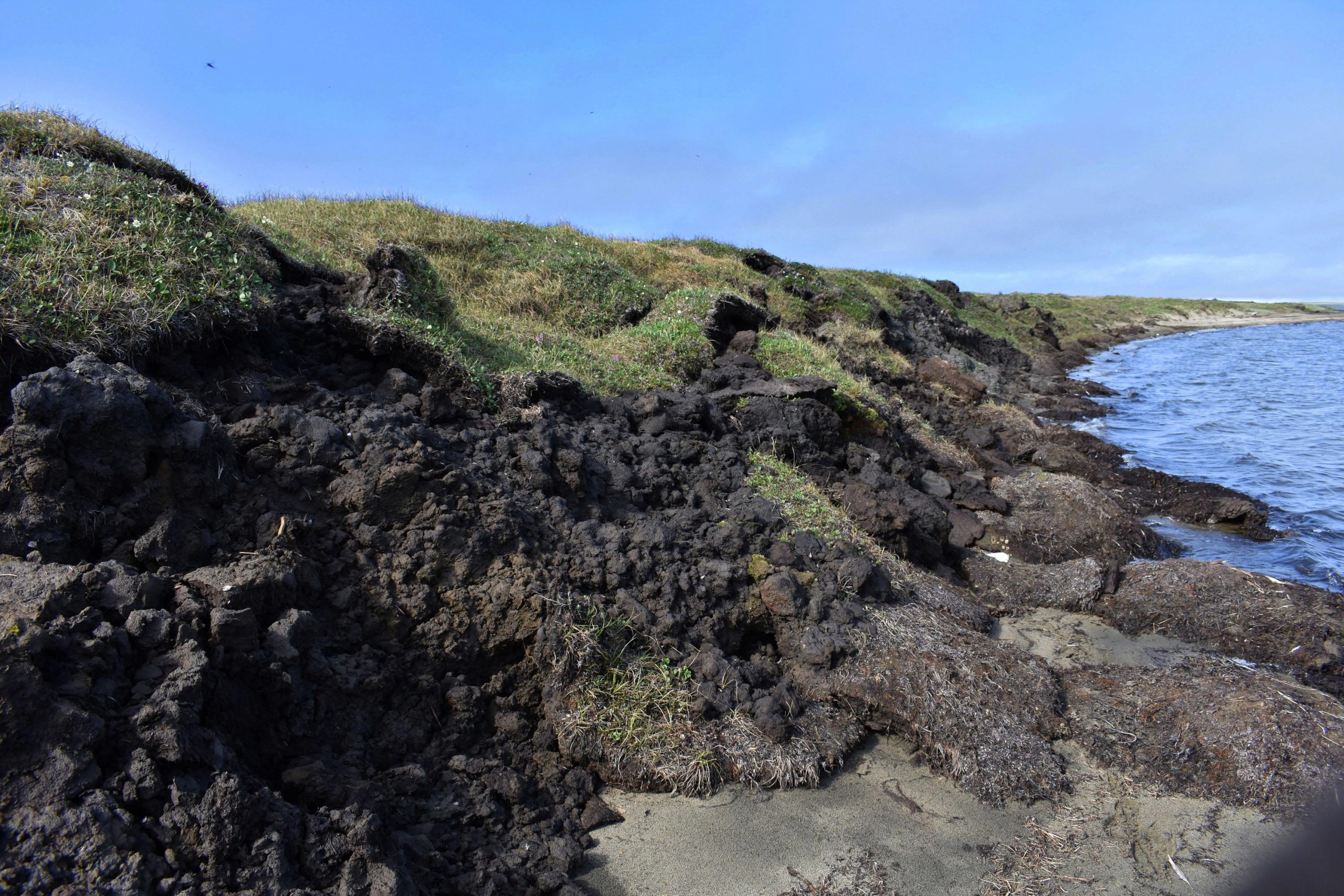
Yet, we know relatively little about this ocean-ward, lateral flows of carbon—especially in the Arctic, where measurements are sparse and where rapid warming is leading to intensification of the hydrological cycle, increased runoff, and permafrost thaw.
This is where Rawlins’s two papers, published in the Journal of Geophysical Research and Environmental Research Letters, come in.
A New Model for Dissolved Organic Carbon (DOC)
Rawlins and his co-authors have modified a numerical model that accurately captures the seasonal accumulation of snow, as well as the freezing and thawing of soils, by adding an accounting of the production, decomposition, storage and “loading” of DOC to streams and rivers. The model now simulates the amount of carbon running off into the region’s rivers with startling accuracy. It’s the first model to capture the seasonal variation in the amount of DOC exported to the ocean, a marked east-west gradient across 24 drainage basins on the North Slope of Alaska and the relatively equal amounts of DOC flowing through north-draining rivers and through west-draining ones.
Perhaps most importantly, the model points to rising amounts of freshwater and DOC exported to a coastal lagoon in Northwest Alaska. The year 2019 particularly stands out, with a massive freshwater export of DOC that was nearly three times the amount exported during the early 1980s. “Increased freshwater export has implications for salinity and other components of the lagoon aquatic environment”, says Rawlins. The changes are linked to increasing precipitation, particularly during the summer, and the effects of warming and thawing soils. “The largest freshwater and DOC increases,” says Rawlins, “occur in Autumn, which is not surprising given the significant losses in sea ice across the nearby Beaufort and Chukchi Seas, in turn connected to our warming climate.”
Ultimately, this new model can help scientists to refine carbon baselines and better understand how global warming is altering the Earth’s carbon cycle.
References:
“Modeling Terrestrial Dissolved Organic Carbon Loading to Western Arctic Rivers” by Michael A. Rawlins, Craig T. Connolly and James W. McClelland, 30 August 2021, Journal of Geophysical Research: Biogeosciences.
DOI: 10.1029/2021JG006420
“Increasing freshwater and dissolved organic carbon flows to Northwest Alaska’s Elson lagoon” by Michael A Rawlins, 12 October 2021, Environmental Research Letters.
DOI: 10.1088/1748-9326/ac2288
This research was supported by the US Department of Energy, National Aeronautics and Space Administration, and the National Science Foundation, and is affiliated with DOE’s Next-Generation Ecosystem Experiments-Arctic project (NGEE-Arctic), NASA’s Arctic Boreal Vulnerability Experiment (ABoVE) and the NSF-supported Beaufort Lagoons Ecosystems Long-Term Ecological Research project (BLE-LTER).
Never miss a breakthrough: Join the SciTechDaily newsletter.
Follow us on Google and Google News.
1 Comment
“A small, but not insignificant amount of this dissolved organic carbon (DOC) is “out-gassed” from the river water and into the atmosphere as a greenhouse gas.”
As shown by the OCO-2 satellite in 2014, a large and significant amount of dissolved organic carbon is out-gassed from tropical oceans as well. Strangely, after being shown at the AGU conference that year, it rarely gets mentioned with respect to the role in the Carbon Cycle. Being in the tropics, the out-gassing does not show the seasonal periodicity of boreal emissions.