

A new materials-based approach is offering insight into one of the most persistent environmental challenges.
PFAS, often called “forever chemicals,” have quietly spread through groundwater, rivers, and even treated drinking water, exposing millions of people worldwide. These compounds are prized in industry for their resistance to heat, water, and oil, but those same properties make them extremely difficult to break down once they enter the environment.
Now, researchers at Flinders University report a new strategy that may overcome one of the biggest limitations in current water treatment: capturing the smallest and most mobile PFAS molecules.
Led by Dr. Witold Bloch, the team developed a specialized material that can bind a wide spectrum of PFAS, including short-chain variants that typically slip through conventional filtration systems. These smaller molecules are increasingly used as replacements for older PFAS chemicals, yet they are harder to remove and can travel more easily through water supplies.
The findings were published in the journal Angewandte Chemie International Edition.
A Molecular Cage That Traps PFAS
The study highlights a nano-sized molecular cage designed to act as a highly selective ‘PFAS trap’.
“While some long-chain PFAS can be partially removed using existing water treatment technologies, the capture of short-chain PFAS – which are more mobile in water – remains a major unresolved challenge,” says project leader Dr. Witold Bloch, from Flinders University’s College of Science and Engineering.
“We discovered that a nano-sized cage captures short-chain PFAS by forcing them to aggregate favorably inside its cavity. This unusually strong binding mechanism is different from that of traditional adsorbent materials.”
To enhance performance, the researchers incorporated these molecular cages into mesoporous silica, a material that typically does not bind PFAS.
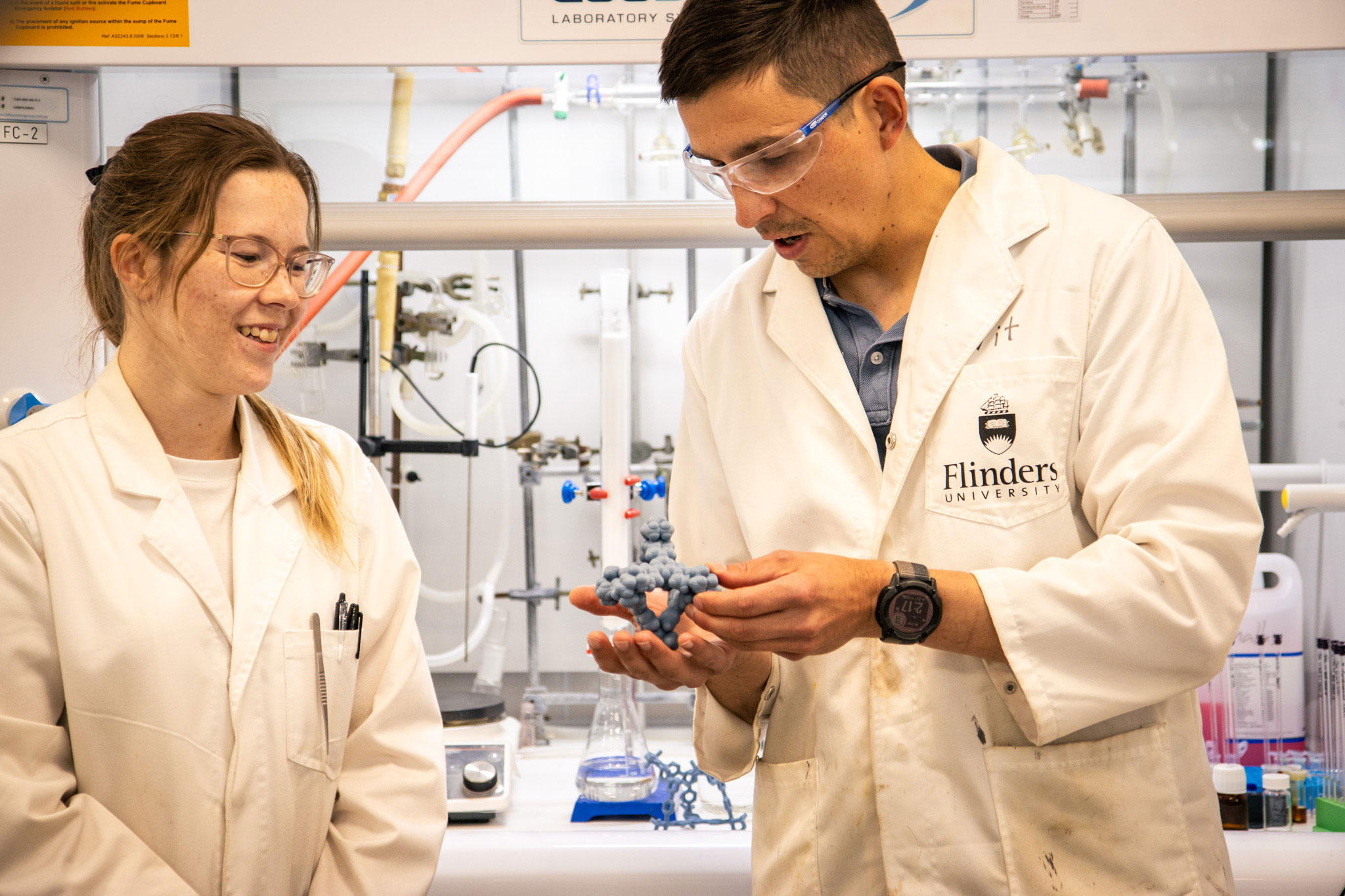
First author Caroline Andersson, a PhD candidate in chemistry at Flinders University, explains that adding the nanosized cage allows the material to capture a wide range of PFAS, including short-chain forms that are notoriously difficult to isolate.
“The most exciting aspect of this project was that we first conducted in-depth studies of how PFAS bind within the cage on the molecular level,” she says. “That allowed us to understand the precise binding behavior and then use that knowledge to design an effective adsorbent for PFAS removal.”
Strong Performance and Reusability
Laboratory tests showed that the material can remove up to 98% of PFAS at environmentally relevant concentrations in model tap water.
“The adsorbent also demonstrated reusability, remaining highly effective after at least five cycles of reuse. These results highlight its potential for integration into water filtration systems for polishing drinking water at the final stage of treatment,” adds Dr. Bloch.
“This research represents an important step toward the development of advanced materials capable of tackling one of the world’s most persistent environmental contaminants,” he concludes.
PFAS compounds originate from industrial processes, aviation firefighting foam, and everyday consumer products. As they enter freshwater and marine environments, they are raising increasing concerns about potential health risks to humans, livestock, and wildlife.
Reference: “Efficient Removal of Short-Chain Perfluoroalkyl Substances by Cavity-Directed Aggregation in a Molecular Cage Host” by Caroline V. I. Andersson, Sumali G. T. Mudiyanselage, Martin D. Peeks, Asja A. Kroeger, Jemma I. Virtue, Maximilian Mann, Justin M. Chalker, Michelle L. Coote, Martin R. Johnston and Witold M. Bloch, 9 February 2026, Angewandte Chemie International Edition.
DOI: 10.1002/anie.202526027
The PFAS study was funded by Australian Research Council grants (FT240100330, DE240100664, DP230100587, CE230100021 and FT220100054), and Playford Trust PhD and ATSE Elevate PhD scholarships. The study used facilities including the MX1 and MX2 beamline at the ANSTO Australian Synchrotron, Australian Cancer Research Foundation detector, Flinders Analytical, Flinders Deepthought and the National Facility of the National Computational Infrastructure, and Microscopy Australia, enabled by NCRIS and the government of South Australia at Flinders Microscopy and Microanalysis.
Never miss a breakthrough: Join the SciTechDaily newsletter.
Follow us on Google and Google News.
4 Comments
Hi! Intresting articles about water. But have you heard about scarab devopments new technic? It cleans 100 proc of everything in water.
I like it
It sounds like real good news but the fact of the matter is that the creation and use of some PFASs still precedes the mainstream medicine recognition and research of a (my) kind of sub-acute non-IgE-mediated food allergy reactions (https://soilandhealth.org/wp-content/uploads/02/0201hyglibcat/020108.coca.pdf) and officially (FDA in the US) approved food poisoning (soy, TBHQ and MSG, minimally) by about seventy years; still no recognition and no research. The reason I mention that is because some of the published symptoms of “alleged” PFAS poisoning are in common with those possible from untested people regularly ingesting unknown allergens aggravated (or not) with toxic food additives. Therefore, problems may occur for people who are led to believe they have a PFAS related illness when they actually are victims of cheaply and easily avoided/remedied food allergies. For medical and legal professionals to focus on PFASs may ultimately deprive large numbers of suffering individuals of the relief they desperately need which may be readily available through mere dietary changes. That’s not to say that PFASs are not harmful or dangerous, just that mainstream medicine is not yet a reliable source of information and/or treatment.
Using autistic frequencies also seperates them. Under a negative octave of natural vibrations will push the sediments apart in between a frequency of 528hz to structure the water molecules. 1 drop of water holds 1.6 sextillion molecules, 1.4 octillion in the hueman body. Crazy stuff! This is great news because water is everything for life itself, we should be treating water plants with the same respect has hospitals.