
A study reveals that microglia regulate anxiety by interacting with neurons, reshaping how scientists understand and treat mental health disorders.
The surge in anxiety experienced in the wake of the pandemic remains unprecedented, yet the origin of anxiety-related disorders, such as obsessive-compulsive spectrum disorder (OCSD), remains elusive. In a new study, scientists from the University of Utah Health have shed light on the crucial role of an often-overlooked cell type in the brain, microglia, in regulating anxiety-linked behaviors in mice used for laboratory tests. This contrasts with the conventional belief that neurons, the predominant brain cell type, control behavior.
The researchers showed that, like buttons on a game controller, specific microglia populations activate anxiety and OCSD behaviors while others dampen them. Further, microglia communicate with neurons to invoke the behaviors. The findings, published in Molecular Psychiatry, could eventually lead to new approaches for targeted therapies.

“A small amount of anxiety is good,” says Nobel Laureate Mario Capecchi, Ph.D., a distinguished professor of human genetics at the Spencer Fox Eccles School of Medicine at the University of Utah and senior author of the study. “Anxiety motivates us, spurs us on, and gives us that extra bit of push that says, ‘I can.’ But a large dose of anxiety overwhelms us. We become mentally paralyzed, the heart beats faster, we sweat, and confusion settles in our minds.”
The newly identified mechanisms could be important for maintaining behaviors within the healthy range under normal conditions. Under pathological conditions, the mechanisms could drive behaviors that become debilitating, Capecchi says.
“This work is unique and has challenged the current dogma about the role of microglia function in the brain,” says Naveen Nagajaran, Ph.D., a geneticist and neuroscientist at U of U Health and the study’s lead author.
Manipulating Microglia
Mice with OCSD-like behaviors can’t resist grooming themselves. They lick their bodies so much that their fur sloughs off, and they develop welts. Previously, Capecchi’s team discovered that a mutation in a gene called Hoxb8 caused mice to show signs of chronic anxiety and to groom themselves excessively. Unexpectedly, they identified that the source of these behaviors was a type of immune cell called microglia. Accounting for only 10% of cells in the brain, microglia had been thought of as the brain’s “trash collectors” that disposed of dying neurons—the most common brain cell—and abnormally shaped proteins. Their discoveries were also among the first to reveal that Hoxb8 microglia were important for controlling behavior by communicating with specific neuronal circuits.

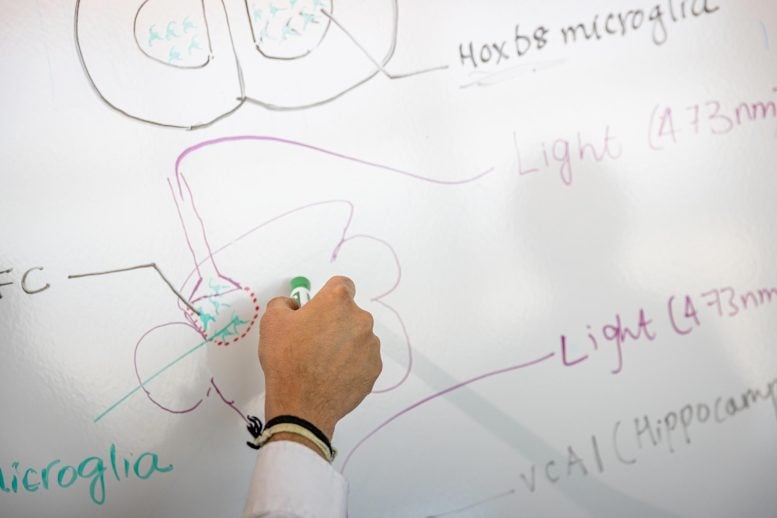
But how microglia accomplished these tasks remained a mystery. To learn more, Nagajaran turned to optogenetics, a technique that combines laser light and genetic engineering. Like playing a video game, he used the laser to stimulate specific populations of microglia in the brain.
Microglia as the Brain’s Behavioral Switch
To the researchers’ amazement, they could turn on anxiety-related behaviors with the flip of a switch. When they used the laser to stimulate one subpopulation, Hoxb8 microglia, the mice became more anxious. When the laser triggered Hoxb8 microglia in other parts of the brain, the mice groomed themselves. Targeting Hoxb8 microglia in yet another location had multiple effects: the mice’s anxiety increased, they groomed themselves, and they froze, an indicator of fear. Whenever the scientists turned the laser off, the behaviors stopped.
“That was a big surprise for us,” Nagarajan says. “It is conventionally thought that only neurons can generate behaviors. The current findings shed light on a second way that the brain generates behaviors using microglia.” In fact, stimulating microglia with the laser caused the neurons sitting next to them to fire more strongly, suggesting that the two cell types communicate with one another to drive distinct behaviors.
Further experiments revealed yet another layer of control by a population of microglia that do not express Hoxb8. Stimulating “non-Hoxb8” and Hoxb8 microglia at the same time prevented the onset of anxiety and OCSD-like behaviors. These results suggested that the two populations of microglia act like a brake and an accelerator. They balance each other out under normal conditions and induce a disease state when the signals are off-balance.
Potential Implications for Anxiety Treatment
The research shows that location and type of microglia are two characteristics that appear to be important for fine-tuning anxiety and OCSD behaviors. From there, microglia communicate with specific neurons and neural circuits that ultimately control behavior, Capecchi says. “We want to learn more about the two-way communications between neurons and microglia,” he says. “We want to know what’s responsible for that.” Defining these interactions in mice could lead to therapeutic targets for controlling excessive anxiety in patients.
Reference: “Optogenetic stimulation of mouse Hoxb8 microglia in specific regions of the brain induces anxiety, grooming, or both” by Naveen Nagarajan and Mario R. Capecchi, 10 April 2023, Molecular Psychiatry.
DOI: 10.1038/s41380-023-02019-w
Never miss a breakthrough: Join the SciTechDaily newsletter.
Follow us on Google and Google News.
1 Comment
I suffer from sjogrens and another autoimmune disease which has recently induced afib and depression and found this article most interesting. Help will not come in my lifetime but maybe helpful to those suffering from these diseases and ptsd. Thanks for your work in this area.