
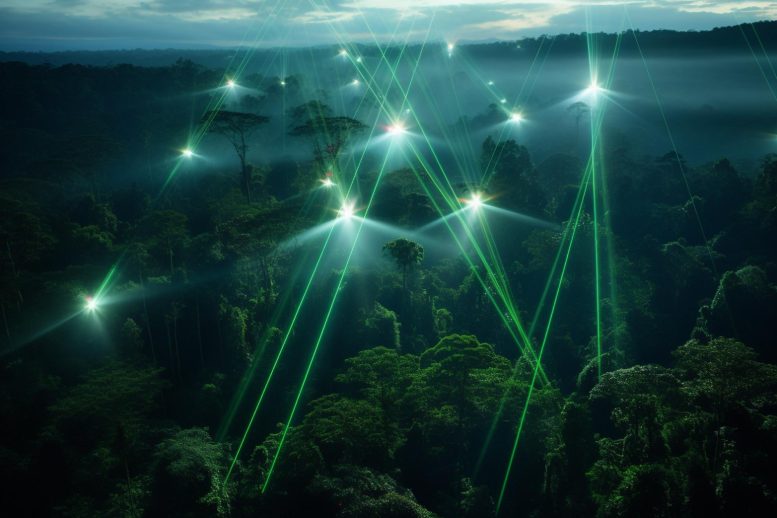
NASA’s GEDI, a space laser, has provided a groundbreaking, detailed structural view of the world’s rainforests, enabling researchers to further understand these complex ecosystems.
Uncovering the Secrets of Rainforest Canopies
We know less about the rainforest canopy, where most of the world’s species live than we do about the surface of Mars or the bottom of the ocean. However, that is about to change thanks to GEDI—a NASA space laser that has provided a detailed structure of the world’s rainforests for the first time ever.
“Tropical forests are mainly unstratified, especially in Amazonia and regions with lower fertility or higher temperatures” reads the title of the recently published paper in the journal Environmental Research Ecology that details the laser’s findings. Authored by researchers from the U.S., the U.K., and Singapore, Christopher Doughty, professor in Northern Arizona University’s School of Informatics, Computing, and Cyber Systems and first author on the study, believes this research is crucial—and long overdue—in finding out more about the tropical ecosystems.
Implications of the Rainforest Structure
“Most of the world’s species live in tropical forests and most of those make use of the canopy, and yet, we know so little,” Doughty said. “Rainforest structure matters because it controls how animals access resources and escape predators, and these findings will help us understand tropical forest animal’s susceptibility to climate change.”
Research into forest canopies has come a long way. Early western visitors described tropical forests as horror vacui (nature abhorring a vacuum) since vegetation was “anxious to fill every available space with stems and leaves.” Later, as scientists began to study tropical forests, they categorized the lush flora into forest layers—a thick upper crown and a thick mid-layer with a thin layer in between. However, this was only observed in a few well-studied locations. The structure across most tropical forests was still unknown.
Enter GEDI
Then came GEDI, the Global Ecosystem Dynamics Investigation, NASA’s game-changing tool for ecosystem investigation.
“A key difference between GEDI and many other satellites is its measurement of three-dimensional canopy structure,” said Hao Tang, professor in the Department of Geography at the National University of Singapore (NUS) and co-author on the paper. Tang, who is also a principal investigator at the NUS Centre for Nature-based Climate Solutions, added, “Conventional satellites, while providing valuable data on land cover and canopy greenness, often lack the detailed vertical information offered by GEDI. This vertical information is crucial for understanding ecosystem dynamics, carbon storage and biodiversity that cannot be easily seen from typical satellite images.”
Launched in late 2018, NASA’s GEDI shoots an invisible laser from the International Space Station into Earth’s forests thousands of times a day. Depending on the amount of energy returned to the satellite, it can provide a detailed 3D map that shows where the leaves and branches are in a forest and how they change over time. This will help researchers understand the amounts of biomass and carbon forests store and how much they lose when disturbed—vital information for understanding Earth’s carbon cycle and how it is changing.
Findings and Implications
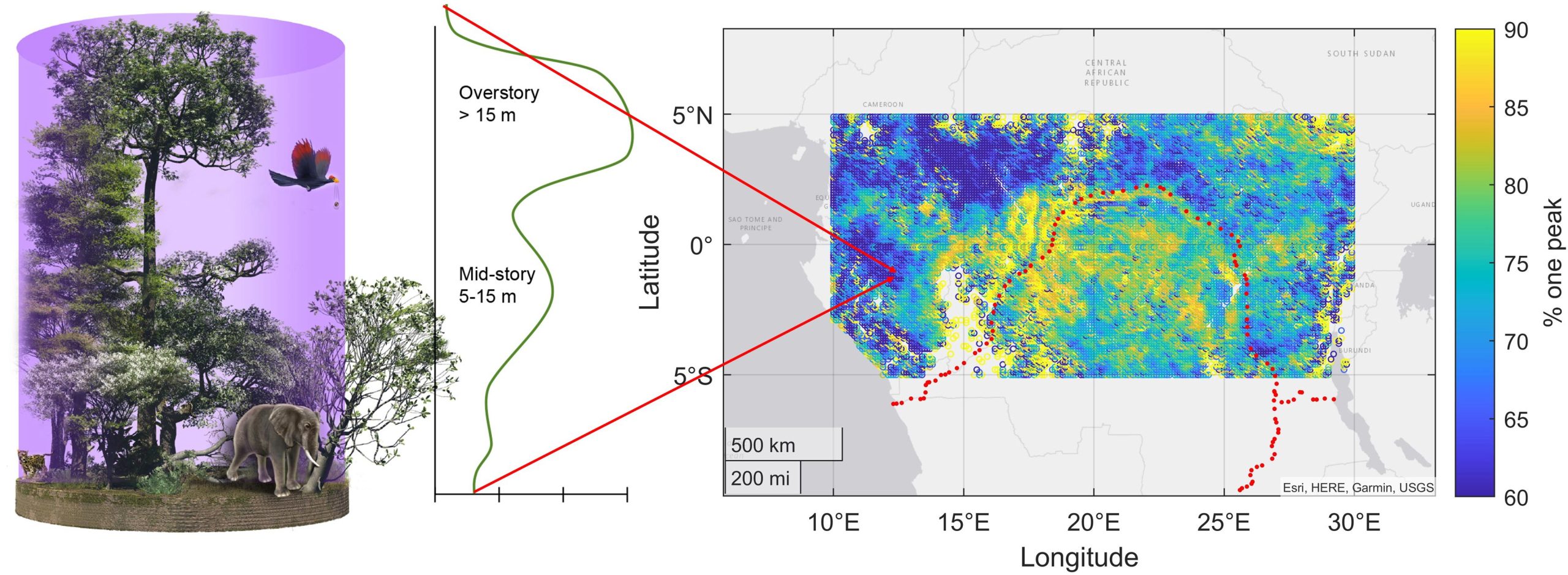
Doughty, Tang, and the other authors of the paper analyzed GEDI data across all tropical forests and found that the structure was simpler and more exposed to sunlight than previously thought. Data also revealed that most tropical forests (80 percent of the Amazon and 70 percent of Southeast Asia and the Congo Basin) have a peak in the number of leaves at 15 meters instead of at the canopy top, debunking the fullest-at-the-top theory of early researchers. While forests vary, a key finding that seemed to remain constant in every scenario was that deviation from more ideal conditions (like lower fertility or higher temperatures) leads to shorter, less stratified forests with lower biomass.
“It was really surprising to see the dominance of this structure type because it differs from what we had learned in the classic textbooks on the topic,” Doughty said. “These findings will not only help us understand how the millions of species that live in a rainforest canopy might acclimate to changing temperatures, but also how much carbon these forests hold and how good they are at fighting climate change.”
Reference: “Tropical forests are mainly unstratified especially in Amazonia and regions with lower fertility or higher temperatures” by Christopher E Doughty, Camille Gaillard, Patrick Burns, Jenna Keany, Andrew Abraham, Yadvinder S Malhi, Jesus Aguirre-Gutierrez, George Koch, Patrick Jantz, Alexander Shenkin and Hao Tang, 13 July 2023, Environmental Research Ecology.
DOI: 10.1088/2752-664X/ace723
Never miss a breakthrough: Join the SciTechDaily newsletter.
Follow us on Google and Google News.
2 Comments
Ok….very interesting & maybe the worst or most negative points will be exposed to eliminate detrimental emissions to planet!
Sounds exactly like LIDAR but different.