
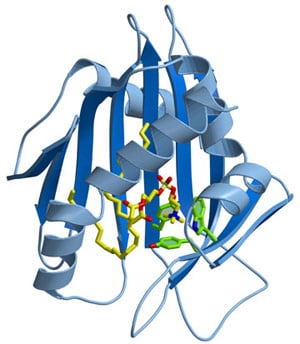
Harvard Medical School researchers have uncovered a new pathway in insulin resistance and show that a newly discovered small-molecule inhibitor can interrupt this pathway and increase insulin signaling.
Insulin resistance unleashes a vicious cycle in Type 2 diabetes whereby excess blood sugar induces the release of yet more insulin by the pancreas. A primary goal of treatment is to boost insulin sensitivity so that liver cells can more effectively store blood sugar and release less of it into the bloodstream.
Researchers at Harvard Medical School have uncovered a new pathway in insulin resistance, one that is governed by protein interactions driven by the lipid composition of cell membranes. They also show that a newly discovered small-molecule inhibitor can interrupt this pathway and increase insulin signaling.
“When taken together with our prior publications, these findings suggest that the inhibitor could be a novel agent for the treatment of Type 2 diabetes,” said David E. Cohen, HMS Robert H. Ebert Professor of Medicine and Health Sciences and Technology at Brigham and Women’s Hospital, and a senior author on the paper.
The findings are published in the July 30 issue of Science Signaling.
The newly revealed pathway is coordinated by a complex of two molecular partners: phosphatidylcholine transfer protein (PC-TP) and thioesterase superfamily member 2 (THEM2). In a previous study, Cohen found that suppressing PC-TP reduced blood sugar levels, boosted insulin sensitivity and improved resistance to Type 2 diabetes in mice. Inactivating THEM2 had a similar effect, but the way in which the two molecular players achieved their benefits in diabetes remained unclear.
Baran Ersoy, a post-doctoral fellow in Cohen’s lab before becoming an HMS instructor in medicine at Brigham and Women’s, launched a multiyear series of studies to find out. He relied on a PC-TP inhibitor dubbed compound A1 (developed previously in Cohen’s laboratory), and found that the PC-TP complex suppressed the insulin signaling pathway at two distinct points.
Ersoy first showed that PC-TP and THEM2 each suppress insulin receptor substrate 2 (IRS2), a protein that would otherwise limit glucose production and storage when insulin binds to the surface of liver cells. He also found that PC-TP and THEM2 suppress a different protein known as mammalian target of rapamycin complex 1, which has similar regulatory effects on glucose control.
In overfed mice with diabetes, the PC-TP complex gets stuck in an “on” position and continues to suppress insulin signaling causing liver cells to make and release too much glucose into the bloodstream. But by using compound A1 to limit PC-TP activity, Ersoy was able to restore the liver’s insulin sensitivity so that mice had lower levels of blood sugar and greater resistance to diabetes symptoms.
What’s more, compound A1 exerted these benefits before the mice could harness other metabolic options for boosting insulin sensitivity. This helped to confirm that the observed improvements in insulin sensitivity had resulted from PC-TP inhibition and not some other adaptive mechanism.
“What attracted us to this was we had a protein with very specific characteristics that regulates an unanticipated metabolic process,” Cohen said. “We saw an opportunity to explain it as well as an opportunity to intervene.”
From here, Cohen’s research team plans to conduct increasingly detailed investigations into how PC-TP and THEM2 regulate insulin signaling and glucose control, in addition to other metabolic effects. “We see more and more examples of genes that regulate metabolism,” Cohen said. “In this case, we’ve taken that research a step further by creating a chemical compound that inhibits the metabolic target and that helps us to understand the mechanism by which it works.”
This work was supported by the National Institutes of Health (DK56626, DK48873, CA122617, HL46457, HL48743, and DK080789), the Harvard Digestive Diseases Center (P30 DK34854), a Ruth L. Kirschstein National Research Service Award (DK093195) and an American Liver Foundation Congressman John Joseph Moakley Postdoctoral Research Fellowship Award.
Reference: “Phosphatidylcholine Transfer Protein Interacts with Thioesterase Superfamily Member 2 to Attenuate Insulin Signaling” by Baran A. Ersoy, Akansha Tarun, Katharine D’Aquino, Nancy J. Hancer, Chinweike Ukomadu, Morris F. White, Thomas Michel, Brendan D. Manning and David E. Cohen, 30 July 2013, Science Signaling.
DOI: 10.1126/scisignal.2004111
Never miss a breakthrough: Join the SciTechDaily newsletter.
Follow us on Google and Google News.
1 Comment
I wish I worked hard enough in High school to attend a prestigious university like Harvard…..this type of research is what drives technology advancement and I would love to be a part of it.