
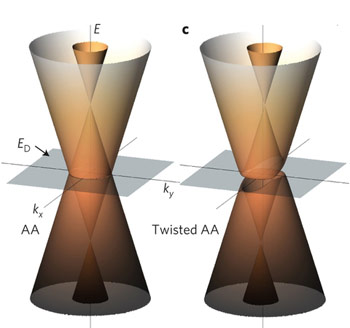
Berkeley Lab researchers have solved a long-standing puzzle, discovering that in the stacking of graphene monolayers subtle misalignments arise, creating an almost imperceptible twist in the final bilayer graphene that prevents the graphene from becoming fully insulating even under a very strong electric field.
Researchers with the U.S. Department of Energy (DOE)’s Lawrence Berkeley National Laboratory (Berkeley Lab) have discovered a unique new twist to the story of graphene, sheets of pure carbon just one atom thick, and in the process appear to have solved a mystery that has held back device development.
Electrons can race through graphene at nearly the speed of light – 100 times faster than they move through silicon. In addition to being superthin and superfast when it comes to conducting electrons, graphene is also superstrong and superflexible, making it a potential superstar material in the electronics and photonics fields, the basis for a host of devices, starting with ultrafast transistors. One big problem, however, has been that graphene’s electron conduction can’t be completely stopped, an essential requirement for on/off devices.
The on/off problem stems from monolayers of graphene having no bandgaps – ranges of energy in which no electron states can exist. Without a bandgap, there is no way to control or modulate electron current and therefore no way to fully realize the enormous promise of graphene in electronic and photonic devices. Berkeley Lab researchers have been able to engineer precisely controlled bandgaps in bilayer graphene through the application of an external electric field. However, when devices were made with these engineered bandgaps, the devices behaved strangely, as if conduction in those bandgaps had not been stopped. Why such devices did not pan out has been a scientific mystery until now.
Working at Berkeley Lab’s Advanced Light Source (ALS), a DOE national user facility, a research team led by ALS scientist Aaron Bostwick has discovered that in the stacking of graphene monolayers subtle misalignments arise, creating an almost imperceptible twist in the final bilayer graphene. Tiny as it is – as small as 0.1 degree – this twist can lead to surprisingly strong changes in the bilayer graphene’s electronic properties.
“The introduction of the twist generates a completely new electronic structure in the bilayer graphene that produces massive and massless Dirac fermions,” says Bostwick. “The massless Dirac fermion branch produced by this new structure prevents bilayer graphene from becoming fully insulating even under a very strong electric field. This explains why bilayer graphene has not lived up to theoretical predictions in actual devices that were based on perfect or untwisted bilayer graphene.”
Bostwick is the corresponding author of a paper describing this research in the journal Nature Materials titled “Coexisting massive and massless Dirac fermions in symmetry-broken bilayer graphene.” Keun Su Kim of the Fritz Haber Institute in Berlin is the lead author Other coauthors are Andrew Walter, Luca Moreschini, Thomas Seyller, Karsten Horn, and Eli Rotenberg, who oversees the research at ALS Beamline 7.0.1.
Rotenberg, Bostwick, Kim and their co-authors tackled the bilayer graphene mystery by performing a series of angle-resolved photoemission spectroscopy (ARPES) experiments at ALS beamline 7.0.1. ARPES is a technique for studying the electronic states of a solid material in which a beam of X-ray photons striking the material’s surface causes the photoemission of electrons. The kinetic energy of these photoelectrons and the angles at which they are ejected are then measured to obtain an electronic spectrum.
“The combination of ARPES and Beamline 7.0.1 enabled us to easily identify the electronic spectrum from the twist in the bilayer graphene,” says Rotenberg. “The spectrum we observed was very different from what has been assumed and contains extra branches consisting of massless Dirac fermions. These new massless Dirac fermions move in a completely unexpected way governed by the symmetry twisted layers.”
Massless Dirac fermions, electrons that essentially behave as if they were photons, are not subject to the same bandgap constraints as conventional electrons. In their Nature Materials paper, the authors state that the twists that generate this massless Dirac fermion spectrum may be nearly inevitable in the making of bilayer graphene and can be introduced as a result of only ten atomic misfits in a square micron of bilayer graphene.
“Now that we understand the problem, we can search for solutions,” says lead author Kim. “For example, we can try to develop fabrication techniques that minimize the twist effects, or reduce the size of the bilayer graphene we make so that we have a better chance of producing locally pure material.”
Beyond solving a bilayer graphene mystery, Kim and his colleagues say the discovery of the twist establishes a new framework on which various fundamental properties of bilayer graphene can be more accurately predicted.
“A lesson learned here is that even such a tiny structural distortion of atomic-scale materials should not be dismissed in describing the electronic properties of these materials fully and accurately,” Kim says.
This research was supported by the DOE Office of Science.
Reference: “Coexisting massive and massless Dirac fermions in symmetry-broken bilayer graphene” by Keun Su Kim, Andrew L. Walter, Luca Moreschini, Thomas Seyller, Karsten Horn, Eli Rotenberg and Aaron Bostwick, 28 July 2013, Nature Materials.
DOI: 10.1038/nmat3717
Never miss a breakthrough: Join the SciTechDaily newsletter.
Follow us on Google and Google News.
2 Comments
I wonder if this is unresolvable? As much as the turbulence in the ignition of fusion prevents this form of nuclear power becoming available?
Doping, as is done with semiconductors, may solve the alignment issue – like using a very thin mortar between the layers.
Perhaps that is how doping has actually worked all along.