
Close Menu
    Facebook X (Twitter) Instagram
    SciTechDaily
    • Biology
    • Chemistry
    • Earth
    • Health
    • Physics
    • Science
    • Space
    • Technology
    Facebook X (Twitter) Pinterest YouTube RSS
    SciTechDaily
    Home»Health»Next-Gen Tumor Treatment: Metal-Free Nanozyme From Graphene Quantum Dots
    Health

    Next-Gen Tumor Treatment: Metal-Free Nanozyme From Graphene Quantum Dots

    By Chinese Academy of SciencesFebruary 10, 2024No Comments2 Mins Read
    Facebook Twitter Pinterest Telegram LinkedIn WhatsApp Email Reddit
    Share
    Facebook Twitter LinkedIn Pinterest Telegram Email Reddit
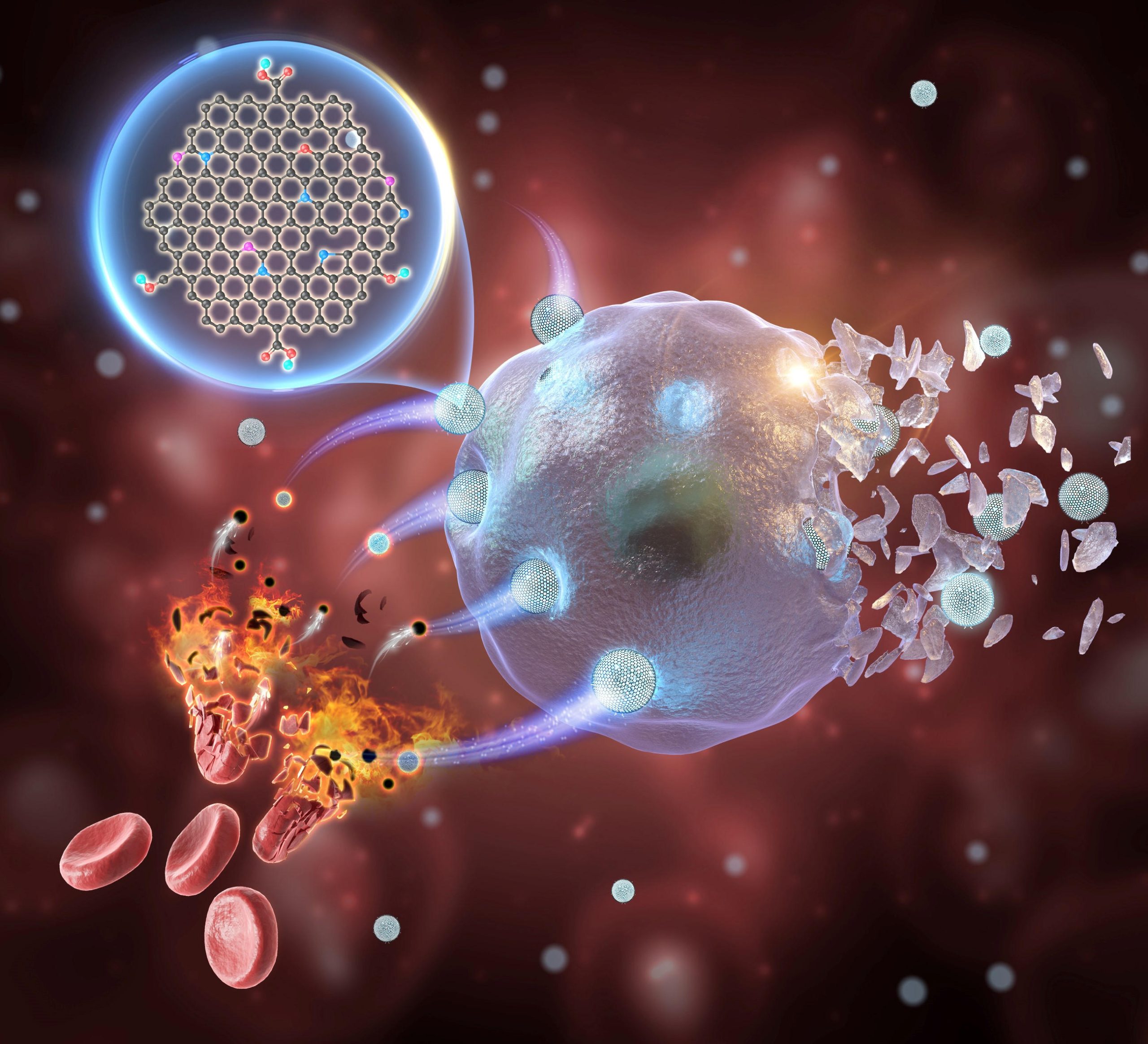
    Schematic Illustration Showing the Role of GQDs
    Schematic illustration showing the role of GQDs, derived from erythrocyte membranes, as peroxidase–mimic enzyme for tumor catalytic therapy. Credit: FHIPS

    A team led by Professor Wang Hui at the Hefei Institutes of Physical Science, part of the Chinese Academy of Sciences, has developed a metal-free nanozyme using graphene quantum dots (GQDs). This innovation is aimed at enhancing the effectiveness of tumor chemodynamic therapy (CDT).

    The study was published in the journal Matter.

    GQDs represent a promising and cost-effective means of addressing the toxicity concerns associated with metal-based nanozymes in tumor CDT. However, the limited catalytic activity of GQDs has posed significant challenges for their clinical application, particularly under challenging catalytic conditions.

    “The obtained GQDs, which are made from red blood cell membranes, are highly effective in treating tumors with few side effects,” said LIU Hongji, a member of the research team. “One of the advantages is that they are metal-free. In addition, they function as excellent peroxidase-like biocatalysts.”

    Enhancing Catalytic Performance

    To enhance the catalytic performance of the GQD-based nanocatalytic adjuvant, the researchers rationally designed GQDs using a diatomic doping strategy. The synergistic electron effect of introducing nitrogen and phosphorus into GQDs can generate highly localized states near the Fermi level, thus enabling efficient enzymatic activity compared to single heteroatom doping.

    The obtained GQDs, derived from erythrocyte membranes, have been shown to possess impressive peroxidase-mimicking activity. As a result, the GQDs are highly effective at inducing apoptosis and ferroptosis of cancer cells in vitro. They also selectively target tumors, with a tumor inhibition rate as high as 77.71% for intravenous injection and 93.22% for intratumoral injection, with no off-target side effects.

    This drug-free, target-specific, and biologically benign nanozyme has great potential as a potent biocatalyst for use in safe cancer treatment.

    Reference: “Graphene quantum dots as metal-free nanozymes for chemodynamic therapy of cancer” by Hongji Liu, Zhiming Deng, Zonghui Zhang, Wenchu Lin, Miqin Zhang and Hui Wang, 10 January 2024, Matter.
    DOI: 10.1016/j.matt.2023.12.005

    Never miss a breakthrough: Join the SciTechDaily newsletter.
    Follow us on Google and Google News.

    Biomedical Engineering Cancer Chinese Academy of Sciences Nanotechnology Quantum Dots
    Share. Facebook Twitter Pinterest LinkedIn Email Reddit

    Related Articles

    A “Double Punch” Nanoparticle Could Reveal and Destroy Brain Cancer Cells

    Scientists Unveil Breakthrough Method to Mass-Produce Cancer-Fighting Natural Killer Cells

    Tiny Metal Nanodots Obliterate Cancer Cells While Largely Sparing Healthy Tissue

    A Noninvasive Test Using Nanoparticles to Detect Cancer Cells and Pinpoint Their Location

    Researchers Reveal How Chronic Inflammation Can Lead to Cancer

    Gold Nanoparticles Intensify Cancer-Killing Radiation

    Injectable, Spontaneously Assembling Vaccines Could Fight Cancer

    Therapeutic Cancer Vaccine Begins Human Clinical Trials

    RNA Delivering Nanoparticles Shrink Tumors in Mice

    Leave A Reply Cancel Reply

    • Facebook
    • Twitter
    • Pinterest
    • YouTube

    Don't Miss a Discovery

    Subscribe for the Latest in Science & Tech!

    Trending News

    125-Million-Year-Old Crocodile Fossil Reveals Astonishing New Secrets

    Scientists Discover an “Impossible” Way Muscle Filaments Can Grow

    A Star’s Spin Could Solve a Longstanding Black Hole Mystery

    NASA Finds Earth Microbes Could Hide in the Moon’s Deep Shadows

    New Study: Intermittent Fasting Lowers Blood Sugar in Type 1 Diabetes

    Alzheimer’s Brain Changes May Begin 7 Years Earlier Than Scientists Thought

    This New Molecule Could Transform How We Recover Gold From Electronic Waste

    A Billion Years Before the Grand Canyon, a Giant Cliff May Have Stretched Across America

    Follow SciTechDaily
    • Facebook
    • Twitter
    • YouTube
    • Pinterest
    • Newsletter
    • RSS
    SciTech News
    • Biology News
    • Chemistry News
    • Earth News
    • Health News
    • Physics News
    • Science News
    • Space News
    • Technology News
    Recent Posts
    • How Insects Conquered Land Was Stranger Than Scientists Thought
    • A 250-Year-Old Heat Mystery Leads to a Surprising Discovery About Human Sweat
    • Thousands of Giant Whales Are Suddenly Flooding Into an Arctic “Feeding Frenzy”
    • AI Searched 150 Million Materials – and Found Two Promising Candidates for Future Electronics
    • A Major Quantum Computing Problem May Finally Have an Answer: Can We Trust the Results?
    Copyright © 1998 - 2026 SciTechDaily. All Rights Reserved.
    • Science News
    • About
    • Contact
    • Editorial Board
    • Privacy Policy
    • Terms of Use

    Type above and press Enter to search. Press Esc to cancel.