
Close Menu
    Facebook X (Twitter) Instagram
    SciTechDaily
    • Biology
    • Chemistry
    • Earth
    • Health
    • Physics
    • Science
    • Space
    • Technology
    Facebook X (Twitter) Pinterest YouTube RSS
    SciTechDaily
    Home»Earth»NOAA Issues First Severe (G4) Geomagnetic Storm Watch Since 2005 – Giant Sunspot Cluster 16x Earth’s Diameter
    Earth

    NOAA Issues First Severe (G4) Geomagnetic Storm Watch Since 2005 – Giant Sunspot Cluster 16x Earth’s Diameter

    By NOAA Space Weather Prediction CenterMay 10, 20241 Comment2 Mins Read
    Facebook Twitter Pinterest Telegram LinkedIn WhatsApp Email Reddit
    Share
    Facebook Twitter LinkedIn Pinterest Telegram Email Reddit
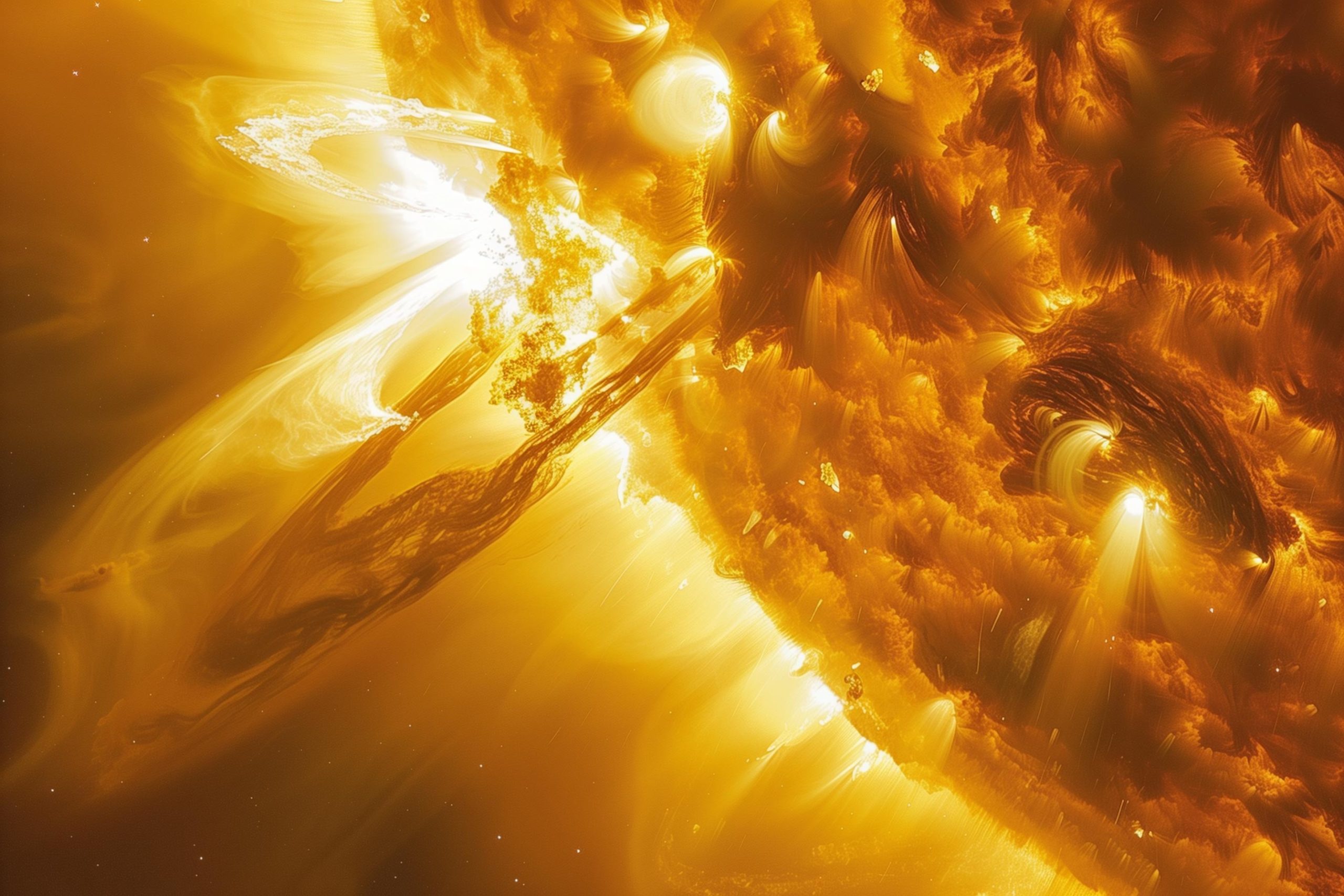
    Coronal Mass Ejection Art Concept
    On May 9, 2024, the NOAA Space Weather Prediction Center issued a Severe (G4) Geomagnetic Storm Watch, prompted by the observation of five Earth-directed coronal mass ejections. Credit: SciTechDaily.com

    On Thursday, May 9, 2024, the NOAA Space Weather Prediction Center issued a Severe (G4) Geomagnetic Storm Watch. At least five earth-directed coronal mass ejections (CMEs) were observed and expected to arrive as early as midday Friday, May 10, 2024, and persist through Sunday, May 12, 2024. Several strong flares have been observed over the past few days and were associated with a large and magnetically complex sunspot cluster (NOAA region 3664), which is 16 times the diameter of Earth.
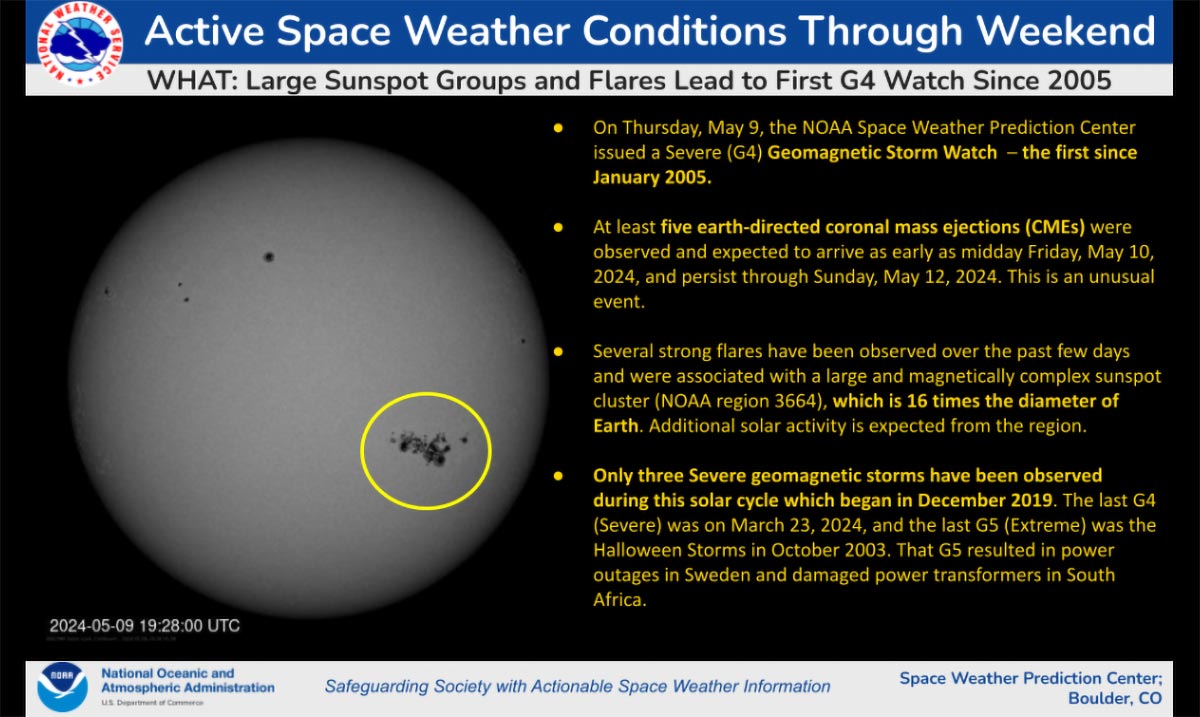
    SWPC Issues First G4 Watch Since 2005
    Credit: NOAA
    • On Thursday, May 9, the NOAA Space Weather Prediction Center issued a Severe (G4) Geomagnetic Storm Watch – the first since January 2005.
    • At least five earth-directed coronal mass ejections (CMEs) were observed and expected to arrive as early as midday Friday, May 10, 2024, and persist through Sunday, May 12, 2024. This is an unusual event.
    • Several strong flares have been observed over the past few days and were associated with a large and magnetically complex sunspot cluster (NOAA region 3664), which is 16 times the diameter of Earth. Additional solar activity is expected from the region.
    • Only three Severe geomagnetic storms have been observed during this solar cycle which began in December 2019. The last G4 (Severe) was on March 23, 2024, and the last G5 (Extreme) was the Halloween Storms in October 2003. That G5 resulted in power outages in Sweden and damaged power transformers in South Africa.

    Never miss a breakthrough: Join the SciTechDaily newsletter.
    Follow us on Google and Google News.

    Coronal Mass Ejections Geomagnetic Storms Solar Flares Space Weather
    Share. Facebook Twitter Pinterest LinkedIn Email Reddit

    Related Articles

    Massive Solar Storm Sparks Rare G4 Alert: What It Means for Earth

    Violent Coronal Mass Ejection Crashes Into Earth’s Magnetosphere, Lighting Up the Sky

    Lightning Impacts Edge of Space in Ways Not Previously Observed

    Space Weather Satellite Set to Go Where No Mission Has Gone Before

    NASA Looks at the Impacts of Strong Solar Flares

    New Light Shed on the Origins of Extreme Space Storms

    New Image of an M7.9 Flare from Active Region 1429

    NASA Continues to Monitor Solar Flares

    Strong Geomagnetic Storms a Possibility After Active Sunspot 1401 Erupted

    1 Comment

    1. Hottan Inductive on May 11, 2024 10:42 am

      I commented that on the May 9th article about solar flares. Actually, since then, NOAA issued a G5 condition before this article was published, so it’s conditions not seen since October 2003’s Halloween Storm. Keep up, scitechdaily!

      Reply
    Leave A Reply Cancel Reply

    • Facebook
    • Twitter
    • Pinterest
    • YouTube

    Don't Miss a Discovery

    Subscribe for the Latest in Science & Tech!

    Trending News

    Breakthrough Bowel Cancer Trial Leaves Patients Cancer-Free for Nearly 3 Years

    Natural Compound Shows Powerful Potential Against Rheumatoid Arthritis

    100,000-Year-Old Neanderthal Fossils in Poland Reveal Unexpected Genetic Connections

    Simple “Gut Reset” May Prevent Weight Gain After Ozempic or Wegovy

    2.8 Days to Disaster: Scientists Warn Low Earth Orbit Could Suddenly Collapse

    Common Food Compound Shows Surprising Power Against Superbugs

    5 Simple Ways To Remember More and Forget Less

    The Atomic Gap That Could Cost the Semiconductor Industry Billions

    Follow SciTechDaily
    • Facebook
    • Twitter
    • YouTube
    • Pinterest
    • Newsletter
    • RSS
    SciTech News
    • Biology News
    • Chemistry News
    • Earth News
    • Health News
    • Physics News
    • Science News
    • Space News
    • Technology News
    Recent Posts
    • Popular Weight-Loss Drugs Found To Cut Heart Attack and Stroke Risk
    • After 37 Years, the World’s Longest-Running Soil Warming Experiment Uncovers a Startling Climate Secret
    • NASA Satellite Captures First-Ever High-Res View of Massive Pacific Tsunami
    • ADHD Isn’t Just a Deficit: Study Reveals Powerful Hidden Strengths
    • Scientists Uncover “Astonishing” Hidden Property of Light
    Copyright © 1998 - 2026 SciTechDaily. All Rights Reserved.
    • Science News
    • About
    • Contact
    • Editorial Board
    • Privacy Policy
    • Terms of Use

    Type above and press Enter to search. Press Esc to cancel.