
Close Menu
    Facebook X (Twitter) Instagram
    SciTechDaily
    • Biology
    • Chemistry
    • Earth
    • Health
    • Physics
    • Science
    • Space
    • Technology
    Facebook X (Twitter) Pinterest YouTube RSS
    SciTechDaily
    Home»Earth»NOAA Scientists: 2020 Was Earth’s 2nd-Hottest Year on Record, Just Behind 2016
    Earth

    NOAA Scientists: 2020 Was Earth’s 2nd-Hottest Year on Record, Just Behind 2016

    By NOAAJanuary 29, 20213 Comments3 Mins Read
    Facebook Twitter Pinterest Telegram LinkedIn WhatsApp Email Reddit
    Share
    Facebook Twitter LinkedIn Pinterest Telegram Email Reddit
    2020 Second Hottest Year on Record
    The world’s seven warmest years have all occurred since 2014, with 10 of the warmest years occurring since 2005.

    It’s official: 2020 ranks as the second-hottest year on record for the planet, knocking 2019 down to third hottest, according to an analysis by NOAA scientists.

    The average land and ocean surface temperature across the globe in 2020 was 1.76 degrees F (0.98 degrees C) above average — just 0.04 degrees F (0.02 degrees C) cooler than the 2016 record.

    The Northern Hemisphere saw its hottest year on record at 2.30 degrees F (1.28 degrees C) above the 20th-century average.
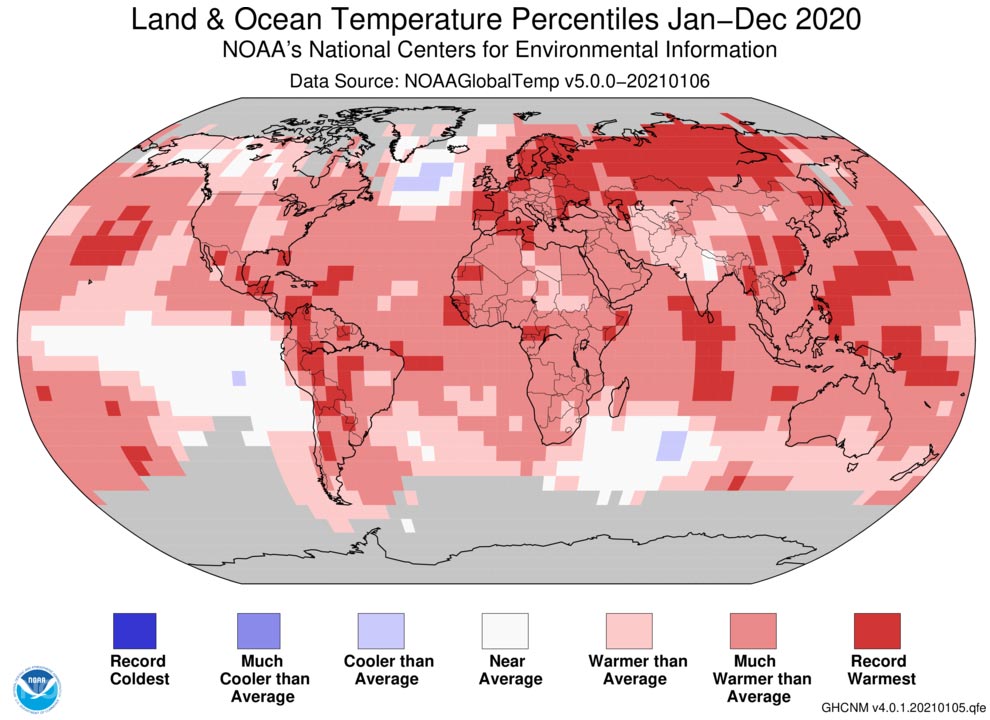
    Land and Ocean Temperature Percentiles 2020
    A world map plotted with color blocks depicting percentiles of global average land and ocean temperatures for the full year 2020. Color blocks depict increasing warmth, from dark blue (record-coldest area) to dark red (record-warmest area) and spanning areas in between that were “much cooler than average” through “much warmer than average”. Credit: NOAA NCEI

    The world’s seven warmest years have all occurred since 2014, with 10 of the warmest years occurring since 2005.

    It was also Earth’s 44th consecutive year with global land and ocean temperatures, at least nominally, above the 20th-century average, according to scientists at NOAA’s National Centers for Environmental Information.
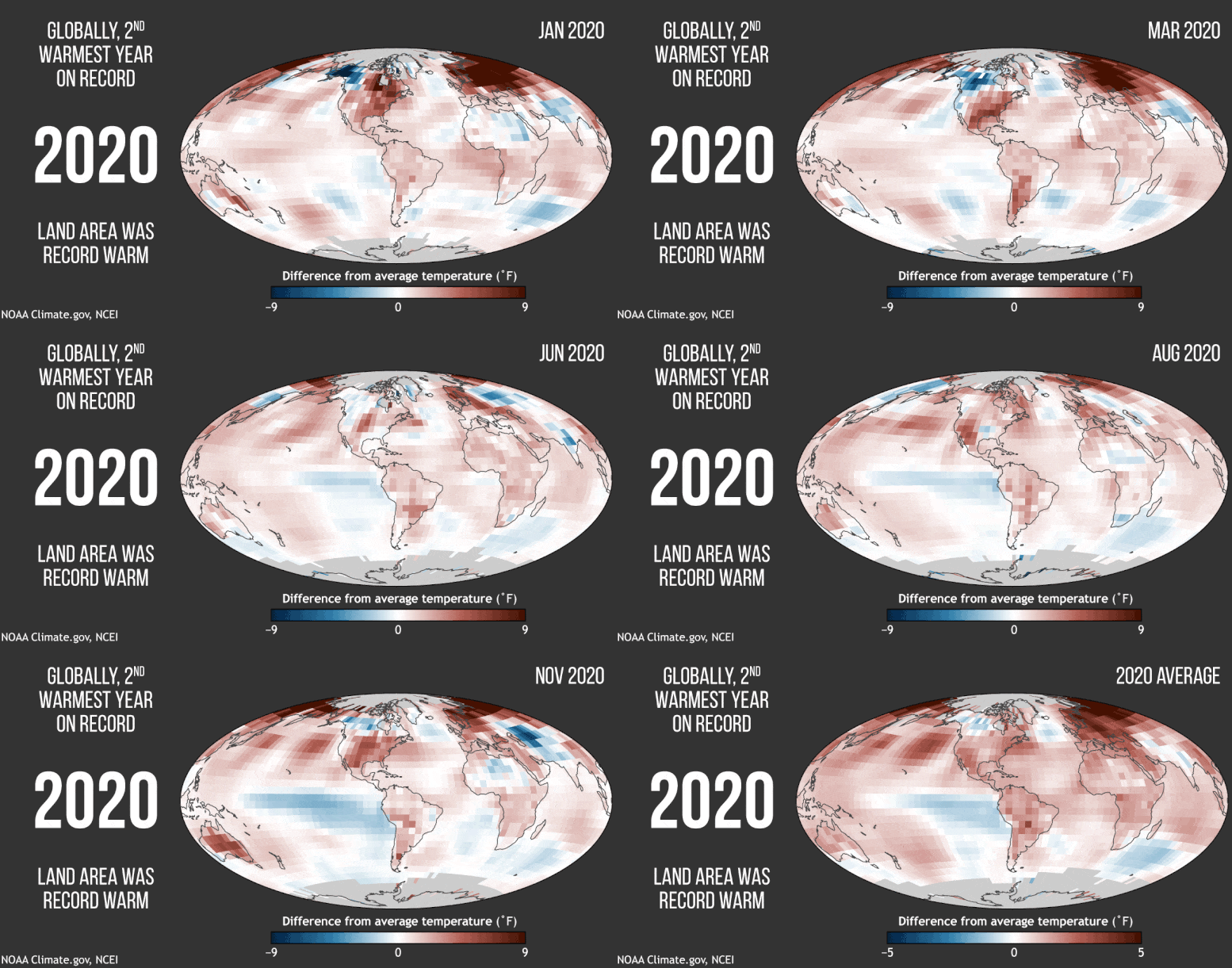
    2020 Second Warmest Year on Record
    A month-by-month animation of temperatures for January through December 2020 compared to the 1981–2010 average, with warm anomalies (difference from the average temperature) of some areas in red and cool anomalies in blue. The final slide shows the 2020 average. Credit: NOAA Climate.gov, using NOAA NCEI data

    2020 As Ranked by Other Scientific Organizations

    NASA scientists, who conducted a separate but similar analysis, have determined that 2020 ties 2016 as the warmest year on record, sharing the first-place spot. 

    Scientists from Copernicus also have 2020 tying with 2016 as the warmest year on record, while the United Kingdom Met Office ranked 2020 as the second-warmest year on record.

    The State of Sea Ice

    The 2020 average annual Arctic sea ice extent (coverage) was approximately 3.93 million square miles and ties 2016 for the smallest on record. The five smallest Arctic annual extents have occurred in the last five years (2016-20).

    The annual Antarctic sea ice extent was near average at 4.44 million square miles.
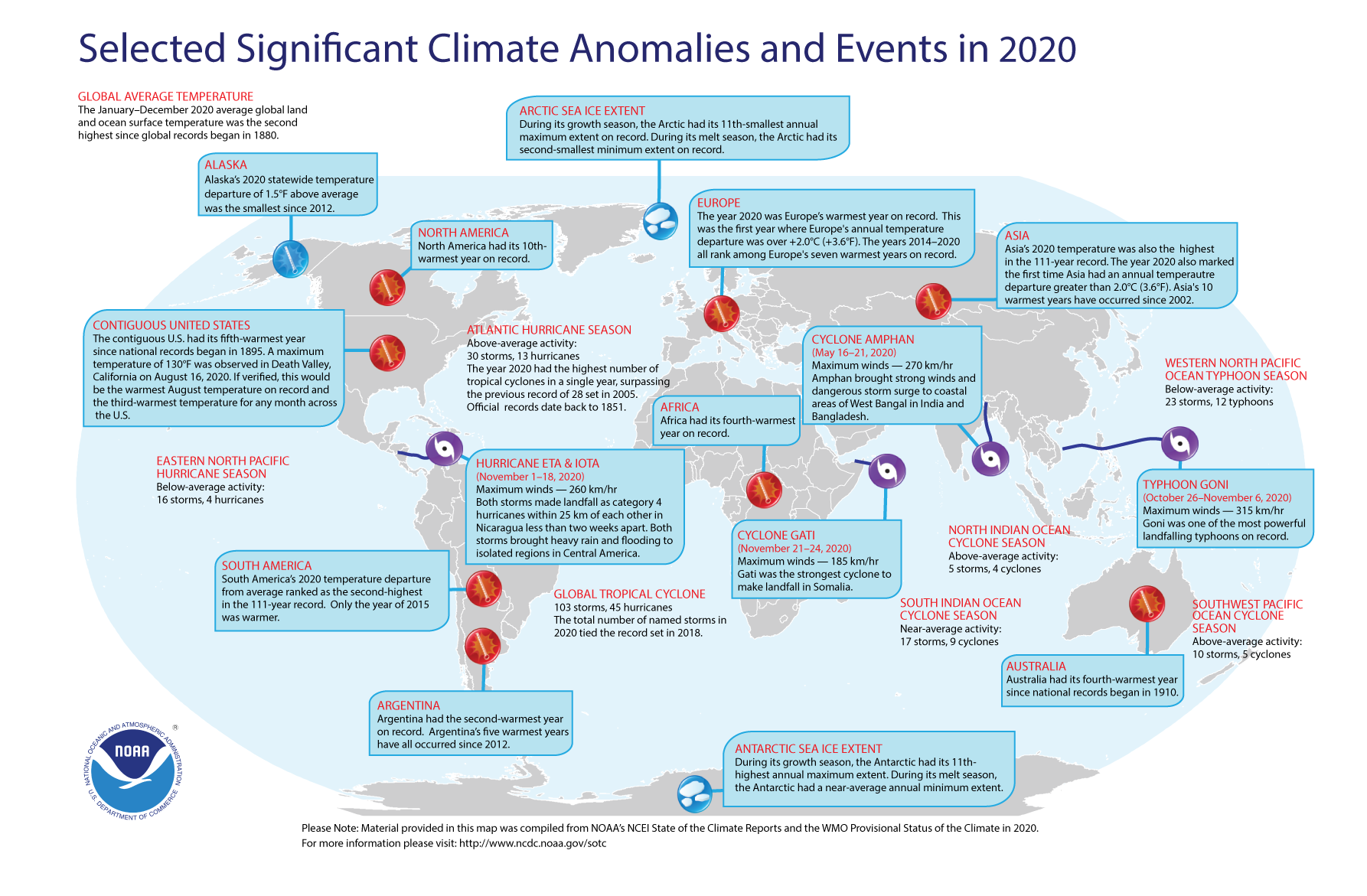
    Climate Anomalies 2020
    An annotated map of the world plotted with the year’s most significant climate events. Please see the story below as well as the report summary from NOAA NCEI at http://bit.ly/Global202012. Credit: NOAA NCEI

    Additional NOAA Findings

    • Global tropical cyclones in 2020 tied a record: A total of 103 named storms occurred around the world in 2020, tying the record number seen in 2018. The North Atlantic played an unusually large role in the global activity in 2020, accounting for about 30% of the global accumulated cyclone energy (ACE) and named storms — which is more than twice its usual share.
    • Oceans were exceptionally warm: The 2020 annual global sea-surface temperature was the third highest on record at 1.37 degrees F (0.76 degrees C) above the 20th-century average — only 2016 and 2019 were warmer. Record-high sea surface temperatures were observed across parts of the Atlantic, Indian, and Pacific oceans.
    • Northern Hemisphere saw sparse snow cover: The average annual Northern Hemisphere snow cover for 2020 was 9.31 million square miles. This was the fourth-smallest annual snow cover in the 1967–2020 record.
    • December 2020: Last month’s average temperature across global land and ocean surfaces was 1.40 degrees F (0.78 degrees C) above the 20th-century average, making it the eighth-warmest December in the 1880–2020 record.

    Never miss a breakthrough: Join the SciTechDaily newsletter.
    Follow us on Google and Google News.

    Climate Change Climate Science Global Warming NOAA
    Share. Facebook Twitter Pinterest LinkedIn Email Reddit

    Related Articles

    NASA and NOAA Show Long-Term Global Warming Trend Continues

    NASA Study Reveals That Historical Records Miss a Fifth of Global Warming

    New Research Shows Long-Term Global Warming Needs External Drivers

    Independent Analyses Reveal 2015 Surface Temperatures Are the Warmest on Record

    NOAA: July 2015 The Warmest Month Ever Recorded

    NASA Study Reveals Oceans Temporarily Hide Global Warming

    New Detailed Global Climate Change Projections from NASA

    New Research Reveals the Missing Piece of the Climate Puzzle

    Research Shows Human Contribution to Glacier Mass Loss Has Steadily Increased

    3 Comments

    1. goldminor on January 29, 2021 9:12 pm

      Why should this surprise anyone “The world’s seven-warmest years have all occurred since 2014, with 10 of the warmest years occurring since 2005.”. If we are in a warm phase, then one would expect the warmest years ever to all sit in a close group. You could compare that to being on the top of a mountain where all the land around you would also be close to the peak of the mountain.

      Reply
      • Clyde Spencer on January 30, 2021 9:25 am

        Yes, another non sequitur from NOAA, intended to panic people who don’t think about the things they read. One might ask, “Why wasn’t a new record set instead of it just being an ‘also ran?'”

        Reply
    2. Richie on January 30, 2021 5:20 am

      “Warmest year” needs a little context. Since when? The era of reasonably accurate global temperature calculation only began in 1979 with the advent of satellite measurement. This coincides with the beginning of a warm-up. From the ’40s to the ’70s, the planet cooled — so much so, scientists were predicting a catastrophic ice age was imminent. .. At any rate, it certainly has been warmer than now several times during the Quaternary. Not sure what all the hand-waving is about.

      Reply
    Leave A Reply Cancel Reply

    • Facebook
    • Twitter
    • Pinterest
    • YouTube

    Don't Miss a Discovery

    Subscribe for the Latest in Science & Tech!

    Trending News

    Largest-Ever Study Finds Medicinal Cannabis Ineffective for Anxiety, Depression, PTSD

    250-Million-Year-Old Egg Solves One of Evolution’s Biggest Mysteries

    Living With Roommates Might Be Changing Your Gut Microbiome Without You Knowing

    Century-Old Cleaning Chemical Linked to 500% Increased Risk of Parkinson’s Disease

    What if Your Memories Never Happened? Physicists Take a New Look at the Boltzmann Brain Paradox

    One of the Universe’s Largest Stars May Be Getting Ready To Explode

    Scientists Discover Enzyme That Could Supercharge Ozempic-Like Weight Loss Drugs

    Popular Sweetener Linked to DNA Damage – “It’s Something You Should Not Be Eating”

    Follow SciTechDaily
    • Facebook
    • Twitter
    • YouTube
    • Pinterest
    • Newsletter
    • RSS
    SciTech News
    • Biology News
    • Chemistry News
    • Earth News
    • Health News
    • Physics News
    • Science News
    • Space News
    • Technology News
    Recent Posts
    • Challenging the Narrative: New Study Shows U.S. Life Expectancy Is Rising Across All States
    • Mystery Illness Kills 5 in Burundi As Doctors Scramble for Answers
    • Bone-Strengthening Discovery Could Reverse Osteoporosis
    • The Most Elusive Number in Physics Just Got Even More Mysterious
    • Scientists Uncover Hidden Trigger Behind Stem Cell Aging
    Copyright © 1998 - 2026 SciTechDaily. All Rights Reserved.
    • Science News
    • About
    • Contact
    • Editorial Board
    • Privacy Policy
    • Terms of Use

    Type above and press Enter to search. Press Esc to cancel.