
Scientists Mapped Out a “Bicyclic Carbon Fixation” Pathway for Speeding Up Gas Fermentation in Specialized Bacteria
Bakers ferment the dough for a well-risen loaf of bread. Likewise, brewers ferment wheat and barley for a smooth, malty glass of beer. And as nature’s foremost bakers and brewers, some microbes can do even more. In fact, certain species of bacteria ferment carbon dioxide (CO2) gas to make their own nutrients of choice. This could be leveraged to help energize our world.
This extraordinary ability—fermenting CO2 into chemical energy—is not lost on scientists who study the nuanced and complex chemical reactions in bacteria.
Among them is National Renewable Energy Laboratory (NREL) researcher Wei Xiong, who said that gas-fermenting bacteria offer lessons on turning waste gases like CO2 into sustainable fuels.
“CO2 removal and conversion are of worldwide interest as CO2 is the most important heat-trapping (greenhouse) gas in the atmosphere. Pathways for CO2 fixation are a crux,” Xiong explained. “We have a special interest in designing new CO2 fixation avenues in bacteria to help them synthesize key biofuel precursors, for example, acetyl-CoA.”
Acetyl-CoA is the main ingredient for making multiple fuel chemicals, including fatty acids, isopropanol, and butanol. And as detailed in a paper that was recently published in the journal Nature Synthesis, Xiong and his colleagues have shown how to improve the production of the fuel precursor using a novel pathway in gas-fermenting bacteria.
By doing so, they brighten the possibility of using biological methods to capture and convert CO2 at the industrial scale.
Simple Carbon Accounting: C1 + C1 = C2
Naturally, gas-fermentation in bacteria follows a linear series of reactions, known to scientists as the Wood-Ljungdahl pathway. This was named after Professors Harland G. Wood and Lars G. Ljungdahl who discovered it in the 1980s. In simple terms, enzymes strip CO2 of its carbon using the electrical energy from nearby hydrogen or carbon monoxide gas. They then affix two of these one-carbon atoms (C1) onto a larger molecule already present in the bacteria, called coenzyme A (CoA). By attaching two carbon handles (C2) to this helper molecule, they become more easily accessible for other reactions.
The final result? Acetyl-CoA, a more energy- and carbon-dense molecule that supports the bacteria’s growth. It is also a handy precursor for making valuable, climate-friendly biofuels.
However, despite its cleverness, the Wood-Ljungdahl pathway alone might not be enough for industrial use. Plus, its seemingly simple math (C1 + C1 = C2) is actually the consequence of a dizzying number of chemical reactions.
“Engineering this pathway to improve efficiency is challenging because of the enzymes’ complexity,” Xiong explained.
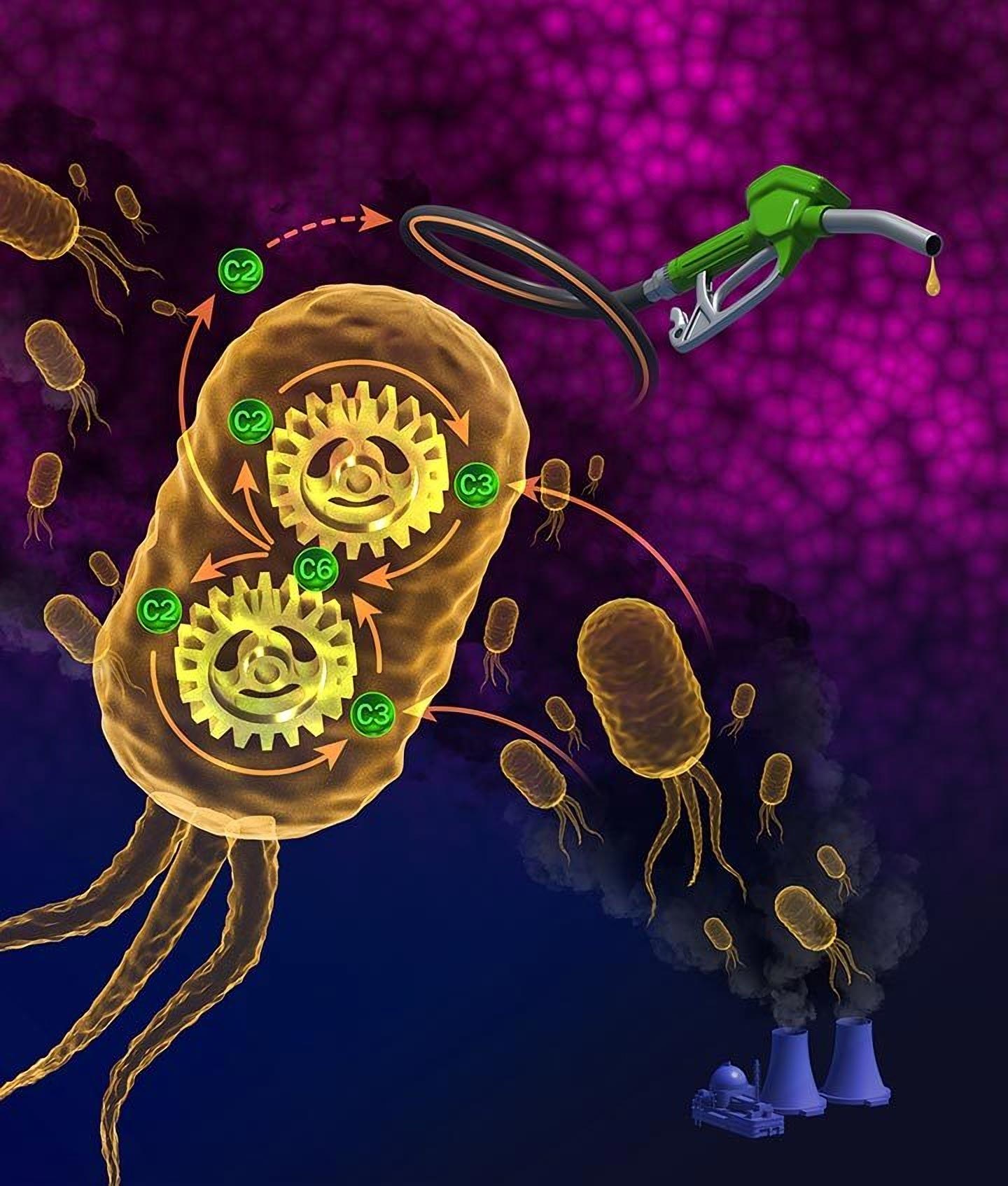
To sidestep improving the Wood-Ljungdahl pathway directly, the researchers set out to conceptualize a completely new pathway for making acetyl-CoA. Using an NREL-developed computer model called PathParser—and state-of-the-art genetic tools—the team invented a new CO2-fixing pathway in a species of gas-fermenting bacteria called Clostridium ljungdahlii.
In the end, the math works out the same: C1 + C1 = C2.
But to get there, it incorporates a pair of parallel reactions—a carbon-fixing bicycle with two wheels working together to capture CO2, transform it using a series of chemical gears, and redirect it to propel acetyl-CoA generation forward (illustrated in the figure at the top of the page). If added to gas-fermenting bacteria, the pathway could complement the Wood-Ljungdahl pathway to more efficiently yield acetyl-CoA.
Can We Ferment Our Way to Carbon-Neutrality?
There is no shortage of waste gases today, and this is likely to remain true well into the future. Millions of tons of CO2 are released every year by heavy industry—a byproduct of refining biofuels, making steel, or mixing concrete. Scientists are exploring technologies for capturing and storing—better still using—CO2 well before it ever reaches the atmosphere.
“In the context of global warming and climate change, scientists seek new solutions from microbial metabolism for converting CO2 to fuels and chemicals,” Xiong said. “Gas-fermenting bacteria actually fix CO2 and represent a carbon-negative way for meeting our energy and environmental demands.”
Who better to learn from than gas-fermenting bacteria that have fixed CO2 with ease for millions of years?
Reference: “Acetyl-CoA synthesis through a bicyclic carbon-fixing pathway in gas-fermenting bacteria” by Chao Wu, Jonathan Lo, Chris Urban, Xiang Gao, Bin Yang, Jonathan Humphreys, Shrameeta Shinde, Xin Wang, Katherine J. Chou, PinChing Maness, Nicolas Tsesmetzis, David Parker and Wei Xiong, 23 June 2022, Nature Synthesis.
DOI: 10.1038/s44160-022-00095-4
This research was supported in part by a U.S. Department of Energy Bioenergy Technologies Office Co-Optimization of Fuels and Engines project and NREL’s Laboratory Directed Research and Development program.
Never miss a breakthrough: Join the SciTechDaily newsletter.
Follow us on Google and Google News.
1 Comment
… Okay!
So, why then we don’t have that… U are not ready for that too…