

New research points to an unexpected way plastic pollution may be influencing Earth’s climate system.
A recent study suggests that microscopic plastic pollution is reducing the ocean’s capacity to take in carbon dioxide, a natural function that plays a central role in keeping the planet’s climate stable.
Microplastics are small plastic particles measuring less than five millimeters. They have spread widely across the environment and are now detected in deep ocean waters, rivers and lakes, the air, soil, Arctic ice, and even inside the human body. Because these particles can carry toxic chemicals, their widespread presence poses serious environmental concerns. When ingested by living organisms, including people, they can contribute to disease, disrupt ecosystems, harm marine species, and degrade soil quality.
Despite growing concern over climate change, scientists say the influence of microplastics on this global problem, especially in ocean systems, has received relatively little attention.
“Climate disruption and plastic pollution are two major environmental challenges that intersect in complex ways. MPs (microplastics) influence biogeochemical processes, disrupt oceanic carbon pumps, and contribute directly to greenhouse gas (GHG) emissions,” the researchers write in a study published in the Journal of Hazardous Materials: Plastics.
According to the authors, microplastics interfere with how marine ecosystems naturally store carbon.
“In marine ecosystems, MPs alter the natural carbon sequestration by affecting phytoplankton and zooplankton, which are key agents of carbon cycling. Additionally, the plastisphere, a microbial community colonizing MPs, plays a significant role in GHG (greenhouse gas production) due to its diverse microbial networks.”
Although microplastics are already recognized as harmful pollutants, the study points to a broader climate consequence. “Our study shows they also interfere with the ocean’s ability to absorb carbon dioxide, a process critical for regulating Earth’s temperature,” said Dr. Ihsanullah Obaidullah, Associate Professor of Integrated Water Processing Technologies at the University of Sharjah and the study’s corresponding author.
Dr. Obaidullah added, “Microplastics disrupt marine life, weaken the ‘biological carbon pump,’ and even release greenhouse gases as they degrade. Over time, these changes could lead to ocean warming, acidification, and biodiversity loss, threatening food security and coastal communities worldwide.”
A hidden climate threat
Dr. Obaidullah describes the study as a “collaborative perspective” involving scientists from China, Hong Kong, Pakistan, and the United Arab Emirates. “We have highlighted an overlooked link between microplastics and climate change. We call for urgent global action to address this emerging threat.”
Rather than presenting new experiments, the authors conducted a scoping review to assess the scope and direction of existing research. By examining the available studies and identifying gaps in current knowledge, they point to a potential greenhouse effect linked to microplastics that has rarely been emphasized in past climate discussions.
“Oceans are Earth’s largest carbon sink,” explained Dr. Ihsanullah. “Microplastics are undermining this natural shield against climate change. Tackling plastic pollution is now part of the fight against global warming.”
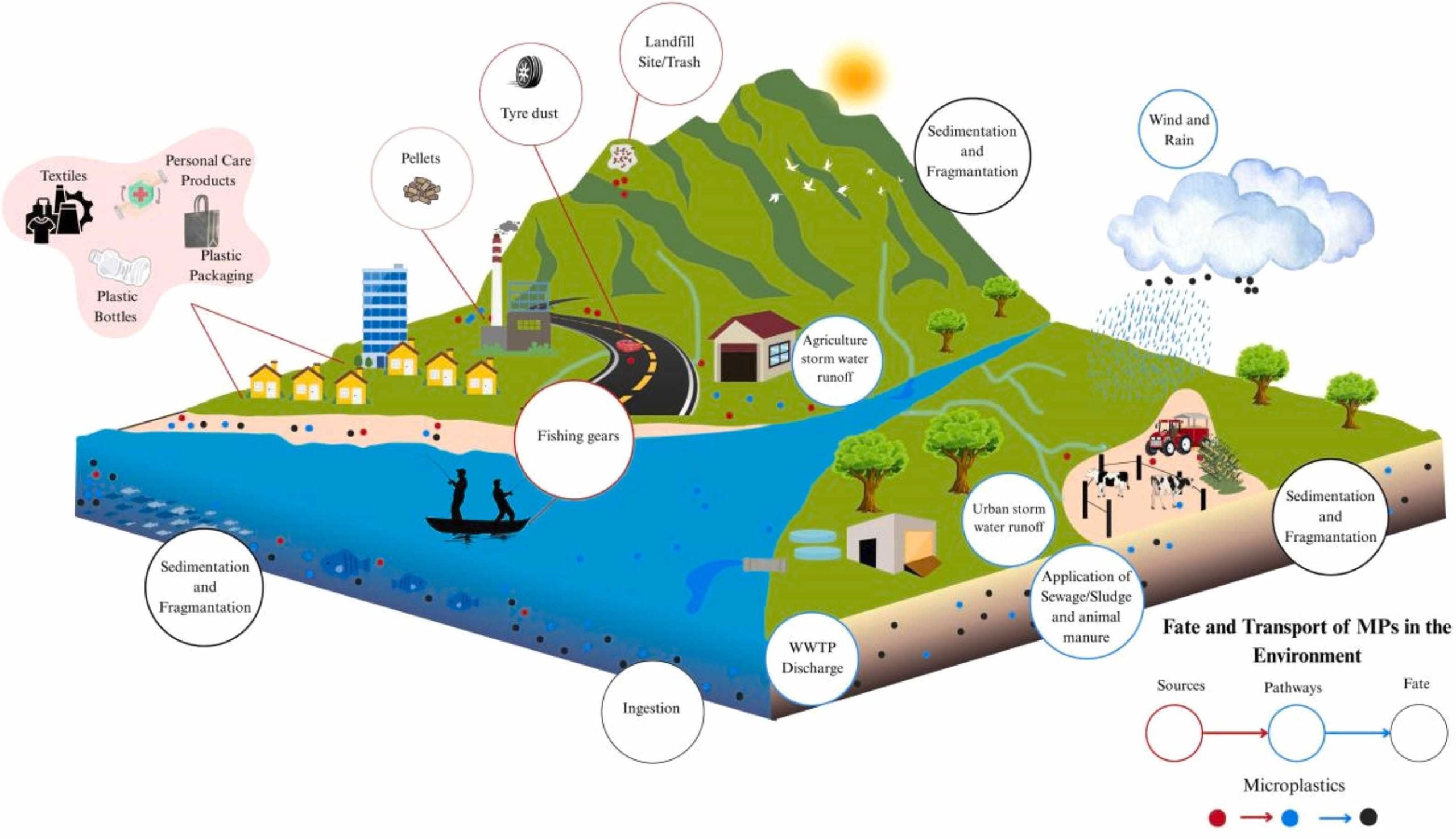
The study emphasizes that “biological carbon pumping” – the ocean’s natural process that transfers carbon from the atmosphere into the deep sea layers – is the primary mechanism linking microplastics to global warming and climate change. “MPs interfere with this process by reducing phytoplankton photosynthesis and impairing zooplankton metabolism,” the authors note.
Another connection, the authors indicate, is related to the plastisphere, an assembly of microbes in aquatic settings that form biofilms on surfaces. “The plastisphere is home to a variety of microorganisms, the majority of which are involved in biological processes like the nitrogen and carbon cycles.” Alarmingly, they maintain, microplastics also emit greenhouse gases during degradation, exacerbating their impact on climate systems.
Unseen connections
The researchers adopted an integrative narrative approach to analyze previous studies, rather than a systematic or scoping review. Their analysis is grounded in desktop research, drawing on peer-reviewed articles, reports from international organizations, and other authoritative sources to critically synthesize knowledge on microplastics, ocean health, climate change, and related socio-environmental issues.
Unlike protocols such as PRISMA, no rigid inclusion or exclusion criteria were applied. Instead, the emphasis was placed on conceptual integration and thematic linkage across disciplines, said Dr. Ihsanullah. A total of 89 studies published mainly after 2015 were reviewed, covering literature from 2010 to 2025. This approach enables a holistic discussion of emerging evidence, knowledge gaps, and policy implications in the context of climate change, the Sustainable Development Goals (SDGs), and human rights.
The study seeks to address knowledge gaps in the literature, which, according to the authors, have largely concentrated on identifying microplastics and developing cleanup strategies. They write, “The extent to which microplastics affect climate change, ocean health, and associated systems is currently unknown. This can be mostly because the issue is novel, intricate, and multifaceted. The significant ecological effects of plastic pollution in the oceans are well recognized, but its exact connections to these extensive environmental processes are not well understood.”
To bridge the gaps, the researchers explore the multifaceted effects of microplastics on ocean health and climate change, urging future studies to highlight the internal linkages between microplastics and climate change dynamics. Such dynamics, they argue, could foster a shift in “perspective in research and policymaking.”
By considering the ecological and economic dimensions of microplastic ocean impact, the study aims to enhance an understanding of plastic pollution and support the development of more effective mitigation strategies, particularly in addressing microplastics’ role in exacerbating environmental challenges such as oxygen depletion and ecosystem destabilization.”
Ubiquitous and versatile
Plastics are not only pervasive but also remarkably versatile, affordable, and durable. They are integral to modern life, used in everything from food, medicine, retail packaging, construction of pipes, insulation and windows, plane parts, interiors for fuel, electronics, consumer goods, and healthcare applications
As a result, the worldwide generation of plastics is massive. A 2025 U.N. report estimates that annual plastic production exceeds 400 million tonnes, half of which is designed for single use, and less than 10 percent of it is recycled. Projections indicate that, without intervention, annual plastic production could triple by 2060.
To date, the world has produced over 8.3 billion tonnes of plastic, with 80 percent ending up in landfills or the environment. Alarmingly, only nine percent of the massive volume is recycled.
While plastics deliver undeniable benefits to society, the authors warn that “their environmental footprint across the entire life cycle has become a growing concern. These plastics, being highly persistent, have become a pressing global environmental challenge.
“The increasing demand for and excessive consumption of plastic have led to serious challenges for human and ecosystem health, posing threats to environmental sustainability and food safety.”
Integrated action is required to address issues
The researchers urge policymakers not to underestimate the long-term impact of microplastics on ecosystems and human life, even if their current effects appear minimal. They caution that “while their (microplastics) current impacts may seem minor, their growing accumulation suggests future significance. The impact of MPs on ocean health, particularly concerning potential ocean warming and acidification, remains an area of concern.”
The authors call for an integrated approach, stressing that microplastic pollution and climate change cannot be addressed in isolation. “In this way, the effects of climate change could be lessened by taking appropriate action to slow down the production of microplastics,” they note.
Among other recommendations, the authors urge the United Nations to revisit its Sustainable Development Goals, pointing out that “plastics are currently represented by a single indicator, which may not adequately capture the widespread risks posed by microplastics across diverse ecological systems.”
They also advocate for immediate and coordinated efforts to “develop governance frameworks that tackle both MP pollution and climate change, particularly their links to ocean acidification and warming.”
To safeguard the oceans and preserve their ability to absorb carbon dioxide, they outline key priorities which include reducing single-use plastics, improving waste management, promoting biodegradable alternatives, and advancing research on how microplastics influence ocean temperature and carbon cycles.
Additionally, they recommend leveraging AI-driven monitoring and innovative materials to curb plastic waste.
When asked about future research directions, Dr. Ihsanullah said, “Our next step is to quantify the climate impact of microplastics and develop integrated solutions. This is not just an environmental issue; it’s a global sustainability challenge.”
Reference: “From pollution to ocean warming: The climate impacts of marine microplastics” by Asim Nawab, Muhammad Tariq Khan, I. Ihsanullah, Mohammad Nafees and Aamir Mehmood Shah, 18 December 2025, Journal of Hazardous Materials: Plastics.
DOI: 10.1016/j.hazmp.2025.100032
Never miss a breakthrough: Join the SciTechDaily newsletter.
Follow us on Google and Google News.
2 Comments
“The extent to which microplastics affect climate change, ocean health, and associated systems is currently unknown.”
However, then they assert unequivocally, “Microplastics disrupt marine life, weaken the ‘biological carbon pump,’ and even release greenhouse gases as they degrade. Over time, these changes could lead to ocean warming, acidification, and biodiversity loss, threatening food security and coastal communities worldwide.” The second statement sounds much more assured than the first. Which is it? If the second is more accurate, where are the numbers?
“The study seeks to address knowledge gaps in the literature, which, …, have largely concentrated on identifying microplastics and developing cleanup strategies.” Then that is what they should be reporting on, the knowledge gaps, rather than broad brush assertions about what MPs “could” do.
Writing in multi-syllabic academese may impress some, but what it often does is simply obfuscate what the authors don’t know. It has often been said that mathematics is the language of science. Where are the numbers?
This press release is sprinkled with the obligatory “ocean acidification,” claiming that MPs can contribute to it, without explanation. I decided to look at the link provided for the original article. I found the following in the introduction: “As plastics undergo chemical and biological degradation in natural environments, climate-active gases such as CO₂, ethylene, and methane are emitted, contributing to ocean acidification [19]. Abiotic breakdown of plastics further exacerbates acidification by lowering seawater pH …”
The associated citation [19] speaks only to methane and ethylene. Only the CO2 has the potential to lower the pH. However, the oceans are NOT acidic and almost certainly never will be, according to the Stanford geochemist Konrad Krauskopf. Even the CO2 seeps in Indonesia, which have saturated the water with carbonic acid, have not lowered the PH to even neutrality, let alone acidic.
They go on to claim, “Plastic in the oceans may interfere with the ocean’s capacity to absorb and sequester carbon dioxide, thus creating another pathway through which plastic pollution contributes to accelerating climate change [5].” However, they don’t explain just how the effect is supposed to take place.
They further claim, “MPs in snow and ice CAN enhance light absorption, reducing surface albedo, which accelerates warming and melting in polar ecosystems.” I’m left with the impression that these researchers are unfamiliar with the behavior of diffuse, non-opaque reflectors. Materials like plastics, even dark ones with small extinction coefficients, tend to appear lighter the smaller the particles are. MPs that are small enough to serve as nuclei for snow crystals will almost certainly have negligible impact on snow albedo.
I’m not impressed with their apparent lack of understanding of the science that their claims are based on.