
Close Menu
    Facebook X (Twitter) Instagram
    SciTechDaily
    • Biology
    • Chemistry
    • Earth
    • Health
    • Physics
    • Science
    • Space
    • Technology
    Facebook X (Twitter) Pinterest YouTube RSS
    SciTechDaily
    Home»Science»Origins of the Sarsen Megaliths: Chemical Composition Reveals Where Stonehenge’s Large Boulders Actually Came From
    Science

    Origins of the Sarsen Megaliths: Chemical Composition Reveals Where Stonehenge’s Large Boulders Actually Came From

    By SciTechDailyJuly 29, 2020No Comments3 Mins Read
    Facebook Twitter Pinterest Telegram LinkedIn WhatsApp Email Reddit
    Share
    Facebook Twitter LinkedIn Pinterest Telegram Email Reddit
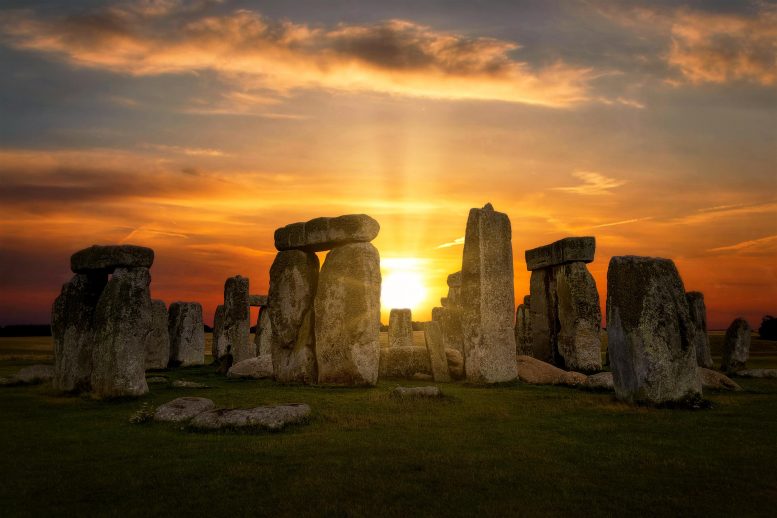
    Stonehenge Sunset
    Stonehenge analysis shows most sarsen stones from West Woods, supporting simultaneous transportation theory.

    Most of Stonehenge’s large boulders share origin in west woods, Wiltshire.

    Most of the hulking sandstone boulders — called sarsens — that make up the United Kingdom’s famous Stonehenge monument appear to share a common origin 25 kilometers (16 miles) away in West Woods, Wiltshire, according to an analysis of the stones’ chemical composition.

    The findings support the theory that the stones were brought to Stonehenge at around the same time, contradicting a previous suggestion that one large sarsen, the Heel Stone, originated in the immediate vicinity of the monument and was erected earlier than the others. The results may also help scientists identify the route the monument’s ancient builders would have taken to transport the enormous rocks to their celebrated resting site.

    “Until recently we did not know it was possible to provenance a stone like sarsen,” says David Nash, the lead author of the study. “It has been really exciting to use 21st-century science to understand the Neolithic past and answer a question that archaeologists have been debating for centuries.”

    Since technology for determining the origins of the enormous sarsens, which tower at up to 30 feet (9 meters) tall, weigh as much as 25 tons, and make up most of Stonehenge, did not exist until recently, most research has revolved around the monument’s smaller “bluestones” — various types of rock that clearly were not gathered locally.

    To learn where the behemoth boulders came from, Nash and colleagues used portable x-ray fluorescence spectrometry (PXRF) to initially characterize their chemical composition, then analyzed the data statistically to determine their degree of chemical variability. Next, the researchers performed inductively coupled plasma mass spectrometry (ICP-MS) and ICP-atomic emission spectrometry (ICP-AES) of samples from a core previously drilled through one sarsen stone and a range of sarsen boulders from across southern Britain. After comparing these signatures, Nash et al. were able to point to West Woods as the sarsens’ earliest home.

    The reason the monument’s builders selected this site remains a mystery, although the researchers suggest the size and quality of West Woods’ stones, and the ease with which the builders could access them, may have factored into the decision.

    Reference: “Origins of the sarsen megaliths at Stonehenge” by David J. Nash, T. Jake R. Ciborowski, J. Stewart Ullyott, Mike Parker Pearson, Timothy Darvill, Susan Greaney, Georgios Maniatis and Katy A. Whitaker, 29 July 2020, Science Advances.
    DOI: 10.1126/sciadv.abc0133

    Never miss a breakthrough: Join the SciTechDaily newsletter.
    Follow us on Google and Google News.

    Archaeology Geology History Stonehenge
    Share. Facebook Twitter Pinterest LinkedIn Email Reddit

    Related Articles

    Deciphering Earth’s Magnetic Mysteries: Mesopotamian Bricks Reveal Ancient Secrets

    Defining Moment in Human Evolution: Turbulent Era Sparked Leap in Human Behavior, Technology 320,000 Years Ago

    When Did Animals Leave Their First Footprint on Earth?

    Cave Site Reveals 78,000-Year-Old Record of Stone Age Innovation

    Paleontologists Provide New Perspective on Triassic Period, Emergence of Dinosaurs

    Scientists Identify a Mineral Signature for Finding Burgess Shale-Type Fossils

    The Stonehenge Hidden Landscapes Project Reveals a Major New Prehistoric Stone Monument

    Humans Implicated in Africa’s Deforestation 3,000 Years Ago

    Archaeologists Inch Closer to Understanding Stonehenge

    Leave A Reply Cancel Reply

    • Facebook
    • Twitter
    • Pinterest
    • YouTube

    Don't Miss a Discovery

    Subscribe for the Latest in Science & Tech!

    Trending News

    First-of-Its-Kind Discovery: Homer’s Iliad Found Embedded in a 1,600-Year-Old Egyptian Mummy

    Beyond Inflammation: Scientists Uncover New Cause of Persistent Rheumatoid Arthritis

    A Simple Molecule Could Unlock Safer, Easier Weight Loss

    Scientists Just Built a Quantum Battery That Charges Almost Instantly

    Researchers Unveil Groundbreaking Sustainable Solution to Vitamin B12 Deficiency

    Millions of People Have Osteopenia Without Realizing It – Here’s What You Need To Know

    Researchers Discover Boosting a Single Protein Helps the Brain Fight Alzheimer’s

    World-First Study Reveals Human Hearts Can Regenerate After a Heart Attack

    Follow SciTechDaily
    • Facebook
    • Twitter
    • YouTube
    • Pinterest
    • Newsletter
    • RSS
    SciTech News
    • Biology News
    • Chemistry News
    • Earth News
    • Health News
    • Physics News
    • Science News
    • Space News
    • Technology News
    Recent Posts
    • After Decades, MIT Researchers Capture the First 3D Atomic View of a Mysterious Material
    • Your Favorite Fishing Spot Is Turning Brown – and the Fish Are Changing
    • 380-Million-Year-Old Fish Fossil Reveals Secrets of Life’s First Steps Onto Land
    • Mezcal “Worm” in a Bottle Mystery: DNA Testing Reveals a Surprise
    • Scientists Turn Red Lettuce Green, Unlocking Hidden Nutrients
    Copyright © 1998 - 2026 SciTechDaily. All Rights Reserved.
    • Science News
    • About
    • Contact
    • Editorial Board
    • Privacy Policy
    • Terms of Use

    Type above and press Enter to search. Press Esc to cancel.