
Researchers at JILA and NIST have developed a technique to mitigate atomic recoil in quantum measurements by using momentum-exchange interactions within a cavity system. This breakthrough could significantly enhance the accuracy of quantum sensors and enable new quantum physics discoveries.
Due to atomic recoil, precisely measuring the energy states of individual atoms has been a historical challenge for physicists. When an atom interacts with a photon, the atom “recoils” in the opposite direction, making it difficult to measure the position and momentum of the atom precisely. This recoil can have big implications for quantum sensing, which detects minute changes in parameters, for example, using changes in gravitational waves to determine the shape of the Earth or even detect dark matter.
JILA and NIST Fellows Ana Maria Rey and James Thompson, JILA Fellow Murray Holland, and their teams proposed a way to overcome this atomic recoil by demonstrating a new type of atomic interaction called momentum-exchange interaction, where atoms exchanged their momentums by exchanging corresponding photons. Details of the research have been published in a new paper in the journal Science.
Using a cavity—an enclosed space composed of mirrors—the researchers observed that the atomic recoil was dampened by atoms exchanging energy states within the confined space. This process created a collective absorption of energy and dispersed the recoil among the entire population of particles.

With these results, other researchers can design cavities to dampen recoil and other outside effects in a wide range of experiments, which can help physicists better understand complex systems or discover new aspects of quantum physics. An improved cavity design could also enable more precise simulations of superconductivity, such as in the case of the Bose-Einstein-Condensate-Bardeen-Cooper-Schrift (BEC-BCS) crossover or high-energy physical systems.
For the first time, the momentum-exchange interaction was observed to induce one-axis twisting (OAT) dynamics, an aspect of quantum entanglement, between atomic momentum states. OAT acts like a quantum braid for entangling different molecules, as each quantum state gets twisted and connected to another particle.
Previously, OAT was only seen in atomic internal states, but now, with these new results, it is thought that OAT induced by momentum exchange could help reduce quantum noise from multiple atoms. Being able to entangle momentum states could also lead to improvement in some physical measurements by quantum sensors, such as gravitational waves.
Leveraging a Density Grating
Within this new study, inspired by previous research from Thompson and his team, the researchers examined the effects of quantum superposition, which allows particles like photons or electrons to exist in multiple quantum states simultaneously.
“In this [new] project, the atoms all share the same spinlabel; the only difference is that each atom is in a superposition between two momentum states,” graduate student and first author Chengyi Luo explained.
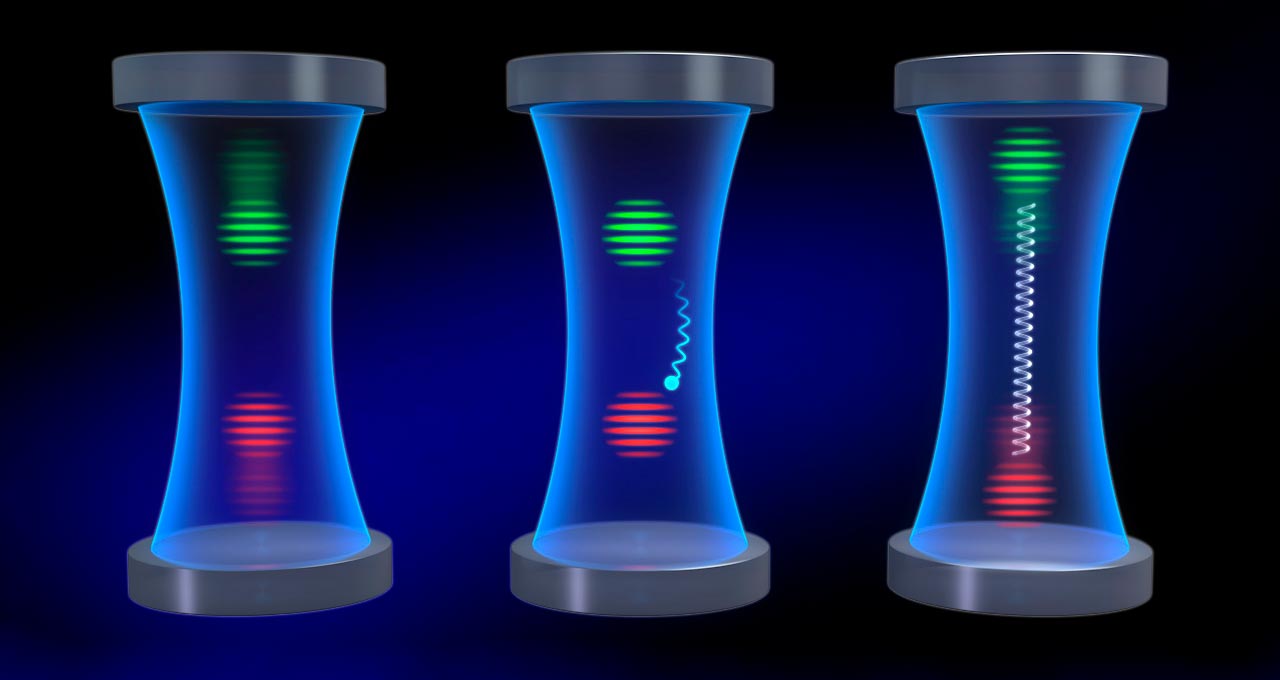
The researchers found they could better control atomic recoil by forcing the atoms to exchange photons and their associated energies. Similar to a game of dodgeball, one atom may “throw” a “dodgeball” (a photon) and recoil in the opposite direction. That “dodgeball” may be caught by a second atom, which can cause the same amount of recoil for this second atom. This cancels out the two recoils experienced by both atoms and averages them for the entire cavity system.
When two atoms exchange their different photon energies, the resulting wave packet (an atom’s wave distribution) in superposition forms a momentum graph known as a density grating, which looks like a fine-toothed comb.
Luo added. “The formation of the density grating indicates two momentum states [within the atom] are ‘coherent’ with each other such that they could interfere [with each other].” The researchers found that the exchange of photons between atoms caused a binding of the two atoms’ wave packets, so they were no longer separate measurements.
The researchers could induce momentum exchange by exploring the interplay between the density grating and the optical cavity. Because the atoms exchanged energy, any recoil from absorbing a photon was dispersed among the entire community of atoms instead of individual particles.
Dampening the Doppler Shift
Using this new control method, the researchers found that they could also use this recoil-dampening system to help mitigate a separate measurement problem: the Doppler shift.
The Doppler shift, a phenomenon in classical physics, explains why the sound of a siren or train horn changes pitch as it passes a listener or why certain stars appear red or blue in night sky images—it’s the change in the frequency of the wave as the source and observer move toward (or away from) each other. In quantum physics, the Doppler shift describes a particle’s energy change due to relative motion.
For researchers like Luo, the Doppler shift can be a challenge to overcome in getting a precise measurement. “When absorbing photons, the atomic recoil will lead to a Doppler shift of the frequency of the photon, which is a big problem when you talk about precision spectroscopy,” he elaborated. By simulating their new method, the researchers found that it could overcome measurement skewing due to Doppler Shift.
Entangling Momentum Exchange
The researchers also found that the momentum exchange between these atoms could be used as a type of quantum entanglement. As John Wilson, a graduate student in the Holland group, elaborated: “As an atom falls, its motion wiggles the cavity frequency. That, in turn, encourages other atoms to collectively feel that feedback mechanism and nudges them to correlate their motion through the shared wobbles.”
To test this “entanglement” even further, the researchers created a bigger separation between the momentum states of the atoms and then induced the momentum exchange. The researchers found that the atoms continued to behave as if they were connected. “This indicates that the two momentum states are really oscillating concerning each other as if being connected by a spring,” added Luo.
Looking ahead, the researchers plan to probe this new form of quantum entanglement further, hoping to better understand how it can be used to improve various types of quantum devices.
Reference: “Momentum-exchange interactions in a Bragg atom interferometer suppress Doppler dephasing” by Chengyi Luo, Haoqing Zhang, Vanessa P. W. Koh, John D. Wilson, Anjun Chu, Murray J. Holland, Ana Maria Rey and James K. Thompson, 2 May 2024, Science.
DOI: 10.1126/science.adi1393
This research was supported by the US Department of Energy, Office of Science, National Quantum Information Science Research Centers, Quantum Systems Accelerator.
Never miss a breakthrough: Join the SciTechDaily newsletter.
Follow us on Google and Google News.
1 Comment
Nothing new;but,this problem can be solved by the principle.The authors have good prise at this work.