
Close Menu
    Facebook X (Twitter) Instagram
    SciTechDaily
    • Biology
    • Chemistry
    • Earth
    • Health
    • Physics
    • Science
    • Space
    • Technology
    Facebook X (Twitter) Pinterest YouTube RSS
    SciTechDaily
    Home»Science»Paleontologists Discover a New Species of Lobopodian
    Science

    Paleontologists Discover a New Species of Lobopodian

    By Jim Shelton, Yale UniversityAugust 10, 2018No Comments3 Mins Read
    Facebook Twitter Pinterest Telegram LinkedIn WhatsApp Email Reddit
    Share
    Facebook Twitter LinkedIn Pinterest Telegram Email Reddit
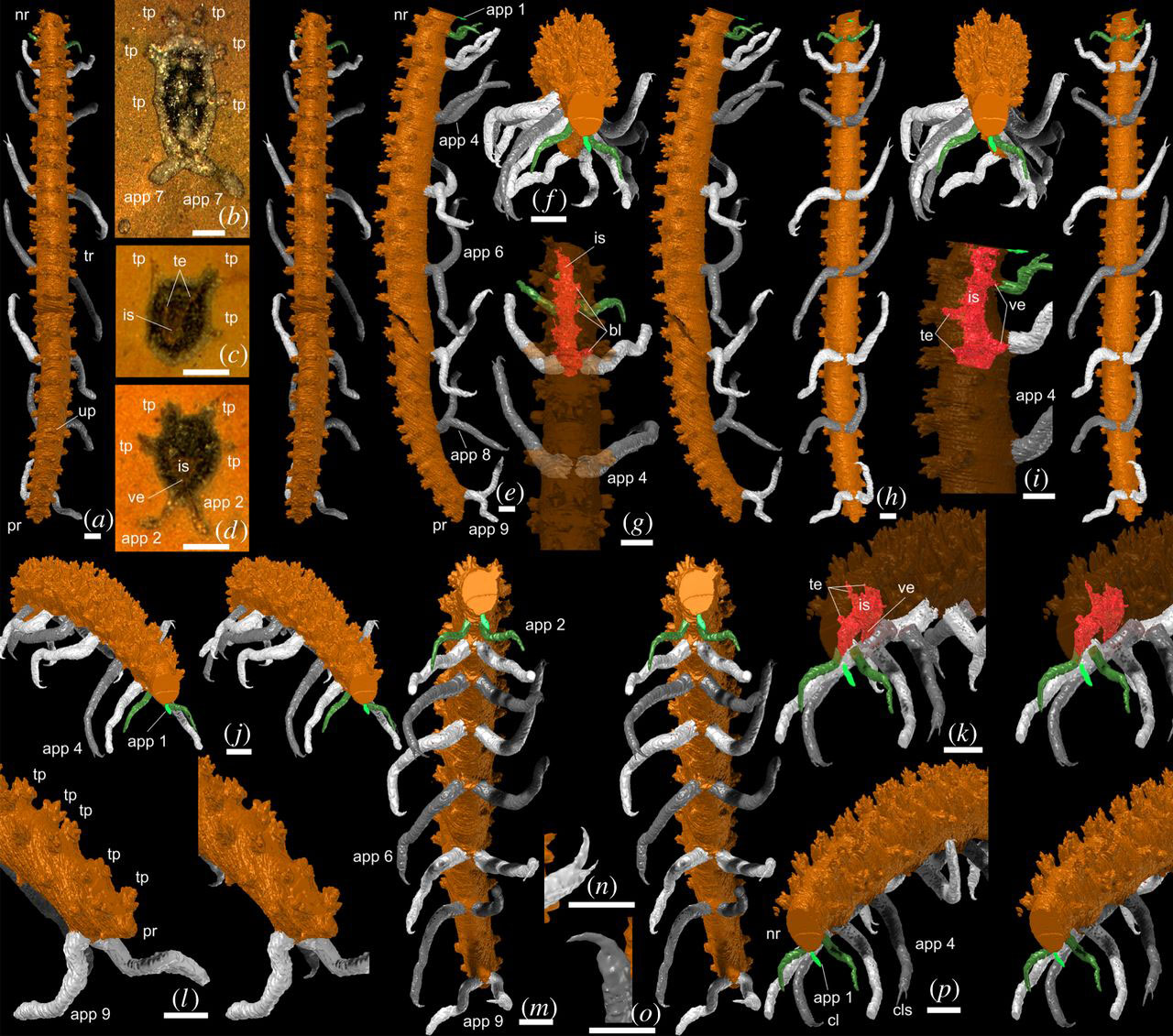
    Thanahita Distos
    Thanahita distos gen. et sp. nov., virtual reconstructions (a,e–p) and specimen in the rock (b–d), OUMNH C.29699. (a,e,f,h,j,m) Whole specimen; dorsal, right lateral, frontal, ventral, anterior oblique, anterior ventral stereo pairs. (b) The specimen on the surface of the split nodule, before grinding. (c,d) The specimen shown on two individual ground surfaces between appendage 2 and 3 (slice 665) and at appendage 2 (slice 705), respectively, which are 0.8 mm apart. (g,i,k) Anterior part of specimen with external surface rendered transparent to show preserved internal structures; dorsal, right lateral, anterior oblique stereo pairs. (l) Posterior part of specimen, postero-lateral oblique stereo-pair. (n,o), Double (n) and single (o) claws on left fifth and left sixth appendages, respectively; sublateral views. (p) Anterior part of specimen; anterior oblique stereo-pair. Scale bars are all 1 mm. app 1–app 9, appendages 1–9; cl, claw; cls, claws; is, internal structures; nr, neck region; pr, post-appendicular region; te, tabular extension of internal structures towards tufted papilla; tp, tufted papilla; tr, trunk; up, unpaired papilla; ve, ventral extension of internal structures towards appendage.

    Yale paleontologist Derek Briggs was part of a research team that identified Thanahita distos, a new species of lobopodian, an ancient relative of modern-day onychophorans, or velvet worms. Thanahita distos was discovered and reconstructed as a virtual fossil using physical-optical tomography. It came from 430 million-year-old Silurian rocks in Herefordshire, England and it is the first marine lobopodian to be formally described from the Silurian. Its closest relative is the iconic Cambrian lobopod Hallucigenia.

    The findings were published on August 8 in the Royal Society journal Open Science. The first author is Derek Siveter of the University of Oxford, and additional authors are from the University of Leicester, Imperial College London, and the University of Manchester.

    Reference: “A three-dimensionally preserved lobopodian from the Herefordshire (Silurian) Lagerstätte, UK” by Derek J. Siveter, Derek E. G. Briggs, David J. Siveter, Mark D. Sutton and David Legg, 8 August 2018, Royal Society Open Science.
    DOI: 10.1098/rsos.172101

    Abstract

    The Herefordshire (Silurian) Lagerstätte (approx. 430 Myr BP) has yielded, among many exceptionally preserved invertebrates, a wide range of new genera belonging to crown-group Panarthropoda. Here, we increase this panarthropod diversity with the lobopodian Thanahita distos, a new total-group panarthropod genus and species. This new lobopodian preserves at least nine paired, long, slender appendages, the anterior two in the head region and the posterior seven representing trunk lobopods. The body ends in a short post-appendicular extension. Some of the trunk lobopods bear two claws, others a single claw. The body is covered by paired, tuft-like papillae. Thanahita distos joins only seven other known three-dimensionally preserved lobopodian or onychophoran (velvet worm) fossil specimens and is the first lobopodian to be formally described from the Silurian. Phylogenetic analysis recovered it, together with all described Hallucigenia species, in a sister-clade to crown-group panarthropods. Its placement in a redefined Hallucigeniidae, an iconic Cambrian clade, indicates the survival of this clade to Silurian times.

    Never miss a breakthrough: Join the SciTechDaily newsletter.
    Follow us on Google and Google News.

    Paleontology Yale University
    Share. Facebook Twitter Pinterest LinkedIn Email Reddit

    Related Articles

    A Crabs-Eye View of the Ancient World – Unusually Large Optical Features on 95-Million-Year-Old Crab Fossil

    Paleontologists Identify a New Species of Prehistoric Reptile, Colobops Noviportensis

    Turtles Share a Recent Common Ancestor with Birds and Crocodiles

    A New Birth Story for Gigantic Marine Lizards That Once Roamed the Oceans

    Earth’s Earliest Primates Lived in Trees

    Study Explains Prevalence of Hadrosaur Skin Among All Known Dinosaur Skin Fossils

    The Preservation of Colors in Fossil Insects

    Scientists Reconstruct the Ancestor of Placental Mammals

    Researchers Conclude Torosaurus and Triceratops Are Different Species of Horned Dinosaurs

    Leave A Reply Cancel Reply

    • Facebook
    • Twitter
    • Pinterest
    • YouTube

    Don't Miss a Discovery

    Subscribe for the Latest in Science & Tech!

    Trending News

    Researchers Have Found a Dietary Compound That Increases Longevity

    Scientists Baffled by Bizarre “Living Fossil” From 275 Million Years Ago

    Your IQ at 23 Could Predict Your Wealth at 27, Study Finds

    320 Light-Years Away, a Planet Confirms a Fundamental Cosmic Assumption

    The Crown Jewel of Dentistry? Breakthrough Tech Could Transform Tooth Repair

    Python Blood Could Hold the Secret to Weight Loss Without Side Effects

    Naturally Occurring Bacteria Completely Eradicate Tumors in Mice With a Single Dose

    New “Nanozyme Hypothesis” Could Rewrite the Story of Life’s Origins

    Follow SciTechDaily
    • Facebook
    • Twitter
    • YouTube
    • Pinterest
    • Newsletter
    • RSS
    SciTech News
    • Biology News
    • Chemistry News
    • Earth News
    • Health News
    • Physics News
    • Science News
    • Space News
    • Technology News
    Recent Posts
    • Scientists Discover Bizarre Crocodile Relative That Walked on Two Legs
    • How Quantum Mechanics Went From Baffling Theory to Revolutionizing Modern Technology
    • Scientists May Have Found the Key to Jupiter and Saturn’s Moon Mystery
    • Scientists Uncover Hidden Clues to the Origin of the Genetic Code
    • Scientists Discover Unexpected Role of Alzheimer’s Protein in Cell Division
    Copyright © 1998 - 2026 SciTechDaily. All Rights Reserved.
    • Science News
    • About
    • Contact
    • Editorial Board
    • Privacy Policy
    • Terms of Use

    Type above and press Enter to search. Press Esc to cancel.