
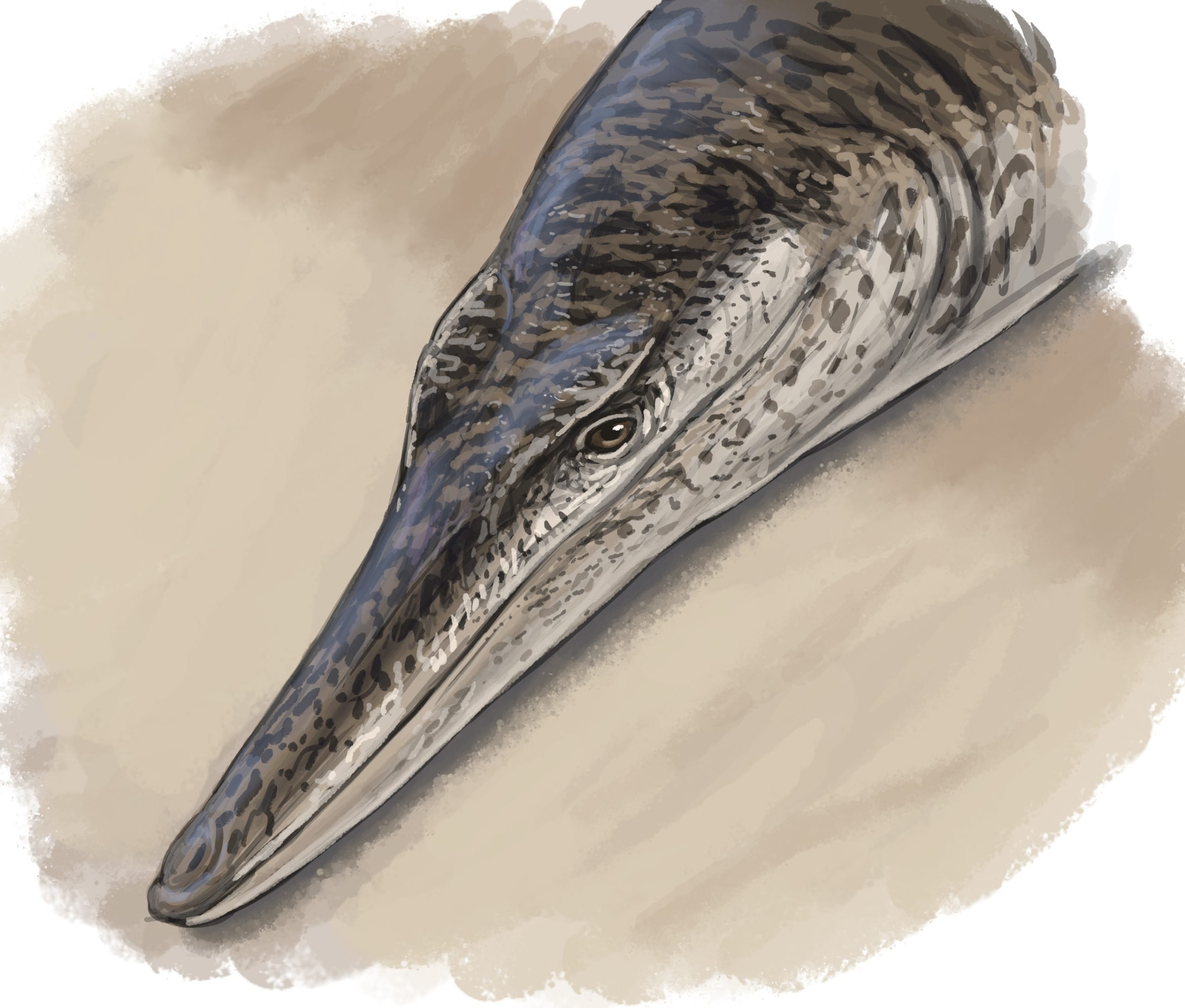
A newly discovered species of marine crocodile from 135 million years ago has been described from Germany.
A new species of ancient marine crocodile, Enalioetes schroederi, has been described by an international team of scientists, including researchers from Germany and the UK. This species lived about 135 million years ago in the shallow seas that once covered much of Germany during the Cretaceous Period.
This ancient crocodile was a member of the family Metriorhynchidae, a remarkable group that evolved a dolphin-like body plan. Metriorhynchids had smooth scaleless skin, flippers, and a tailfin. They fed on a variety of prey, including fast-moving animals like squids and fish, but some metriorhynchid species had large, serrated teeth suggesting they fed on other marine reptiles. Metriorhynchids are best known from the Jurassic Period, with their fossils becoming rarer in the Cretaceous. Enalioetes schroederi is known from a three-dimensional skull, making it the best-preserved metriorhynchid known from the Cretaceous.
Advanced Imaging Reveals Detailed Anatomy
Sven Sachs, from the Naturkunde-Museum Bielefeld and project leader, said: “The specimen is remarkable as it is one of very few metriorhynchids that is known by a three-dimensionally preserved skull. This allowed us to CT scan the specimen and so we were able to learn a lot about the internal anatomy of these marine crocodiles. The remarkable preservation allowed us to reconstruct the internal cavities and even the inner ears of the animal.”
Dr Mark Young, of the University of Edinburgh’s School of GeoSciences, explains: “Enalioetes gives us fresh insight into how metriorhynchids were evolving during the Cretaceous Period. During the Jurassic metriorhynchids evolved a body plan radically different from other crocodiles – flippers, tailfins, loss of bony armor, and smooth scaleless skin. These changes were adaptations to an increasingly marine lifestyle. Enalioetes shows us that this trend continued into the Cretaceous, as Enalioetes had even larger eyes than other metriorhynchids (which were already big by crocodylian standards) and the bony inner ears were even more compact than other metriorhynchids, a sign that Enalioetes was probably a faster swimmer.”
The perfectly preserved skull along with the first neck vertebrae were discovered more than a hundred years ago by the German government architect D. Hapke in a quarry in Sachsenhagen near Hannover. The specimen has an interesting history. It was given for preparation and study to Henry Schroeder of the Prussian Geological Survey in Berlin where it was thought to have been incorporated in the collection. This led to the assumption the specimen went lost during WWII. Later the specimen was rediscovered in the Minden Museum in Western Germany. It turned out that the specimen had been returned to the finder whose family brought it to Minden where they found a new home after WW2, taking the specimen with them. The crocodile is therefore one of the valuable specimens in the Minden collection.
Henry Schroeder of the Berlin Geological Survey provided the initial description, and after him, the species is named.
By comparing the fossil with those from other museum collections, Sachs and his team determined it was a species new to science.
Reference: “A new genus of metriorhynchid crocodylomorph from the Lower Cretaceous of Germany” by Sven Sachs, Mark T. Young, Jahn J. Hornung, Thomas Cowgill, Julia A. Schwab and Stephen L. Brusatte, 18 July 2024, Journal of Systematic Palaeontology.
DOI: 10.1080/14772019.2024.2359946
Never miss a breakthrough: Join the SciTechDaily newsletter.
Follow us on Google and Google News.
2 Comments
Looks like what we call agar fish in Savannah Georgia I wonder what the most one can weight what’s the
I have caught those “ancient fish” twice in my lofe on Escambia River. They are rare, but alive and thriving. It is a short nosed alligator gar. I don’t eat them because their scales are next to impossible to remove, but they are a very worthy fighting fish!