
Researchers found that nerves and cancer-supporting cells team up early to drive pancreatic cancer—breaking that alliance could weaken the disease before it fully forms.
Pancreatic cancer is one of the hardest cancers to find early and one of the most difficult to treat. Standard therapies often fail, which has pushed scientists to search for new ways to interrupt how the disease takes hold. While researchers have long known that the nervous system can help cancer spread later on, its role at the very beginning of pancreatic cancer has been much less clear.
“One phenomenon that is known is called perineural invasion,” says Jeremy Nigri, a postdoc in Professor David Tuveson’s lab at Cold Spring Harbor Laboratory (CSHL). “This means cancer cells will migrate within the nerve and use the nerve as a way to metastasize.”
Early Cancer Growth Begins Before Tumors Form
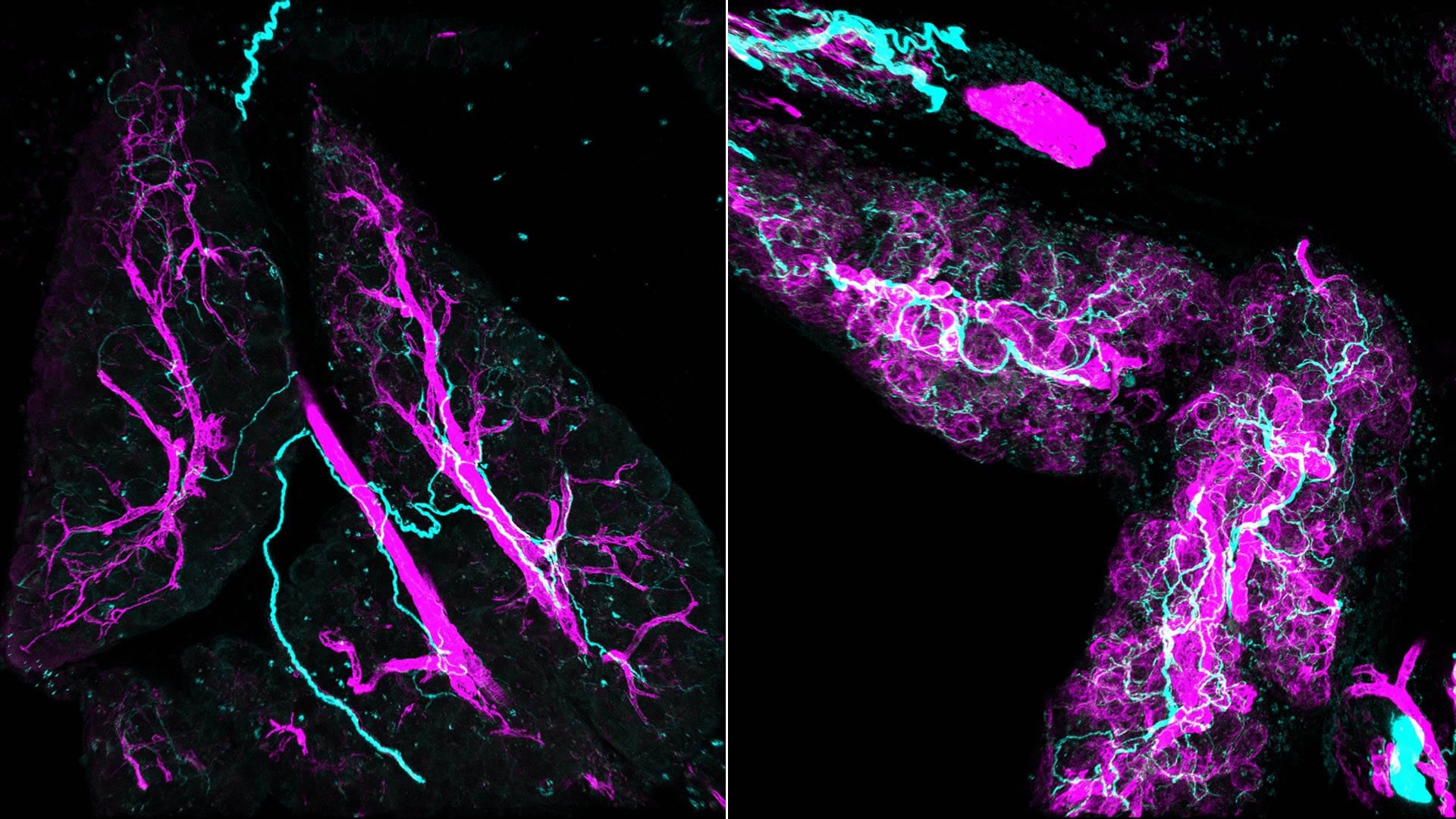
New research from Nigri and his colleagues shows that nerves are involved far earlier than previously thought. Their work reveals that the nervous system actively contributes to pancreatic cancer development even before tumors appear. Using advanced 3D imaging, the team found that tumor-supporting fibroblasts known as myCAFs release signals that draw in nearby nerve fibers.
Once these nerve fibers arrive, they interact closely with myCAFs inside pancreatic lesions. Together, they help create conditions that allow cancerous changes to progress. The study was published in Cancer Discovery, a journal of the American Association for Cancer Research.
3D Imaging Reveals a Hidden Nerve Network
To uncover this process, the researchers used a method called whole-mount immunofluorescence, which allowed them to capture three-dimensional images of pancreatic lesions and the cells surrounding them. Traditional 2D images show nerve fibers as small, disconnected dots. In contrast, the 3D images exposed a thick, interconnected web of nerves winding through and around the myCAFs and lesions.
“When we first saw this picture, I was shocked,” Nigri says. “I couldn’t even imagine the lesion like this. I’d only ever seen it in 2D.”
A Self-Reinforcing Loop Between Nerves and Fibroblasts
Further experiments using mice and human cells revealed a powerful feedback loop between myCAFs and the nervous system. The researchers found that myCAFs release chemical signals that attract nerve fibers from the sympathetic nervous system, which controls the body’s fight-or-flight response.
These incoming nerve fibers release norepinephrine, a neurotransmitter that binds to fibroblasts and triggers a surge of calcium inside the cells. This calcium spike further activates myCAFs, encouraging pre-cancerous growth. At the same time, it draws in even more nerve fibers, strengthening a cycle that continues to fuel disease progression.
Disrupting Nerve Signals Slows Tumor Growth
The team also tested what happens when this nerve activity is interrupted. “In one experiment, we use a neurotoxin to disable the sympathetic nervous system,” Nigri says. “We show reduced fibroblast activation and a nearly 50% reduction in tumor growth.”
New Treatment Possibilities
Because this nerve-fibroblast interaction occurs so early, targeting it could open the door to new treatment approaches. The findings suggest that existing drugs, including doxazosin, might be useful when paired with established therapies such as chemotherapy or immunotherapy.
“The next step will be to study this more in detail and try to find a way to block the crosstalk between fibroblasts and nerves,” Nigri says. “With support from groups like the Lustgarten Foundation and Pancreatic Cancer Action Network, we hope to one day help improve patient outcomes.”
Reference: “Myofibroblasts induce neuroplasticity to promote pancreatic inflammation and cancer progression” by Jérémy Nigri, Wenjun Lan, Melanie L. Fung, Charlotte Kayser, Astrid Deschênes, Juliene Hinds, Sanjeev Kaushalya, Sara A. Pawlak, Jennifer S. Thalappillil, Sandeep Nadella, Marc Hilmi, Wungki Park, Rajya Kappagantula, Youngkyu Park, Zhen Zhao, Jonathan Preall, Christine A. Iacobuzio-Donahue, Kevin J. Tracey, Jeremy C. Borniger and David A. Tuveson, 9 February 2026, Cancer Discovery.
DOI: 10.1158/2159-8290.CD-25-1337
Never miss a breakthrough: Join the SciTechDaily newsletter.
Follow us on Google and Google News.