
Close Menu
    Facebook X (Twitter) Instagram
    SciTechDaily
    • Biology
    • Chemistry
    • Earth
    • Health
    • Physics
    • Science
    • Space
    • Technology
    Facebook X (Twitter) Pinterest YouTube RSS
    SciTechDaily
    Home»Space»Paving the Moon: A New Laser Approach to Creating Lunar Roads and Landing Pads
    Space

    Paving the Moon: A New Laser Approach to Creating Lunar Roads and Landing Pads

    By Scientific ReportsNovember 6, 20232 Comments4 Mins Read
    Facebook Twitter Pinterest Telegram LinkedIn WhatsApp Email Reddit
    Share
    Facebook Twitter LinkedIn Pinterest Telegram Email Reddit
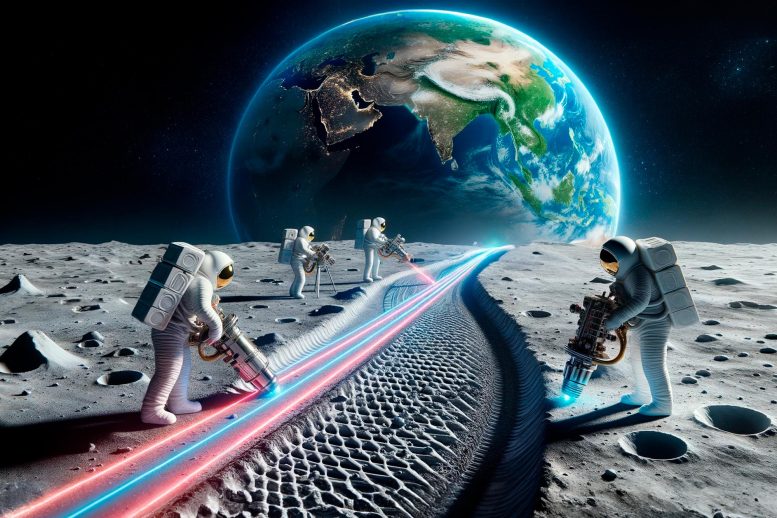
    Making Roads on Moon
    Researchers have presented a proof-of-concept study in Scientific Reports that illustrates the potential of using lasers to melt lunar soil, forming a durable material suitable for paving roads and landing pads on the Moon. Conducted on Earth using a lunar dust substitute, the study indicates the technique’s feasibility for Moon application, though refinements are necessary.

    A study demonstrates the potential of lasers to melt lunar soil for creating roads and landing pads on the Moon, using resources available on-site.

    It may be possible to create paved roads and landing pads on the Moon by using lasers to melt lunar soil into a more solid, layered substance, reports a proof-of-concept study in Scientific Reports. Although these experiments were carried out on Earth using a substitute for lunar dust, these findings demonstrate the viability of the technique and suggest it could be replicated on the Moon. However, further work may be needed to refine the process, according to the scientists.

    Challenges of Moon Dust

    Moon dust poses a significant challenge to lunar rovers as, due to the low levels of gravity, it tends to float around when disturbed and can damage equipment. Therefore, the infrastructure such as roads and landing pads will be essential to mitigate dust issues and facilitate transport on the Moon. However, transporting materials for construction from Earth is costly, so it will be essential to use the resources available on the Moon.
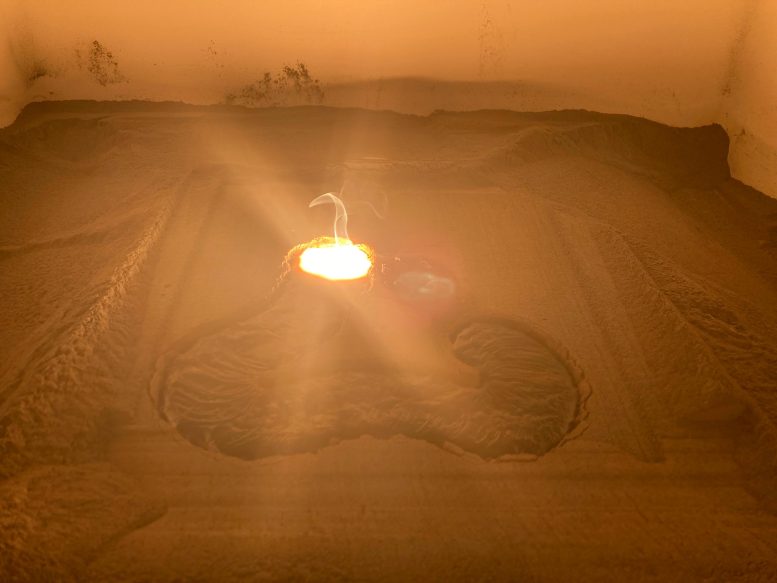
    Laser Melts Moondust
    The PAVER consortium made use of a 12-kilowatt carbon dioxide laser to melt simulated moondust into a glassy solid surface, as a way of constructing paved surfaces on the face of the Moon. At facilities installed at Clausthal University of Technology, the consortium achieved a spot size of 5-10 cm. Proceeding through trial and error, they devised a strategy using a 4.5 cm diameter laser beam to produce triangular, hollow-centred geometric shapes approximately 20 cm across. These could be interlocked to create solid surfaces across large areas of lunar soil which could serve as roads or landing pads. Credit: PAVER Consortium

    Methodology and Results

    Ginés-Palomares, Miranda Fateri, and Jens Günster melted a fine-grained material called EAC-1A (developed by ESA as a substitute for lunar soil) with a carbon dioxide laser to simulate how lunar dust can be melted by focused solar radiation on the Moon into a solid substance.

    The researchers experimented with laser beams of different strengths and sizes (up to 12 kilowatts and 100 millimeters across respectively) in order to create a robust material, although they established that criss-crossing or overlapping the laser beam path led to cracking. They developed a strategy using a 45-millimeter diameter laser beam to produce triangular, hollow-centered geometric shapes approximately 250 millimeters in size. These could be interlocked to create solid surface across large areas of lunar soil which could serve as roads and landing pads, suggest the authors.
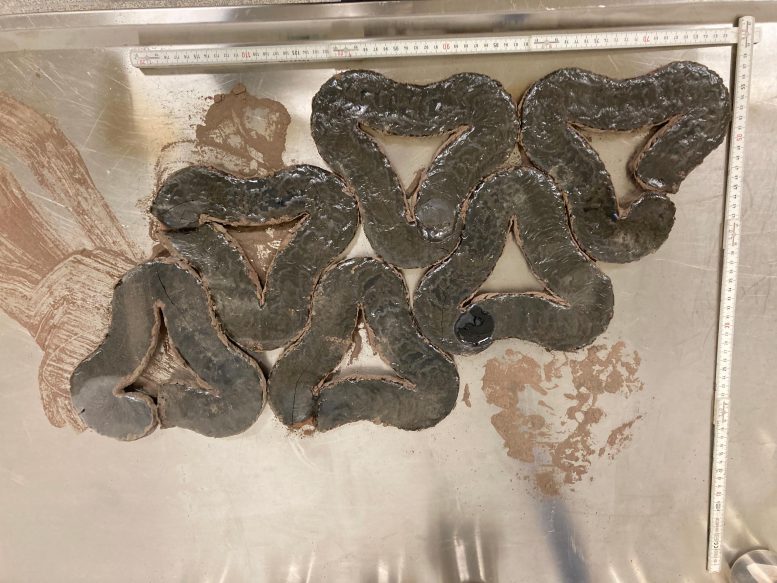
    Interlocking Shapes To Make Paved Surfaces
    At facilities installed at Clausthal University of Technology, the PAVER Consortium achieved a spot size of 5-10 cm for melting simulated moondust. Proceeding through trial and error, they devised a strategy using a 4.5 cm diameter laser beam to produce triangular, hollow-centred geometric shapes approximately 20 cm across. These could be interlocked to create solid surfaces across large areas of lunar soil which could serve as roads or landing pads. Credit: PAVER Consortium

    Implementation on the Moon

    To reproduce this approach on the Moon, the authors calculate that a lens of approximately 2.37 meters squared would need to be transported from Earth to act as a sunlight concentrator in place of the laser. The relatively small size of equipment needed would be an advantage in future Moon missions.

    For more on this research, see How Lasers Transform Moon Dust Into Roads.

    Reference: “Laser melting manufacturing of large elements of lunar regolith simulant for paving on the Moon” by Juan-Carlos Ginés-Palomares, Miranda Fateri, Eckehard Kalhöfer, Tim Schubert, Lena Meyer, Nico Kolsch, Monika Brandić Lipińska, Robert Davenport, Barbara Imhof, René Waclavicek, Matthias Sperl, Advenit Makaya and Jens Günster, 12 October 2023, Scientific Reports.
    DOI: 10.1038/s41598-023-42008-1

    Never miss a breakthrough: Join the SciTechDaily newsletter.
    Follow us on Google and Google News.

    Moon Scientific Reports
    Share. Facebook Twitter Pinterest LinkedIn Email Reddit

    Related Articles

    Research Papers Explore Titan’s Atmosphere

    NASA LRO Spacecraft Reveals Geological Activity on the Moon’s Surface

    Moon Data Allows Creation of Detailed Lunar 3-D Map

    NASA Plans Space Outpost on the Far Side of the Moon at Earth Moon Lagrange Point 2

    NASA’s GRAIL Mission Returns Video From Far Side of the Moon

    MIT Researchers Examine New Lunar Dynamo Evidence

    Russian Mars Moon Probe Phobos-Grunt Crashed In Pacific Ocean

    GRAIL Probes Now Orbiting The Moon

    Scientists Rank Most Livable Alien Worlds

    2 Comments

    1. Hottan Lunettic on November 7, 2023 6:37 pm

      I have no idea if that’s feasible, energy-wise, or the most reasonable and practical way. I can’t be my usual critical self, because that’s just too cool. They’ve got pastel moonraking lasers, astronauts with laser-cannons paving extraterrestrially. They suggest a solar concentrating lens to melt lunar regolith into pavement from lunar orbit. I believe the appropriate scientific term is “Dude!”.

      Reply
    2. Cjmacintosh on November 12, 2023 8:57 am

      Exactly who you gonna get to build all this stuff on the moon when they announce that they’re going to put a person of color in a female on the moon. I think you better look back at earth and determine who built everything that’s around you it was men.

      Reply
    Leave A Reply Cancel Reply

    • Facebook
    • Twitter
    • Pinterest
    • YouTube

    Don't Miss a Discovery

    Subscribe for the Latest in Science & Tech!

    Trending News

    5 Simple Ways To Remember More and Forget Less

    The Atomic Gap That Could Cost the Semiconductor Industry Billions

    Researchers Finally Solve 50-Year-Old Blood Group Mystery

    Scientists Discover “Molecular Switch” That Fuels Alzheimer’s Brain Inflammation

    Trees Emit Tiny Lightning Flashes During Storms and Scientists Finally Prove It

    Pomegranate Compound Could Help Protect Against Heart Disease

    Your Blood Test Might Already Show Alzheimer’s Risk

    Scientists Were Wrong About This Strange “Rule-Breaking” Particle

    Follow SciTechDaily
    • Facebook
    • Twitter
    • YouTube
    • Pinterest
    • Newsletter
    • RSS
    SciTech News
    • Biology News
    • Chemistry News
    • Earth News
    • Health News
    • Physics News
    • Science News
    • Space News
    • Technology News
    Recent Posts
    • Hidden Parasite Found in Popular Portuguese Lake Raises Health Concerns
    • This Simple Trick Can Boost Your Workout Endurance by 20%
    • This Popular Supplement May Interfere With Cancer Treatment, Scientists Warn
    • Scientists Propose Radical New Way To Detect Alien Life – Without Traditional Biosignatures
    • Scientists Just Discovered Light Can Actually Slow Plant Growth
    Copyright © 1998 - 2026 SciTechDaily. All Rights Reserved.
    • Science News
    • About
    • Contact
    • Editorial Board
    • Privacy Policy
    • Terms of Use

    Type above and press Enter to search. Press Esc to cancel.