
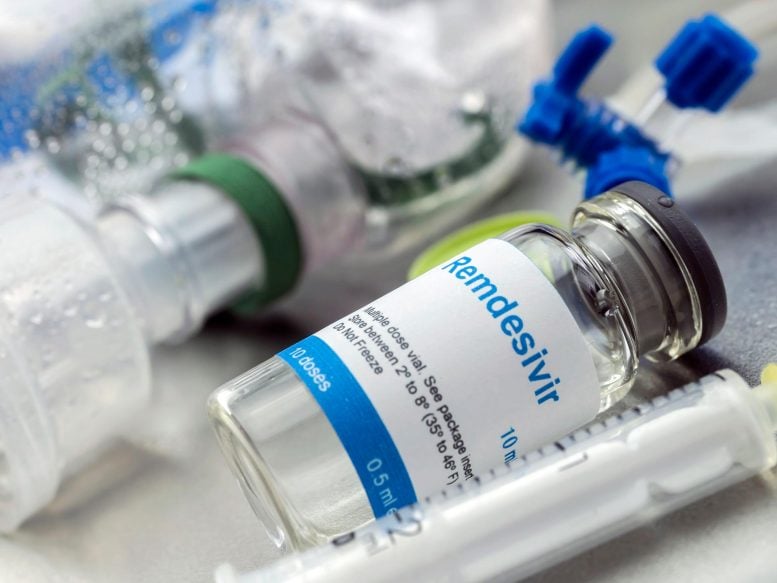
University of Cincinnati researcher urges caution using remdesivir to treat COVID-19.
While the world has its eyes on vaccines to stop the spread of coronavirus, therapeutics are still necessary to treat hospitalized patients. One of these treatments, remdesivir, is the first and only antiviral agent of its kind that the U.S. Food and Drug Administration (FDA) has approved so far for COVID-19.
Research at the University of Cincinnati, however, contends that this antiviral drug is being used too indiscriminately when treating patients hospitalized with the virus. The study is published in the journal Fundamental & Clinical Pharmacology.
The FDA approved remdesivir, marketed as Veklury, for emergency use authorization in May 2020 to treat COVID-19 and granted full approval for treatment in October 2020. The World Health Organization came out in November 2020 with a conditional recommendation advising against its use entirely citing: “More research is needed, especially to provide higher certainty of evidence for specific groups of patients.”
In the UC study, lead author Bingfang Yan, a pharmaceutical scientist, and his UC graduate students Yue Shen and William Eades, found that the drug permanently stops the activity of an enzyme called CES-2, which is found in the intestine, liver, and kidney and is needed for the breakdown of many medications.

“This enzyme normally breaks down and activates medicines in certain antivirals or inactivates other medicines such in certain anticoagulants,” says Yan, professor at the James L. Winkle College of Pharmacy. On the other hand, he says this breakdown increases the toxicity of many more medications such as with heart medicines and anticancer drugs.
An antiviral is a drug against viruses and an anticoagulant is a drug that hinders the clotting of blood. What further complicates the issue, Yan says, is that when delivered through an IV, remdesivir does not treat the virus unless the body has additional specific enzymes, which are not found in all patients. It can also cause other antiviral drugs, such as those used for HIV/AIDs and hepatitis C, to not work properly.
Remdesivir is only administered through the veins in a hospital setting, with the FDA typically recommending a dose of once a day, for approximately 10 days, and “intravenous injection of remdesivir can cause safety concerns because of high initial concentrations of the drug in the system,” says Yan, noting, “If physicians use it, they have to use it with caution.”
He adds, “Clearly, the treatment should be used for the right patients and in the proper dosages with care when used in combination with other medications.”
Reference: “Remdesivir potently inhibits carboxylesterase‐2 through covalent modifications: signifying strong drug‐drug interactions” by Yue Shen, William Eades and Bingfang Yan, 28 December 2020, Fundamental & Clinical Pharmacology.
DOI: 10.1111/fcp.12643
Yan’s UC laboratory studies how drugs are metabolized in the body to see if certain people should or should not use the drug or use it at a different dose. He has, for decades, been supported by the National Institutes of Health.
Never miss a breakthrough: Join the SciTechDaily newsletter.
Follow us on Google and Google News.
2 Comments
Please put those positive / negative Remdesivir news on hold. No one understand who’s paying you!
Here are clinical trials in which remdesivir failed to shorten hospital stays or reduce deaths:
https://www.medrxiv.org/content/10.1101/2020.10.15.20209817v1
https://pubmed.ncbi.nlm.nih.gov/33264556/
https://www.nejm.org/na101/home/literatum/publisher/mms/journals/content/nejm/0/nejm.ahead-of-print/nejmoa2023184/20201202/images/img_medium/nejmoa2023184_f2.jpeg
https://www.nejm.org/na101/home/literatum/publisher/mms/journals/content/nejm/0/nejm.ahead-of-print/nejmoa2023184/20201202/images/img_medium/nejmoa2023184_f3.jpeg
https://rebelem.com/remdesivir-in-moderate-covid-19/
https://www.ncbi.nlm.nih.gov/pmc/articles/PMC7190303/
The researchers who completed the 1,643-participant, New York City remdesivir clinical trial imply that in the ACTT-1 clinical trial, the sicker patients must have been sneaked into the placebo group to get the rigged result that got remdesivir approved:
https://www.medrxiv.org/content/10.1101/2020.08.10.20171637v1
https://link.springer.com/article/10.1007/s41669-020-00243-6
Remdesivir is totally useless against all viral diseases, including the flu, common cold, and Ebola:
https://www.nejm.org/doi/full/10.1056/NEJMoa1910993
https://www.nejm.org/na101/home/literatum/publisher/mms/journals/content/nejm/2019/nejm_2019.381.issue-24/nejmoa1910993/20191206/images/img_xlarge/nejmoa1910993_f1.jpeg
Remdesivir is fraudulently indicated for end-stage COVID-19 when in truth, it has absolutely no benefit in reducing the cytokine storm, in fact, might make it slightly worse:
https://www.nature.com/articles/s41591-020-1051-9
https://www.nature.com/articles/s41591-020-1051-9/figures/5
https://www.mdpi.com/tropicalmed/tropicalmed-05-00112/article_deploy/html/images/tropicalmed-05-00112-g004.png
Remdesivir, hydroxychloroquine, and chloroquine cause cardiovascular QT interval prolongation and sinus bradycardia but favipiravir does not:
https://www.ncbi.nlm.nih.gov/pmc/articles/PMC7571425/
https://www.sciencedirect.com/science/article/abs/pii/S0022073620305835
https://www.ncbi.nlm.nih.gov/pmc/articles/PMC7598346/
https://www.ncbi.nlm.nih.gov/pmc/articles/PMC7682945/
Remdesivir causes liver damage:
https://theprint.in/health/govt-reviewing-remdesivir-use-for-covid-after-hospitals-report-liver-damage-in-patients/454169/
https://www.ncbi.nlm.nih.gov/pmc/articles/PMC7381904/
https://pubmed.ncbi.nlm.nih.gov/33006138/
Remdesivir causes kidney damage but favipiravir does not:
https://www.rxlist.com/consumer_remdesivir_rdv/drugs-condition.htm
https://theprint.in/health/cipla-to-experiment-with-change-in-covid-drug-remdesivir-recipe-to-reduce-effect-on-kidneys/571951/
http://pharmabiz.com/NewsDetails.aspx?aid=134341&sid=1
https://advances.massgeneral.org/research-and-innovation/article.aspx?id=1224
https://pubmed.ncbi.nlm.nih.gov/33252992/
https://pubmed.ncbi.nlm.nih.gov/33340409/
Because of the above-described damage to heart function, liver function, and kidney function, the survivors in the placebo group are better off than the survivors in the remdesivir group
Remdesivir, Kaletra, and ribavirin worsen the skin rash problem during COVID-19 but favipiravir does not:
https://pubmed.ncbi.nlm.nih.gov/33301232/
More than 100 very popular drugs that have been approved worldwide, including statins for cholesterol, ACE inhibitors and ARBs for blood pressure, corticosteroids and NSAIDs for pain or inflammation, antibiotics for infections, progestins, anabolic steroids, methotrexate, anti-fungals, anti-virals, chemotherapy drugs, alcoholic drinks, tobacco, and ionizing radiation, ALL CAUSE BIRTH DEFECTS:
https://www.researchgate.net/profile/Daryl_Lynch/publication/287212052/figure/tbl1/AS:669660978622474@1536671027816/Teratogenic-Medications-Queried-for-During-Study-Period.png
http://www.emdocs.net/wp-content/uploads/2017/05/Screen-Shot-2017-05-09-at-12.48.32-AM-768×993.png
In Europe, ESICM now advises against remdesivir:
https://wkzo.com/2020/11/13/worlds-top-intensive-care-body-advises-against-remdesivir-for-sickest-covid-patients/
France and Luxembourg have stopped buying remdesivir, while all other European Union nations are refusing to buy their fair share of the EU’s oversupply of remdesivir that their proportional populations in the EU would require them to buy:
https://www.bmj.com/content/371/bmj.m4749
https://finance.yahoo.com/chart/GILD
https://translate.google.com/translate?hl=en&sl=fr&u=https://1dex.ch/2020/11/le-scandale-du-remdesivir-ne-fait-que-commencer-lettre-ouverte-dun-citoyen-suisse/&prev=search&pto=aue