
Close Menu
    Facebook X (Twitter) Instagram
    SciTechDaily
    • Biology
    • Chemistry
    • Earth
    • Health
    • Physics
    • Science
    • Space
    • Technology
    Facebook X (Twitter) Pinterest YouTube RSS
    SciTechDaily
    Home»Physics»Physicists Build Invisibility Cloaks for Visible Light in Diffusive Media
    Physics

    Physicists Build Invisibility Cloaks for Visible Light in Diffusive Media

    By Karlsruhe Institute of TechnologyJune 6, 2014No Comments3 Mins Read
    Facebook Twitter Pinterest Telegram LinkedIn WhatsApp Email Reddit
    Share
    Facebook Twitter LinkedIn Pinterest Telegram Email Reddit
    Invisibility Cloaks for Visible Light in Diffusive Media
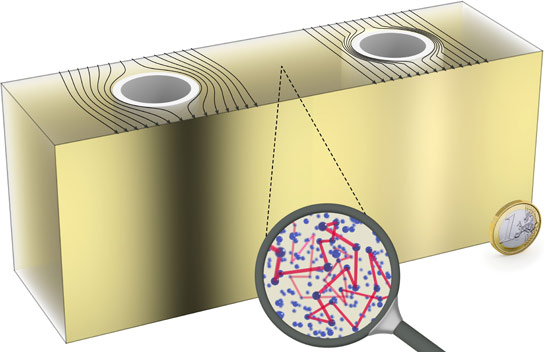
    In a diffusive light-scattering medium, light moves on random paths (see magnifying glass). A normal object (left) casts a shadow, an object with an invisibility cloak (right) does not. Credit: R. Schittny / KIT

    Physicists from the Karlsruhe Institute of Technology have developed a simple method for building and testing an invisibility cloak for diffusive light-scattering media.

    Real invisibility cloaks are rather complex and work in certain situations only. The laws of physics prevent an optical invisibility cloak from making objects in the air invisible for any direction, color, and polarization. If the medium is changed, however, it becomes much easier to hide objects. KIT physicists have now succeeded in manufacturing with relatively simple means and testing an ideal invisibility cloak for diffusive light-scattering media, such as fog or milk. Their results are published in the renowned Science journal.

    In diffusive media, light does no longer propagate linearly, but is scattered permanently by the particles in the medium. Examples are fog, clouds, or frosted glass panes that let the light in, but hide the light source. “This property of light-scattering media can be used to hide objects inside,” says Robert Schittny, first author of the study. “The new invisibility cloaks have a rather simple structure.”

    In the experiment, Schittny used an extended light source to illuminate a Plexiglas tank of a few centimeters in width from the back. The tank was filled with a white, turbid liquid. Objects inside cast a visible shadow onto the tank wall. Simple metal cylinders or spheres of a few centimeters in diameter were used as test objects. To hide them, they were first coated with a white dispersion paint, such that the light was reflected in a diffusive manner. To pass the light around the object, the researchers applied a thin shell made of the transparent silicon material PDMS, to which a certain concentration of light-scattering melamine microparticles was added. The silicon/melamine shell caused a quicker diffusion than in the environment and, thus, passed the light around the objects. Hence, they no longer cast a shadow. “Disappearance of the shadow indicates successful cloaking.”

    “Ideal optical invisibility cloaks in air have a drawback,” Martin Wegener points out. He conducts research at the KIT Institute of Applied Physics and the KIT Institute of Nanotechnology. “They violate Albert Einstein’s theory of relativity that prescribes an upper limit for the speed of light. “In diffuse media, in which light is scattered several times, however, the effective speed of light is reduced. Here, ideal invisibility cloaks can be realized.”

    The study performed by Wegener and Schittny was funded by the DFG Center for Functional Nanostructures (CFN) and represents pure fundamental research to demonstrate the principle. “We will have to wait a long time for real applications, but with the help of the principle found, it might be possible to produce frosted glass panes for bathrooms with integrated metal bars or sensors against burglary. These sensors or bars would be invisible from the inside and outside,” Schittny explains.

    Reference: “Invisibility cloaking in a diffusive light scattering medium” by Robert Schittny, Muamer Kadic, Tiemo Bückmann and Martin Wegener, 5 June 2014, Science.
    DOI: 10.1126/science.1254524

    Never miss a breakthrough: Join the SciTechDaily newsletter.
    Follow us on Google and Google News.

    Invisibility Karlsruhe Institute of Technology
    Share. Facebook Twitter Pinterest LinkedIn Email Reddit

    Related Articles

    Scientists Forge New “Superalloy” That Could Revolutionize Jet Engines and Power Plants

    Ghost Particles Just Got Lighter: KATRIN Sets a New Benchmark for Neutrino Mass

    Unlocking the 4th Dimension: Space-Time Crystals Unleash New Power Over Light

    Unlocking Quantum Communication: The Power of Diamond-Based Qubits

    KATRIN Experiment Constrains the Mass of Mysterious Neutrino Particles With Unprecedented Precision

    Kit Researchers Create Mechanical Invisibility Cloak

    Researchers Transmit Wireless Data at 100 Gbit/s

    Thermal Cloak Molds the Flow of Heat Around an Object

    “Schrödinger’s Hat” Conceals Matter Waves Inside an Invisible Container

    Leave A Reply Cancel Reply

    • Facebook
    • Twitter
    • Pinterest
    • YouTube

    Don't Miss a Discovery

    Subscribe for the Latest in Science & Tech!

    Trending News

    Enormous Prehistoric Insects Puzzle Scientists

    Scientists Develop Bioengineered Chewing Gum That Could Help Fight Oral Cancer

    After 37 Years, the World’s Longest-Running Soil Warming Experiment Uncovers a Startling Climate Secret

    NASA Satellite Captures First-Ever High-Res View of Massive Pacific Tsunami

    ADHD Isn’t Just a Deficit: Study Reveals Powerful Hidden Strengths

    Scientists Discover Stem Cells That Could Regrow Teeth and Bone

    Early Cannabis Use May Stall Key Brain Skills in Teens

    Popular Vitamin D Supplement Has “Previously Unknown” Negative Effect, Study Finds

    Follow SciTechDaily
    • Facebook
    • Twitter
    • YouTube
    • Pinterest
    • Newsletter
    • RSS
    SciTech News
    • Biology News
    • Chemistry News
    • Earth News
    • Health News
    • Physics News
    • Science News
    • Space News
    • Technology News
    Recent Posts
    • Beyond Inflammation: Scientists Uncover New Cause of Persistent Rheumatoid Arthritis
    • Cancer-Like Mutations Found in the Brain May Be Driving Alzheimer’s Disease
    • A Simple Molecule Could Unlock Safer, Easier Weight Loss
    • Stretching Diamonds Unlocks Powerful New Quantum Sensing Abilities
    • This Robot Could Explore Mars 3x Faster Than Today’s Rovers
    Copyright © 1998 - 2026 SciTechDaily. All Rights Reserved.
    • Science News
    • About
    • Contact
    • Editorial Board
    • Privacy Policy
    • Terms of Use

    Type above and press Enter to search. Press Esc to cancel.