
Researchers are fine-tuning the application of plasma to agriculture to speed up germination and help plants grow strong.
Ever since scientists discovered that plasma treatment leads to faster growth and higher yields of some agricultural crops, physicists, chemists, and biologists have been working together to tease out the mechanisms driving this phenomenon.
Today researchers are fine-tuning the application of plasma to agriculture in order to reap the benefits of a robust harvest without triggering unwanted side effects. Apply a plasma for too short a time, said biochemist Alexander Volkov, “and we don’t get the positive effect. If it’s treated too long, it can modify or cause damage to the DNA.”
Volkov, a professor at Oakwood University in Huntsville, Alabama, has been studying the intersection of plants and plasma since the advent of the field. At the American Physical Society’s Gaseous Electronics Conference this week, he described findings from recent experiments comparing modes of plasma delivery. Treating seeds by exposing them to a plasma ball–a glass sphere, often sold as a toy, that generates filaments of glowing gas–improved the wetting properties of the seed surface. The high-frequency electromagnetic fields and photons generated by the ball effectively corrugated the seed surface and, as a result, sped up germination.
In general, he said, plasma delivered by any method–whether by jet, ball, or sheet–seemed to accelerate water uptake, or imbibition, and germination by changing the surface properties of the seed. In a related poster session, he reported that treating bean seeds with helium plasma jets induced roughness, corrugation, and the opening of pores on seed coats. Volkov explained: “Water can penetrate easily through spores and accelerate germination.”
However, plasma does not affect every kind of seed equally. Researchers from Jazan University in the Kingdom of Saudi Arabia described recent work measuring the effects of plasma treatment on grape, acacia, wheat, and sorghum seeds. In all cases, the plasma seemed to “etch” the surface of the seed, which boosted imbibition. They observed faster germination in all the species, but the effects were most pronounced in grape seeds, followed by acacia, followed by wheat, and sorghum.
Katherina Stapelmann, an engineer at North Carolina State University who chaired the session on plasma medicine and agriculture, said the study suggests ways plasma could increase yields in countries that do not have harsh winters.
“Grape plants need poor temperature to break their dormancy and go back into their spring cycles,” said Stapelmann. Direct treatment with plasma may serve that function and enable grape plants to grow.
Stapelmann predicts that plasma will be most useful in improving unusual or high-value crops, rather than crops like corn that have already been optimized through genetic engineering. “For specialty crops and others that are difficult to grow, this can really improve the growth and yield of the seeds.”
Other researchers at Nagoya University, in Japan, reported promising results from a study that looked at the effects of treating rice plants with plasma directly, instead of exclusively treating the seeds. Another group in Japan, from Kyushu University, presented data from experiments on radishes suggesting that seed color and seed age could influence the response of a plant to plasma.
For Volkov, this research hits close to home. During the pandemic, he has filled his garden exclusively with plants treated with plasma as dry seeds. He is now working his way through the harvest.
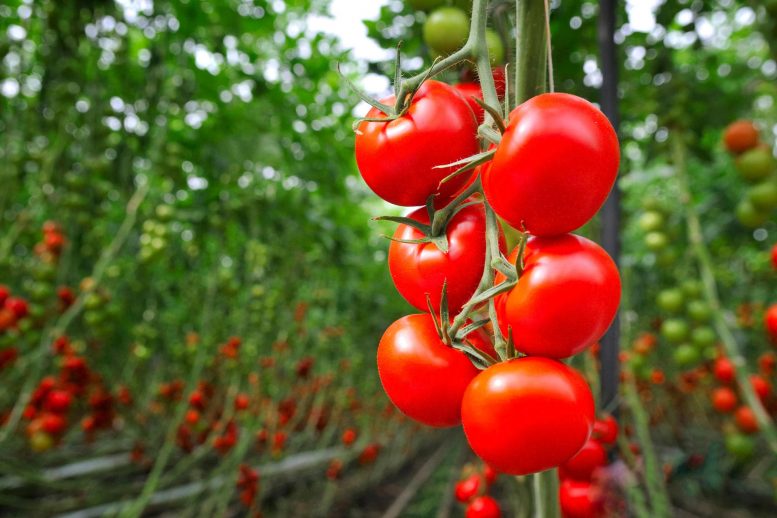
“We’ve got a fantastic amount of cucumbers, tomatoes, and everything.”
Never miss a breakthrough: Join the SciTechDaily newsletter.
Follow us on Google and Google News.